


























Views
Downloads

Two-Step Equations Worksheet | Grade 8 Math Essential
Paste this activity's link or code into your existing LMS (Google Classroom, Canvas, Teams, Schoology, Moodle, etc.).
Students can open and work on the activity right away, with no student login required.
You'll still be able to track student progress and results from your teacher account.
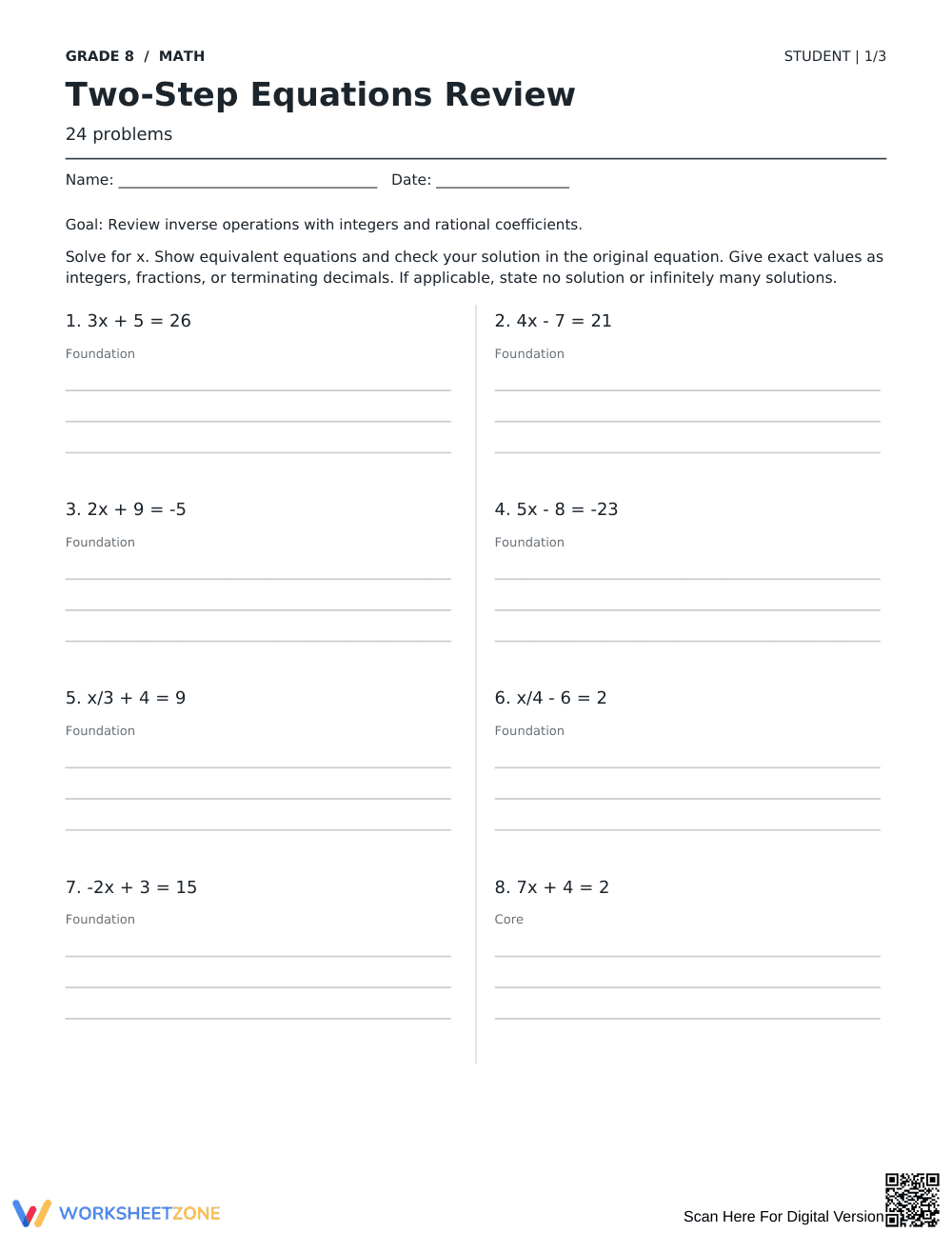
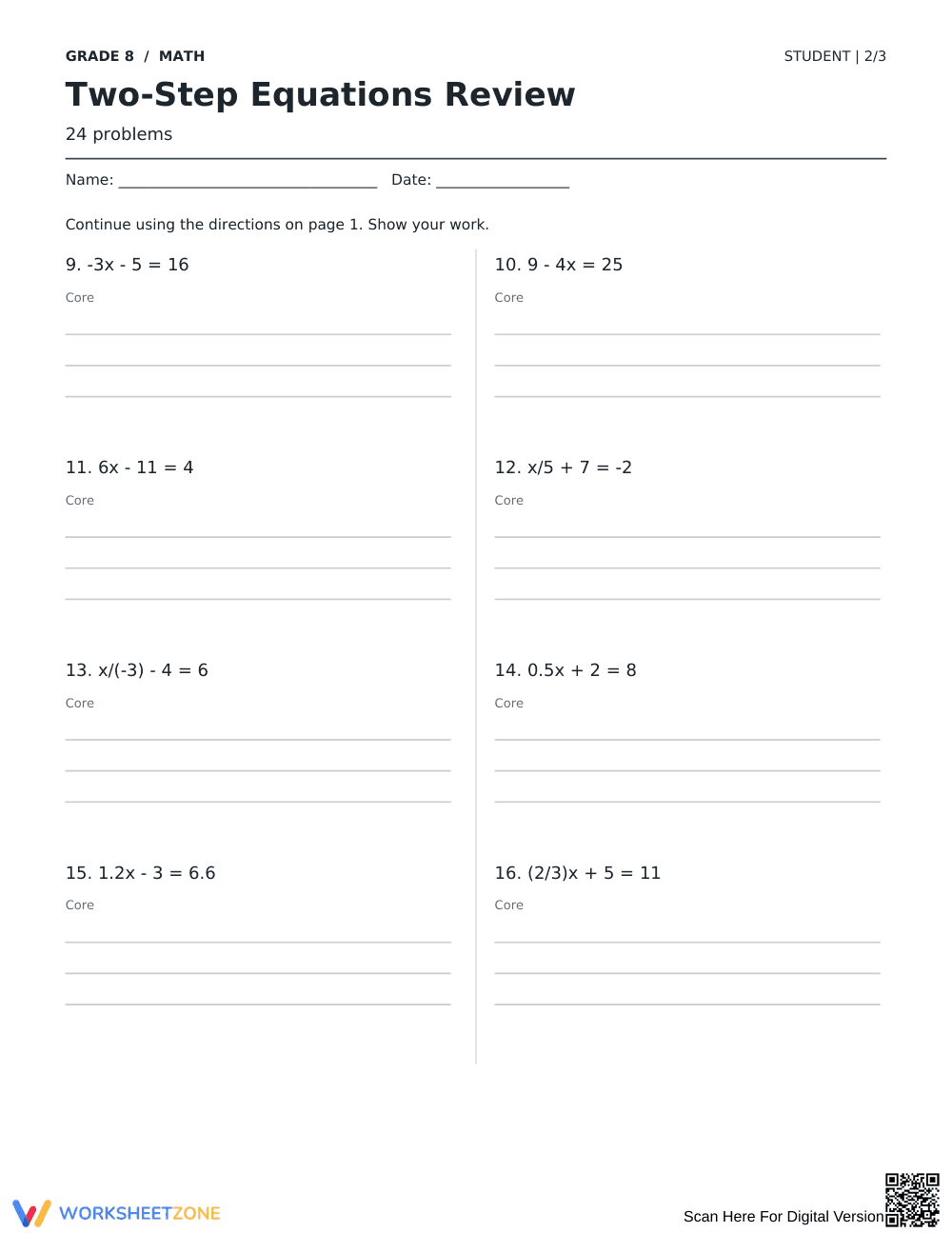
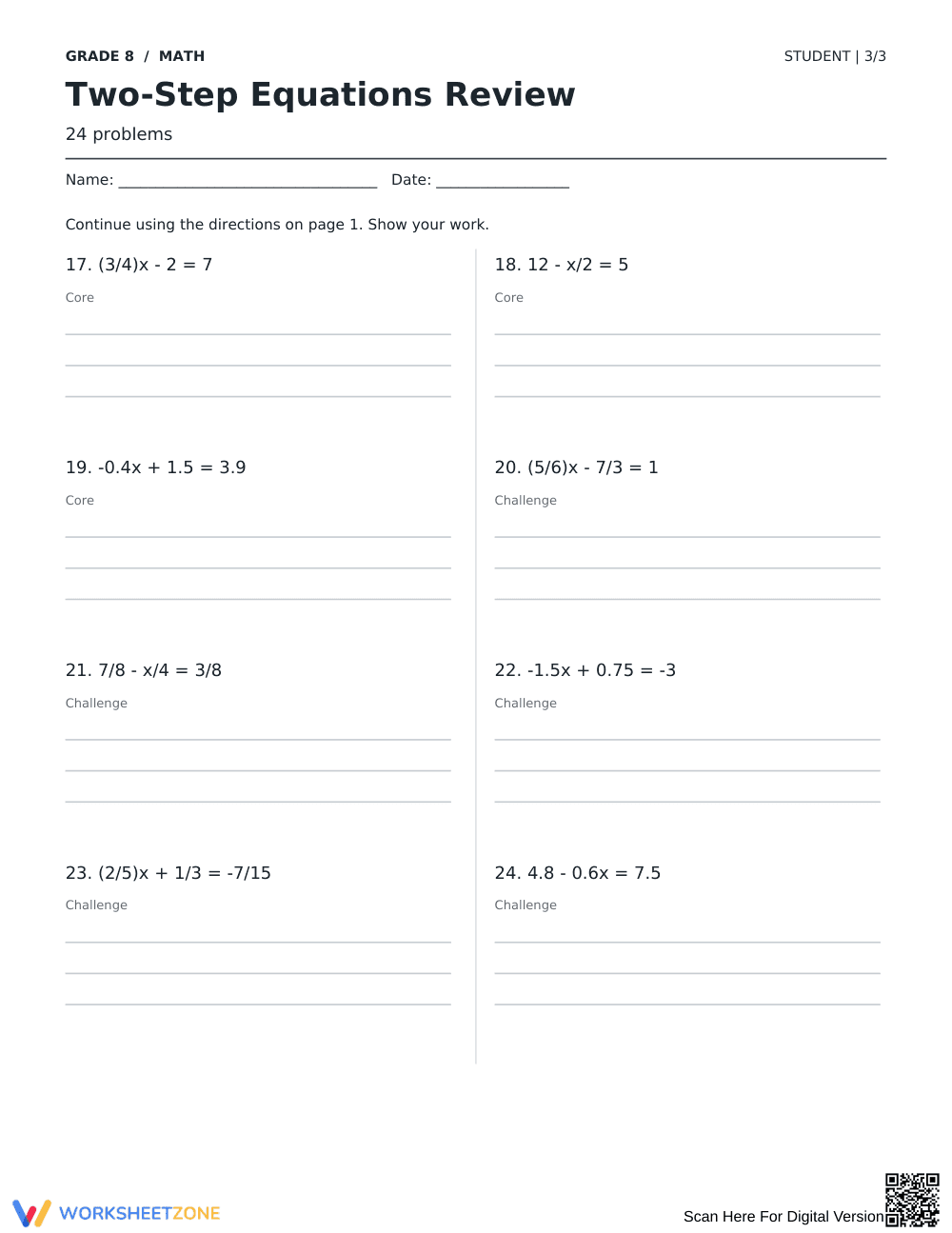
This Grade 8 math worksheet develops procedural fluency in solving two-step linear equations with rational coefficients. Students apply inverse operations across 24 leveled equations to isolate variables, simplify fractions and decimals, and check their solutions. The structured format builds foundational mastery required for multi-step equations and advanced algebraic reasoning.
At a Glance
- Grade: 8 · Subject: Mathematics
- Standard:
CCSS.MATH.CONTENT.8.EE.C.7— Solve linear equations in one variable with rational number coefficients.- Skill Focus: Two-step linear equations with integers, fractions, and decimals
- Format: 3 student pages · 24 problems · Answer key included · Printable PDF
- Best For: Independent practice, skills review, and targeted remediation
- Time: 30–45 minutes
This 3-page printable resource delivers 24 single-variable linear equations arranged on dedicated lined workspace, supported by a 2-page answer key showing intermediate steps. Tasks feature a progression from integer constants to rational fractions and terminating decimals. Students write equivalent equations, compute inverse operations, and substitute solutions back into original equations to verify accuracy.
Skill Progression
- Guided practice (Problems 1–7): Foundation exercises use whole numbers and basic integer division to establish operational cadence.
- Supported practice (Problems 8–19): Core exercises introduce negative coefficients, simple decimals, and fractional multipliers requiring two distinct inverse steps.
- Independent practice (Problems 20–24): Challenge exercises demand solving non-standard forms with fraction addition and decimal operations.
This sequence reinforces a gradual-release instructional model that transitions learners from structured arithmetic to autonomous equation solving.
Standards Alignment
This worksheet aligns directly to `CCSS.MATH.CONTENT.8.EE.C.7`, requiring students to solve linear equations in one variable with rational number coefficients. It also supports `CCSS.MATH.CONTENT.7.EE.B.4` through two-step operational fluency. Both standard codes can be copied directly into lesson plans, IEP goals, or district curriculum mapping tools.
How to Use It
Assign this worksheet after direct instruction on inverse operations as an independent consolidation activity or tiered homework assignment. During small-group intervention, monitor work on problems 8 through 13 to check whether students correctly isolate the variable before dividing by negative values. Students typically complete the 24 problems in 30 to 45 minutes.
Who It's For
This practice set serves Grade 8 general math students, pre-algebra learners, and high school algebra students requiring targeted intervention. Built-in tiered sections support flexible differentiation without altering lesson objectives. Pair this resource with an inverse operations anchor chart or a worked-example video for optimal scaffolding.
Mastery of linear equations in one variable represents an essential milestone in adolescent mathematical development under CCSS.MATH.CONTENT.8.EE.C.7. This 24-problem review reinforces two-step equation solving by systematically bridging integer arithmetic with rational number coefficients, including negative values, terminating decimals, and fractions. According to Fisher & Frey (2014), structured deliberate practice with graduated task complexity enables students to internalize cognitive problem-solving scripts, transitioning from procedural reliance to conceptual fluency. By prompting learners to isolate variables through inverse operations and verify exact solutions, this resource directly addresses persistent middle school algebra misconceptions regarding negative coefficients and fraction division. The tiered progression supports classroom educators in evaluating student readiness for multi-step expressions and systems of linear equations. As emphasized in curriculum research, targeted equation fluency practice provides the operational bedrock necessary for sustained secondary mathematics achievement and rigorous high school coursework.


