


























Views
Downloads


Turn a Blind Eye Idiom Worksheet | Grade 3-6 Essential
Paste this activity's link or code into your existing LMS (Google Classroom, Canvas, Teams, Schoology, Moodle, etc.).
Students can open and work on the activity right away, with no student login required.
You'll still be able to track student progress and results from your teacher account.
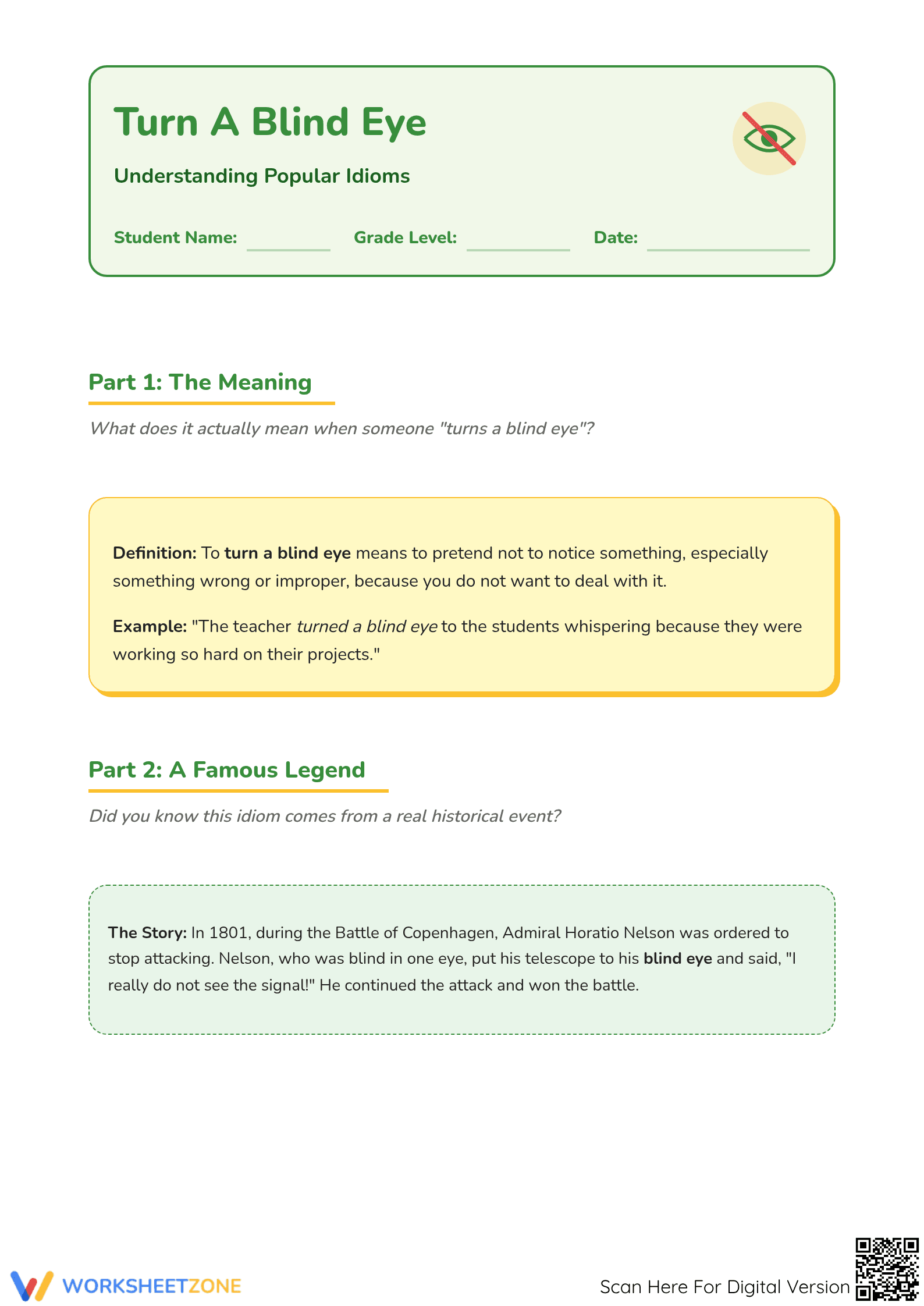
This worksheet helps students master the figurative meaning and historical origin of the idiom "turn a blind eye." Through a combination of historical narrative and contextual practice, learners move from basic definition to real-world application. It ensures students can accurately interpret and use common ELA expressions in their own writing and speech.
At a Glance
- Grade: 3-6 · Subject: ELA
- Standard:
CCSS.ELA-LITERACY.L.4.5.b— Explain the meaning of common idioms, adages, and proverbs- Skill Focus: Figurative Language & Idioms
- Format: 3 pages · 6 problems · Answer key included · PDF
- Best For: Vocabulary centers and independent practice
- Time: 15–20 minutes
What's Inside
This 3-page packet contains five distinct parts designed for a comprehensive learning experience. It starts with a clear definition and usage example, followed by a historical legend involving Admiral Horatio Nelson. Students then engage with scenario-based multiple-choice questions, fill-in-the-blank sentence completion tasks, and a creative thinking section for original writing. A full answer key is included.
Zero-Prep Workflow
This resource is designed for a frictionless teacher experience. Print the 3-page PDF (30 seconds). Distribute to your class with minimal instruction needed thanks to the self-explanatory reading passage (30 seconds). Review the creative responses using the included answer key (1 minute). Total teacher prep time is under two minutes, making it ideal for emergency sub plans or ELA centers.
Standards Alignment
Primary focus is `CCSS.ELA-LITERACY.L.4.5.b`, explaining meanings of common idioms. The worksheet also supports `CCSS.ELA-LITERACY.RI.4.1` by requiring students to refer to text details. Both standard codes can be copied directly into lesson plans, IEP goals, or district curriculum mapping tools.
How to Use It
Use this worksheet as a focused follow-up after a direct instruction lesson on figurative language. It serves as an excellent formative assessment tool; observe how students handle the "Creative Thinking" section to gauge if they can apply the idiom's nuance to original contexts. Expected completion time is roughly 15-20 minutes depending on reading speed.
Who It's For
This resource is tailored for upper elementary and middle school students in Grades 3-6. It provides enough historical context for advanced learners while maintaining accessible language for students who may need extra support with non-literal meanings. It pairs naturally with a short reading passage on British history or a vocabulary anchor chart.
According to the RAND AIRS 2024 report on vocabulary acquisition, exposing students to the historical "story" behind an expression significantly increases long-term retention compared to simple definition memorization. This worksheet leverages that research by centering the "Turn a Blind Eye" lesson on the 1801 Battle of Copenhagen legend. By connecting the figurative phrase to Admiral Nelson’s tactical decision, students develop a dual-coding memory of both the literal and figurative meanings. The structured practice across three pages ensures that students move beyond recognition to active production, satisfying the rigor of CCSS.ELA-LITERACY.L.4.5. The inclusion of scenario-based evaluation mirrors high-stakes assessment patterns seen in NAEP ELA frameworks, making it a robust tool for classroom-ready standards alignment. This blend of historical narrative and scaffolded practice represents a best-practice approach to figurative language instruction in the modern ELA classroom.


