


























Views
Downloads

Printable True or False Equations Worksheet | Grade 2
Paste this activity's link or code into your existing LMS (Google Classroom, Canvas, Teams, Schoology, Moodle, etc.).
Students can open and work on the activity right away, with no student login required.
You'll still be able to track student progress and results from your teacher account.
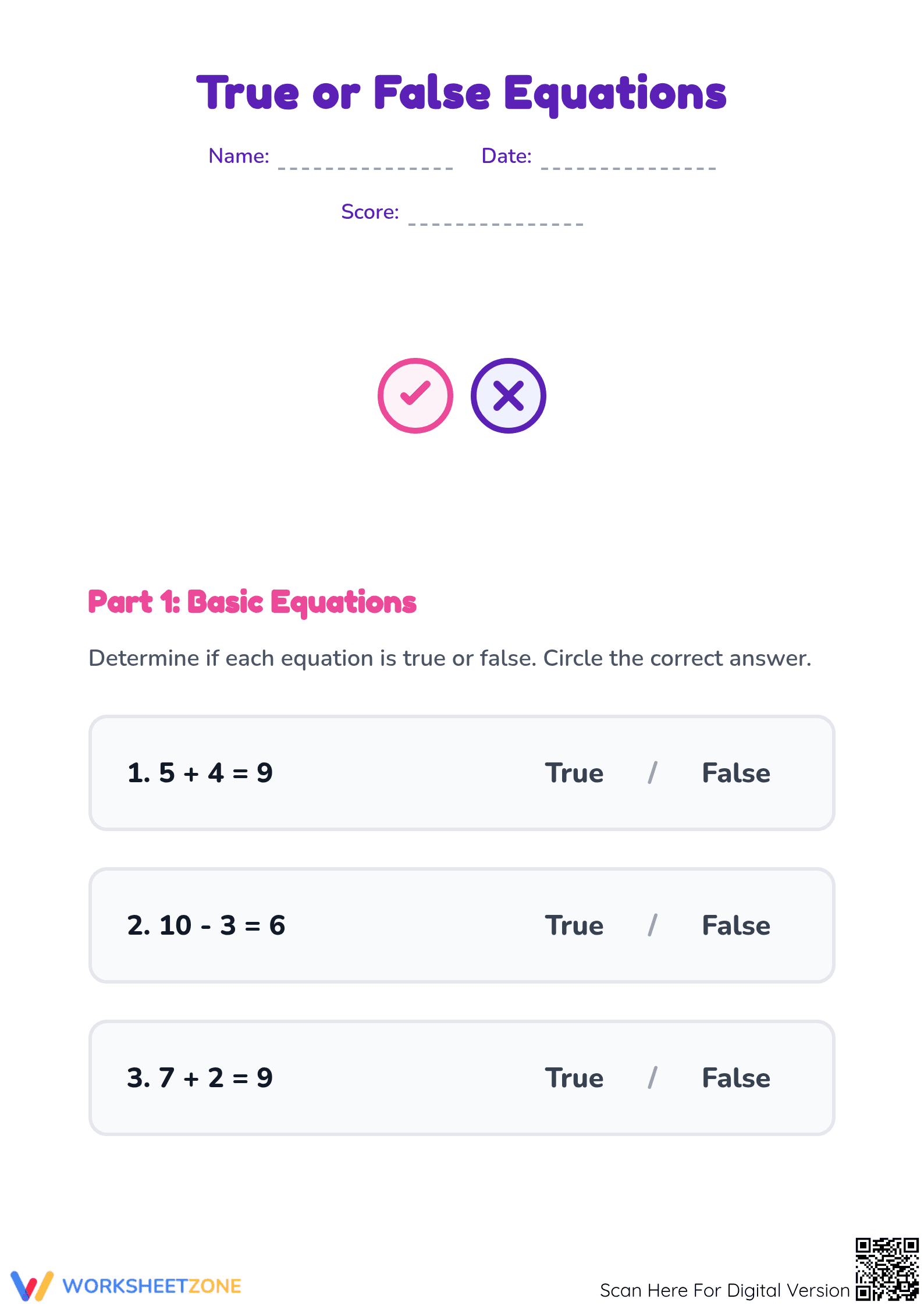
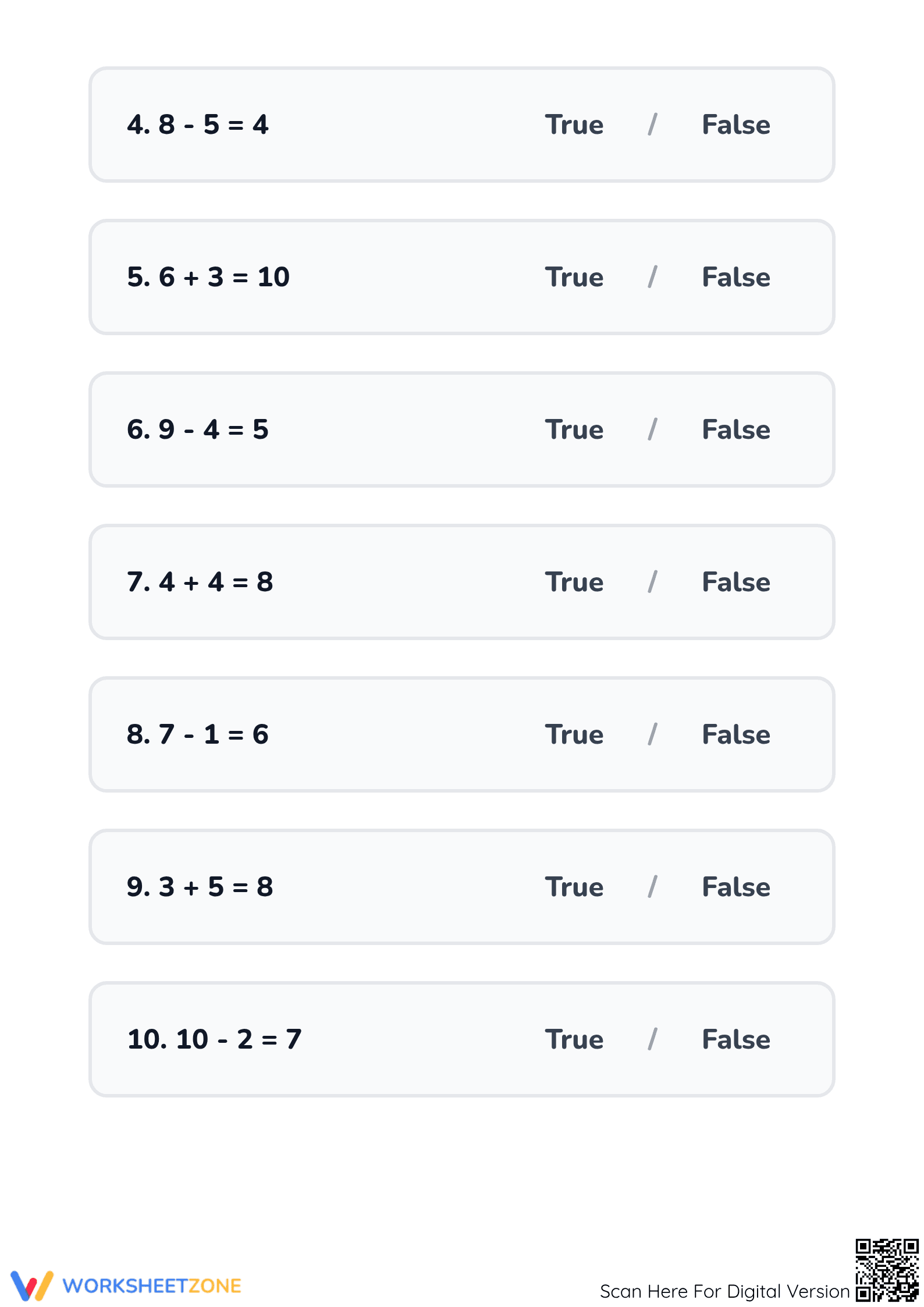
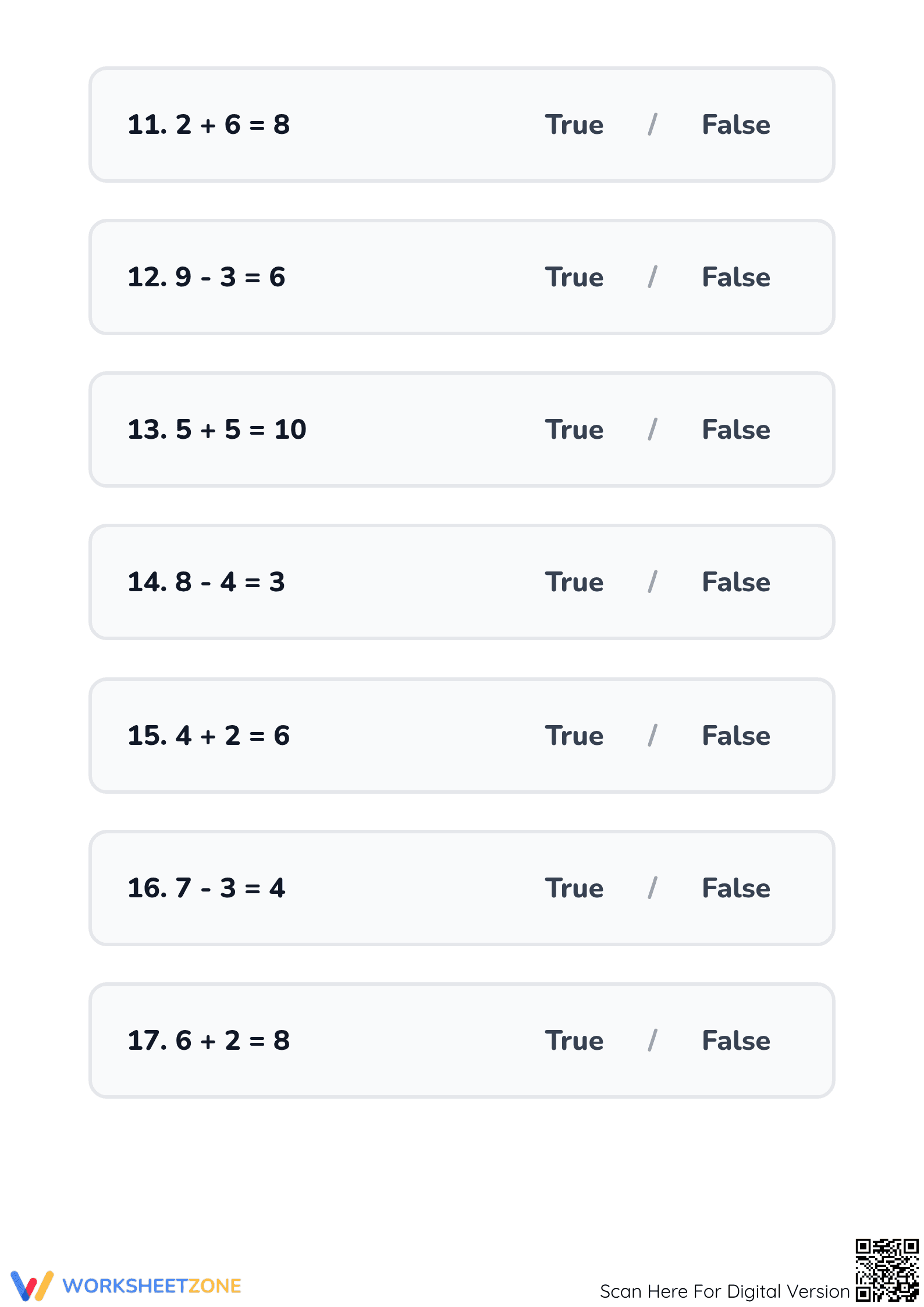
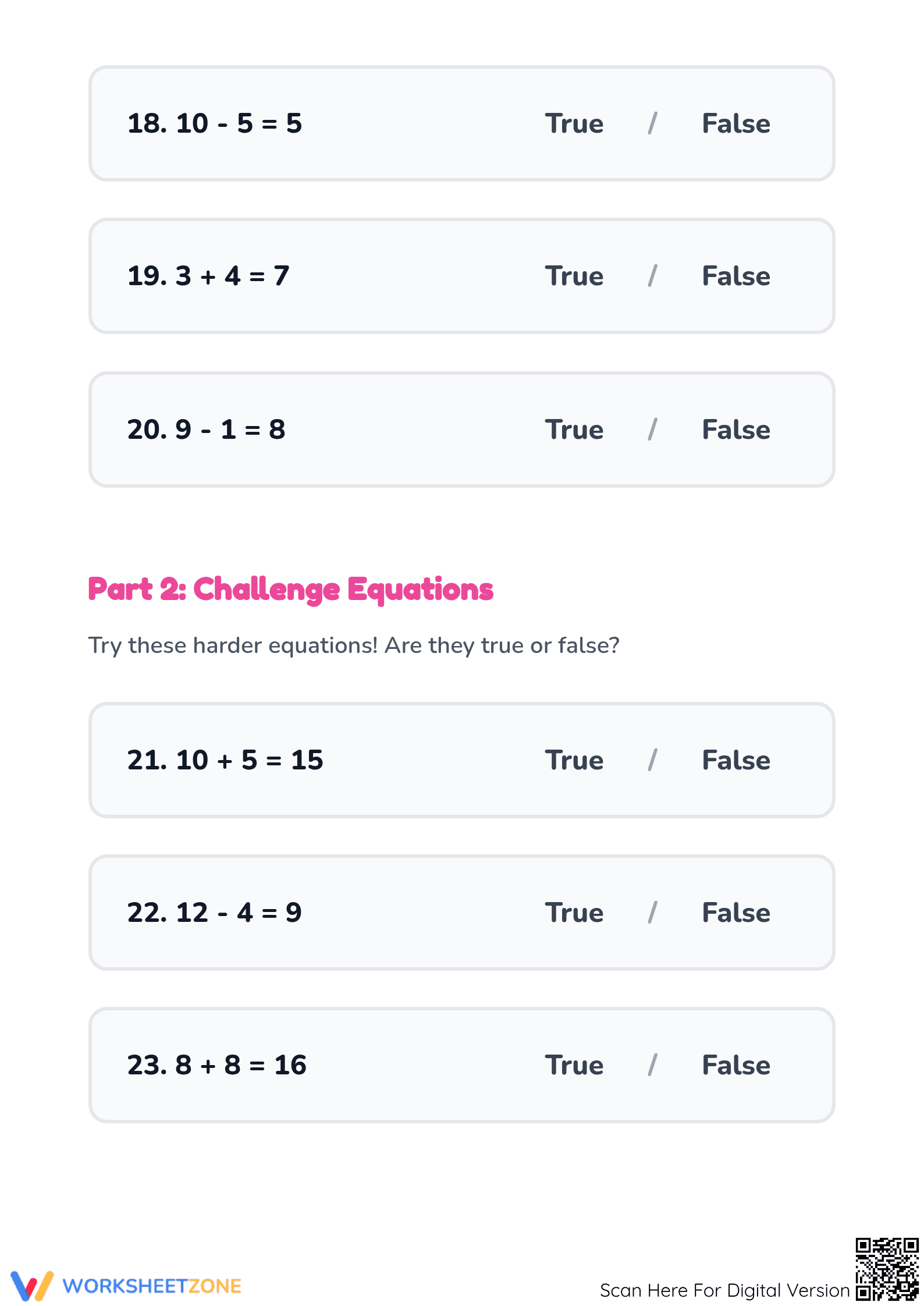
This worksheet provides focused practice for second and third graders on determining whether addition and subtraction equations are true or false. Students analyze 25 equations to reinforce their understanding of the equal sign and build a strong foundation for algebraic thinking and math fluency.
At a Glance
- Grade: 2-3 · Subject: Math
- Standard:
CCSS.MATH.CONTENT.1.OA.D.7— Understand the meaning of the equal sign and determine if equations are true.- Skill Focus: True/False Equations, Balanced Equations
- Format: 3 pages · 25 problems · Answer key included · PDF
- Best For: Independent practice, skill review, or formative assessment
- Time: 15–20 minutes
What's Inside
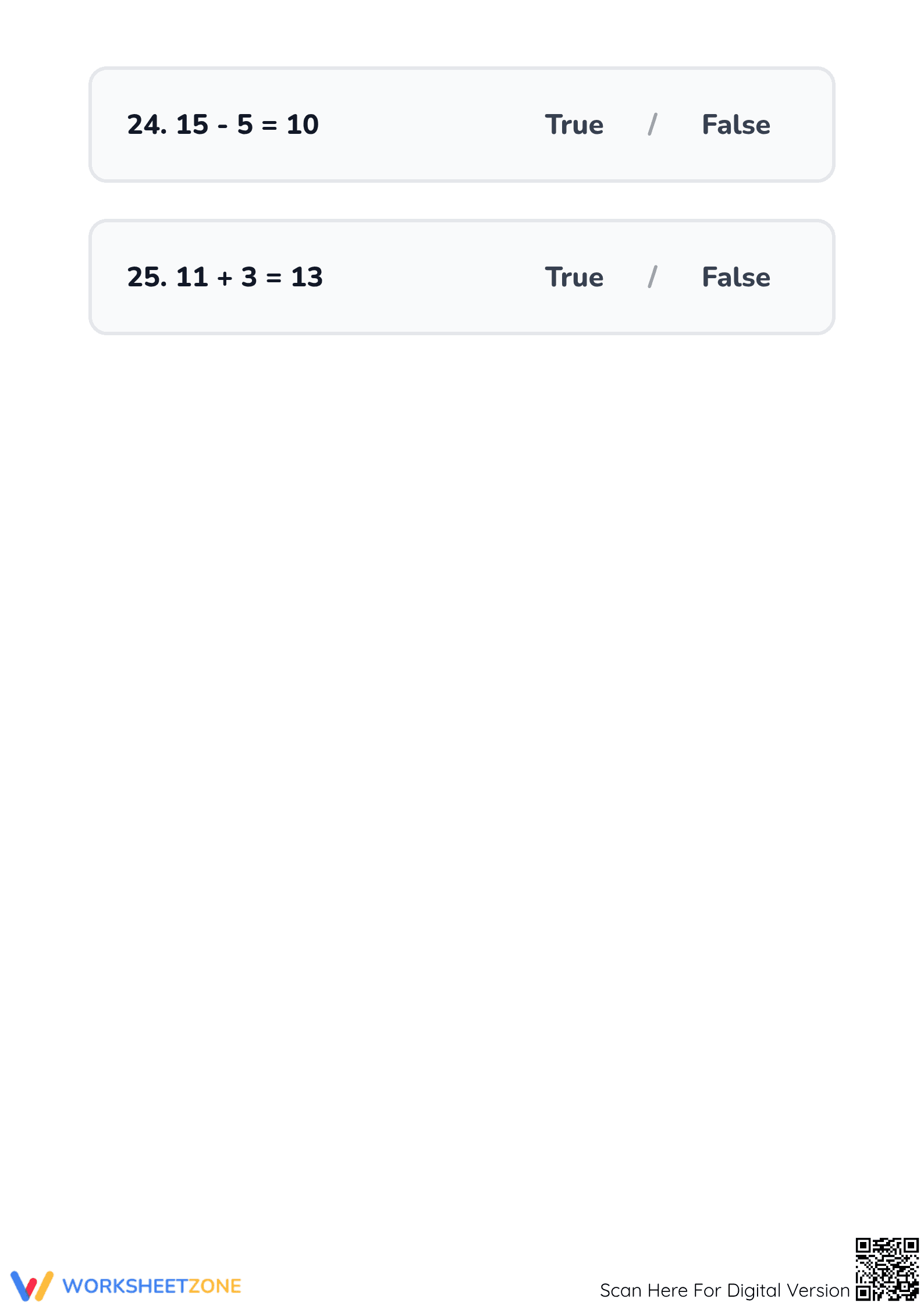
This five-page PDF includes a three-page worksheet with 25 distinct problems and a comprehensive two-page answer key. The worksheet is structured into two parts: "Basic Equations" (problems 1-20) and "Challenge Equations" (problems 21-25), offering a gentle increase in difficulty. No special materials are needed.
Skill Progression
The worksheet follows a gradual release model to build student confidence.
- Guided Practice: The first section offers 20 basic problems using addition and subtraction facts within 20, ideal for review or direct instruction follow-up.
- Supported Practice: The clear "True / False" format with simple circling helps students focus on the mathematical logic of each balanced equation.
- Independent Practice: The final five "Challenge Equations" use slightly larger numbers, encouraging independent application and serving as an extension for early finishers.
This progression mirrors the "I Do, We Do, You Do" framework, making it a flexible tool for whole-class or small-group settings.
Standards Alignment
Directly aligned with CCSS.MATH.CONTENT.1.OA.D.7, this worksheet requires students to "Understand the meaning of the equal sign, and determine if equations involving addition and subtraction are true or false." Although a first-grade standard, its mastery is crucial for success in second-grade content, like CCSS.MATH.CONTENT.2.OA.A.1 (solving one- and two-step word problems). Standard codes can be copied into lesson plans or curriculum mapping tools.
How to Use It
Ideal for independent practice after a direct instruction lesson on the equal sign, this versatile worksheet can also be used for morning work or as a math center. For formative assessment, observe student pauses; this often reveals misconceptions about the equal sign (e.g., "the answer is" vs. "is the same as"). Most students complete it in 15-20 minutes.
Who It's For
Primarily for second-grade students solidifying their understanding of equations, it's also an effective intervention tool for third-graders struggling with balanced equations. The two-part structure offers light differentiation. Pair with a visual anchor chart (e.g., balanced scale) to reinforce the "same on both sides" concept.
This worksheet provides targeted practice on the foundational algebraic concept of understanding the equal sign. Aligned with CCSS.MATH.CONTENT.1.OA.D.7, it focuses on determining if addition and subtraction equations are true or false. This skill is critical for algebraic reasoning and procedural fluency. By offering 25 structured problems, the resource gives students opportunities to engage with mathematical precision, essential for building automaticity in more complex problems. It provides concrete, actionable data for teachers on student mastery.


