




























Views
Downloads
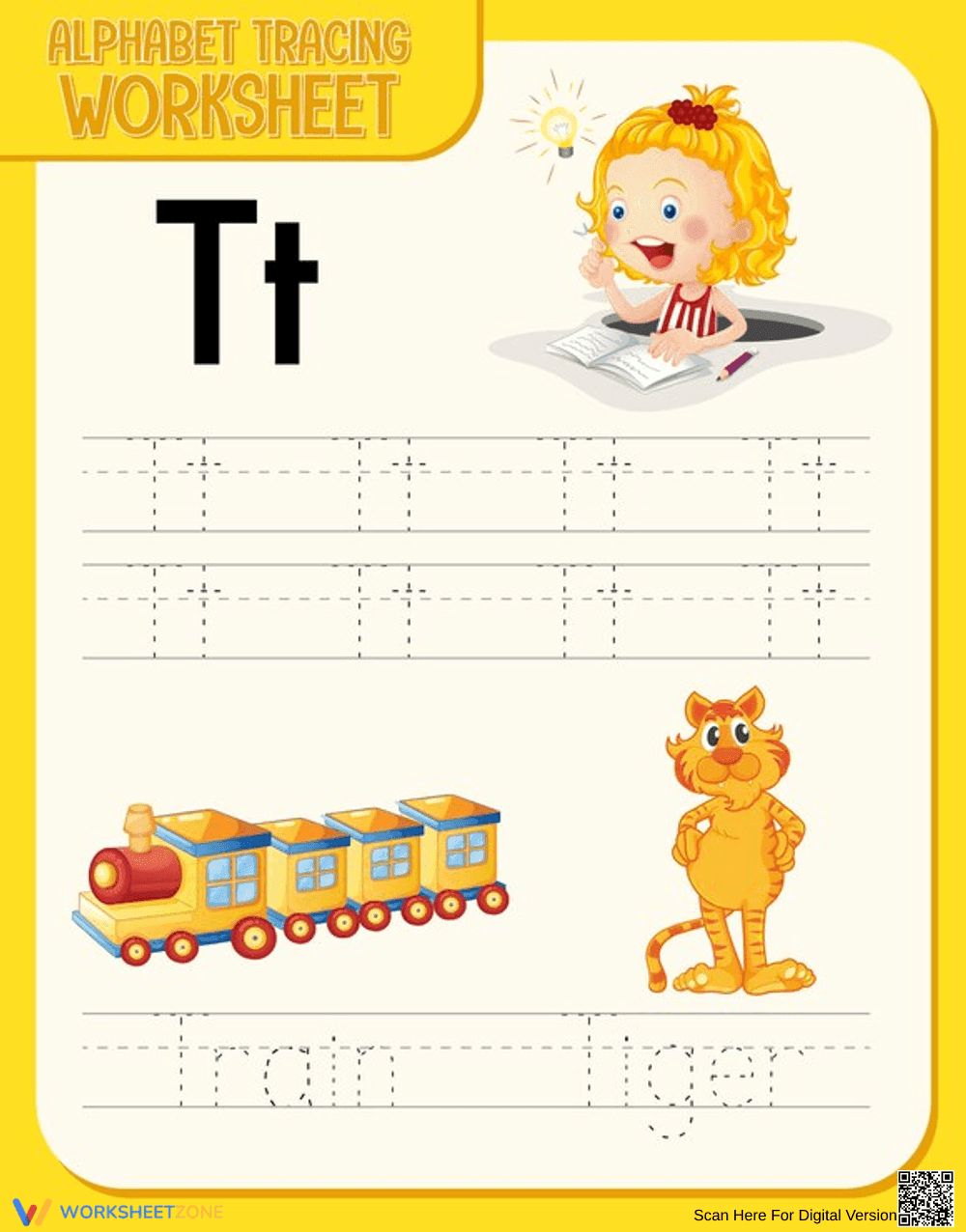

Essential Letter T Tracing Worksheet | Kindergarten

Paste this activity's link or code into your existing LMS (Google Classroom, Canvas, Teams, Schoology, Moodle, etc.).
Students can open and work on the activity right away, with no student login required.
You'll still be able to track student progress and results from your teacher account.
This Kindergarten English worksheet provides focused practice for mastering the letter T through guided tracing. Students develop fine motor control while learning the distinct strokes required for both uppercase and lowercase forms. By connecting letter shapes to familiar objects like trains and tigers, the resource reinforces phonemic awareness alongside handwriting proficiency.
At a Glance
- Grade: Kindergarten · Subject: English
- Standard:
CCSS.ELA-LITERACY.L.K.1.A— Print many upper- and lowercase letters accurately and legibly- Skill Focus: Letter T Formation
- Format: 1 page · 10 tasks · Answer key N/A · PDF
- Best For: Morning work or literacy centers
- Time: 10–15 minutes
What's Inside
The worksheet features a clear, large-format example of the letter T in both cases at the top. Below, two dedicated rows of dashed-line guides allow for repetitive tracing of individual letters. The bottom section transitions from isolated letters to whole-word tracing, featuring the words "train" and "tiger" accompanied by high-quality thematic illustrations to maintain student engagement.
Zero-Prep Workflow
This resource is designed for immediate classroom implementation. First, print the single-page PDF (30 seconds). Next, distribute the sheets to students during your phonics block or as a transition activity (1 minute). Finally, provide immediate verbal feedback as you circulate the room, checking for proper pencil grip and stroke direction (ongoing). Total teacher preparation time is under 2 minutes, making this an ideal emergency sub-plan component.
Standards Alignment
This resource aligns with CCSS.ELA-LITERACY.L.K.1.A, which requires students to print many upper- and lowercase letters. It specifically targets the vertical and horizontal stroke patterns unique to the letter T. This standard code can be copied directly into lesson plans, IEP goals, or district curriculum mapping tools.
How to Use It
Use this worksheet during the "You Do" phase of a gradual release model after demonstrating letter formation on a whiteboard. It serves as an excellent formative assessment tool; observe if students start their strokes from the top down, which is a key indicator of developing handwriting fluency. Completion typically takes 10 to 15 minutes.
Who It's For
This activity is ideal for Kindergarten students beginning their literacy journey and Grade 1 students requiring remedial handwriting support. It pairs naturally with an alphabet anchor chart or a read-aloud book featuring "T" words. The visual cues make it accessible for English Language Learners (ELL) building foundational vocabulary.
According to the RAND AIRS 2024 report on foundational literacy, explicit instruction in letter formation is a critical precursor to reading fluency and orthographic mapping. This worksheet addresses the specific requirements of CCSS.ELA-LITERACY.L.K.1.A by providing the repetitive, scaffolded practice necessary for students to internalize the motor movements associated with the letter T. Research from Fisher & Frey (2014) emphasizes that integrating visual icons, such as the train and tiger featured here, helps young learners bridge the gap between abstract symbols and concrete meaning. By offering both isolated letter practice and word-level application, this resource ensures that students move beyond simple imitation toward functional writing skills. Consistent use of such structured tracing activities has been shown in NAEP studies to correlate with improved writing legibility in later primary grades, making this an essential tool for early childhood educators.


