




























Views
Downloads
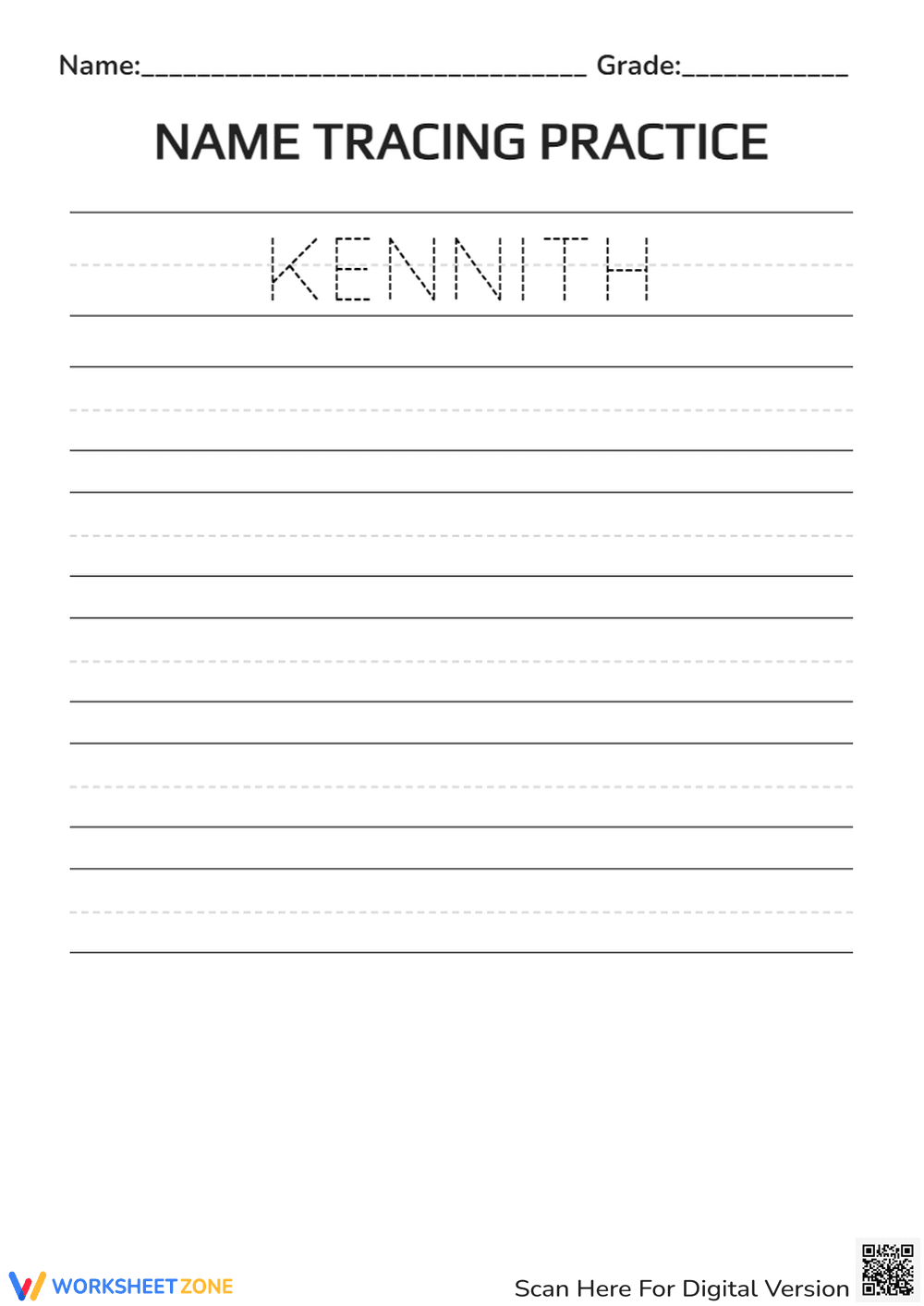

KENNITH Name Tracing Worksheet | Essential Grade K-1

Paste this activity's link or code into your existing LMS (Google Classroom, Canvas, Teams, Schoology, Moodle, etc.).
Students can open and work on the activity right away, with no student login required.
You'll still be able to track student progress and results from your teacher account.
Handwriting mastery starts with personal connection. This worksheet helps students learn to write the name 'KENNITH' through guided tracing and independent repetition. By focusing on a specific name, learners build the muscle memory and letter-spacing skills necessary for fluent writing in early elementary grades, ensuring a smooth transition to sentence construction.
At a Glance
- Grade: Kindergarten · Subject: Handwriting
- Standard:
CCSS.ELA-LITERACY.L.K.1.A— Print many upper- and lowercase letters accurately- Skill Focus: Name recognition and letter formation
- Format: 1 page · 8 problems · Answer key not applicable · PDF
- Best For: Morning work or daily handwriting practice
- Time: 5–10 minutes
This single-page PDF features the name 'KENNITH' in large, dashed font for initial tracing. Below the guided model, seven primary-ruled lines provide ample space for students to transition from tracing to independent writing. The clear layout ensures students focus on vertical alignment and consistent letter sizing without distractions, making it a perfect addition to any literacy folder.
Zero-Prep Workflow
Teachers can integrate this into their daily routine in three simple steps. First, print the required number of copies in under 30 seconds. Second, distribute the sheets during morning arrival or literacy centers. Third, review student progress by checking for proper pencil grip and stroke order. Total teacher preparation time is less than 2 minutes, making it an ideal resource for busy classrooms.
Standards Alignment
This resource aligns with CCSS.ELA-LITERACY.L.K.1.A, which requires students to print many upper- and lowercase letters. It also supports foundational writing skills by encouraging proper letter orientation and spacing. Both standard codes can be copied directly into lesson plans, IEP goals, or district curriculum mapping tools to ensure compliance with state and national frameworks.
How to Use It
Use this worksheet during the "You Do" phase of a handwriting lesson to reinforce letter formation. It is also an excellent formative assessment tool; observe if the student starts letters from the top and maintains consistent height across the 7 practice lines. Expected completion typically takes 5 to 10 minutes depending on the student's fine motor development.
Who It's For
Designed for Kindergarten and first-grade students, this worksheet is ideal for those needing targeted practice with specific letter combinations. It is particularly helpful for students named Kennith or for learning the specific mechanics of the letters K, E, N, I, T, and H. It pairs naturally with an alphabet anchor chart or a direct instruction lesson.
Research by Fisher & Frey (2014) emphasizes the importance of the gradual release of responsibility, moving from guided tracing to independent production. This worksheet facilitates that transition by providing a clear model of the name 'KENNITH' followed by repetitive practice lines. According to the RAND AIRS 2024 report, personalized content like name tracing increases student engagement and retention of orthographic patterns. By mastering the specific sequence of letters in their own name or a peer's name, students develop the fine motor control required for the CCSS.ELA-LITERACY.L.K.1.A standard. This targeted approach ensures that early learners build a strong foundation in handwriting, which is a critical precursor to composition and literacy. The 8 rows of practice provided here offer the necessary volume of repetition to move from conscious effort to automaticity in letter formation.


