


























Views
Downloads
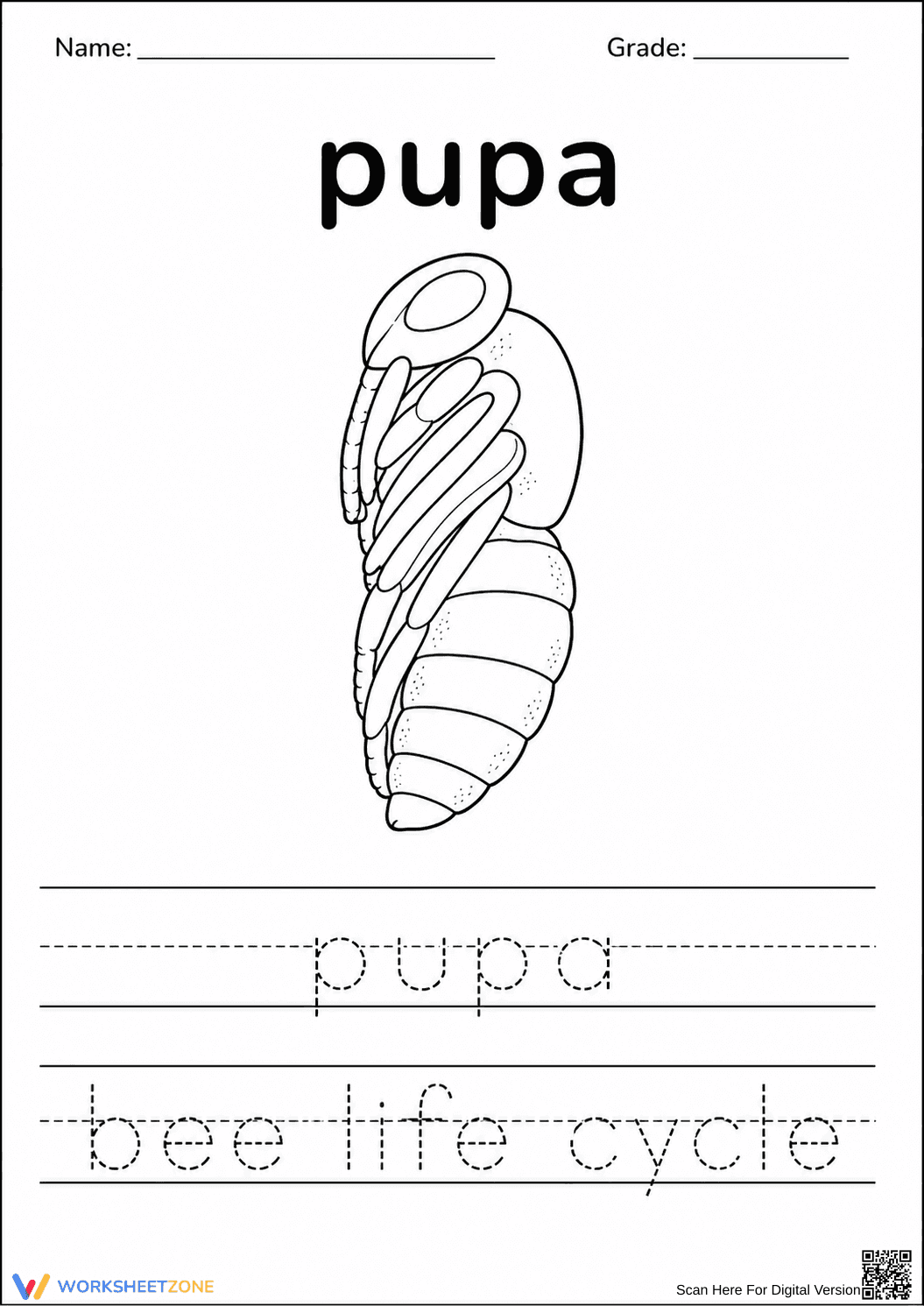

Printable Bee Life Cycle Pupa Worksheet | Grade K-1
Paste this activity's link or code into your existing LMS (Google Classroom, Canvas, Teams, Schoology, Moodle, etc.).
Students can open and work on the activity right away, with no student login required.
You'll still be able to track student progress and results from your teacher account.
This Grade K-1 science worksheet introduces early learners to the pupa stage of the bee life cycle through integrated handwriting practice. By combining visual identification with fine motor skill development, students reinforce their understanding of biological growth while mastering specific scientific vocabulary in a focused, age-appropriate activity.
At a Glance
- Grade: K-1 · Subject: Science
- Standard:
K-LS1-1— Observe and describe patterns of what animals need to survive- Skill Focus: Life cycle vocabulary and letter formation
- Format: 1 page · 2 tracing tasks · No answer key needed · PDF
- Best For: Morning work or science center activity
- Time: 5–10 minutes
What's Inside
Inside this single-page PDF, educators will find a large, clear illustration of a honeybee pupa suitable for coloring. Below the image, students are provided with two primary-lined tracing rows. The first row features the word "pupa" in a dashed font, and the second row features the phrase "bee life cycle." The layout is spacious to accommodate developing fine motor skills and ensure young learners can comfortably practice their letter formation.
Zero-Prep Workflow
This resource is designed for immediate classroom implementation with a total teacher prep time of under 2 minutes. First, print the required number of copies for your group (1 minute). Second, distribute the sheets along with pencils and crayons (1 minute). Third, review the completed work during a quick walk-around or as students transition to their next station. It is an ideal sub plan filler that requires no specialized science background to administer.
Standards Alignment
This worksheet aligns with K-LS1-1, focusing on the observation of animal growth patterns and life cycles. It also supports foundational ELA standards by requiring students to print lowercase letters accurately on primary lines. Both standard codes can be copied directly into lesson plans, IEP goals, or district curriculum mapping tools.
How to Use It
Use this worksheet during the "elaborate" phase of a 5E science lesson on insects or pollinators. It serves as a perfect formative assessment to check if students can identify the pupa stage visually and trace the corresponding vocabulary. Expected completion time is 5 to 10 minutes, making it a great transition tool between direct instruction and independent reading centers.
Who It's For
This resource is tailored for Kindergarten and First Grade students, particularly those needing extra support with pencil grip, letter spacing, and basic science vocabulary. It pairs naturally with a classroom anchor chart showing the full four-stage bee life cycle or a read-aloud book about how caterpillars and grubs transform into adult insects.
According to the RAND AIRS 2024 report, integrating literacy tasks like handwriting into content-area instruction, such as science, significantly improves vocabulary retention in early childhood education. This worksheet targets the K-LS1-1 standard by focusing on the pupa stage, a critical transition in the honeybee's development, asking students to observe and describe patterns of what animals need to survive. By tracing the specific term "pupa," students move beyond simple recognition to active linguistic engagement with scientific concepts. Research emphasizes that writing to learn helps young students internalize complex cycles by connecting physical movement with cognitive processing. This 1-page resource provides the necessary scaffolding for young learners to document their observations of the natural world. It ensures that the foundational concept of metamorphosis is reinforced through repetitive, structured practice that meets both science and literacy requirements for the primary classroom environment.


