




























Views
Downloads

Printable Letter Q Tracing Worksheet | Grade 1

Paste this activity's link or code into your existing LMS (Google Classroom, Canvas, Teams, Schoology, Moodle, etc.).
Students can open and work on the activity right away, with no student login required.
You'll still be able to track student progress and results from your teacher account.
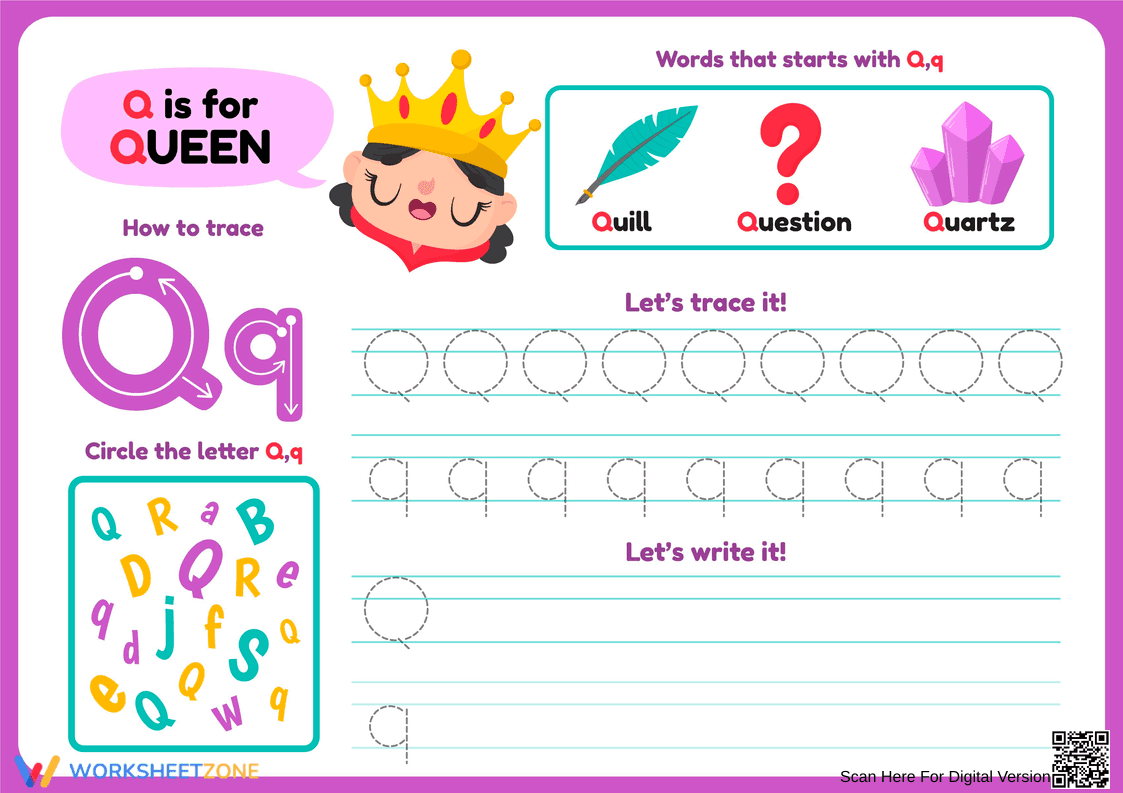
This Grade 1 English worksheet provides focused practice on the letter Q to build foundational handwriting and letter recognition skills. Students trace, write, and identify both uppercase and lowercase forms, reinforcing proper stroke order and fine motor control for early literacy development.
At a Glance
- Grade: 1 · Subject: English
- Standard:
CCSS.ELA-LITERACY.L.1.1.A— Print all upper- and lowercase letters- Skill Focus: Letter Q tracing and writing
- Format: 1 page · 4 tasks · No answer key needed · PDF
- Best For: Morning work or literacy centers
- Time: 10–15 minutes
This single-page resource features four distinct activity zones designed to support early writers. It begins with a vocabulary section introducing words like "Queen" and "Quill" alongside directional arrows demonstrating proper letter formation. Students then complete a visual discrimination task by circling the letter Q in a mixed-letter box. Finally, the page offers guided tracing lines for both uppercase and lowercase Q, followed by blank primary lines for independent writing practice.
This resource is designed for immediate classroom implementation with a zero-prep workflow:
- Print (1 minute): Generate copies directly from the PDF file. The high-contrast design ensures clear printing in both color and grayscale.
- Distribute (1 minute): Hand out to students during morning routines or transition periods. The visual instructions make the tasks self-explanatory.
- Review (1 minute): Quickly scan student pages to check for correct stroke direction and letter sizing.
With under two minutes of total teacher preparation, this worksheet serves as an excellent emergency sub plan or independent center activity.
This activity aligns directly with CCSS.ELA-LITERACY.L.1.1.A, requiring students to print all upper- and lowercase letters. By combining directional modeling with guided tracing and independent writing, the worksheet ensures students practice correct letter formation. Both standard codes can be copied directly into lesson plans, IEP goals, or district curriculum mapping tools.
Teachers can utilize this worksheet as a targeted morning work assignment to settle students into the day while reinforcing phonics instruction. It also functions perfectly as an independent literacy center station after a direct instruction lesson on the letter Q. While students work, teachers can conduct formative assessments by observing pencil grip and stroke sequence, correcting any bottom-to-top writing habits immediately. Expected completion time ranges from 10 to 15 minutes.
This printable is ideal for first-grade students refining their print handwriting, as well as kindergarteners ready for advanced letter practice. The inclusion of directional arrows provides necessary scaffolding for students struggling with fine motor skills or letter reversals. It pairs naturally with alphabet anchor charts or introductory phonics lessons focusing on the "kw" sound.
Developing automaticity in handwriting is a critical component of early literacy that directly impacts future writing fluency and reading comprehension. According to Fisher & Frey (2014), explicit instruction and repeated practice in letter formation reduce the cognitive load required for transcription, allowing young learners to focus their mental energy on idea generation and spelling. This resource supports that foundational development by targeting CCSS.ELA-LITERACY.L.1.1.A, ensuring students can accurately print all upper- and lowercase letters. By integrating visual discrimination, guided tracing, and independent writing into a single activity, the worksheet provides the structured repetition necessary for mastery. Consistent practice with specific letters like Q helps solidify neural pathways associated with fine motor control and symbol recognition, establishing a strong base for subsequent academic success in elementary education.


