


























Views
Downloads

Essential Grade 3 Vocabulary Worksheet | Printable
Paste this activity's link or code into your existing LMS (Google Classroom, Canvas, Teams, Schoology, Moodle, etc.).
Students can open and work on the activity right away, with no student login required.
You'll still be able to track student progress and results from your teacher account.
This Grade 3 vocabulary worksheet helps students master 15 essential verbs and adjectives through structured contextual practice. Students identify parts of speech and apply new terms in multiple-choice and fill-in-the-blank sentences to solidify their understanding. By the end of the lesson, learners will confidently use academic language and phrasal verbs in their daily communication.
At a Glance
- Grade: 3 · Subject: English Language Arts
- Standard:
CCSS.ELA-LITERACY.L.3.6— Acquire and use accurately grade-appropriate conversational, general academic, and domain-specific words- Skill Focus: Verbs, adjectives, and phrasal verbs
- Format: 2 pages · 10 problems · Answer key included · PDF
- Best For: Independent practice or vocabulary center activity
- Time: 15–20 minutes
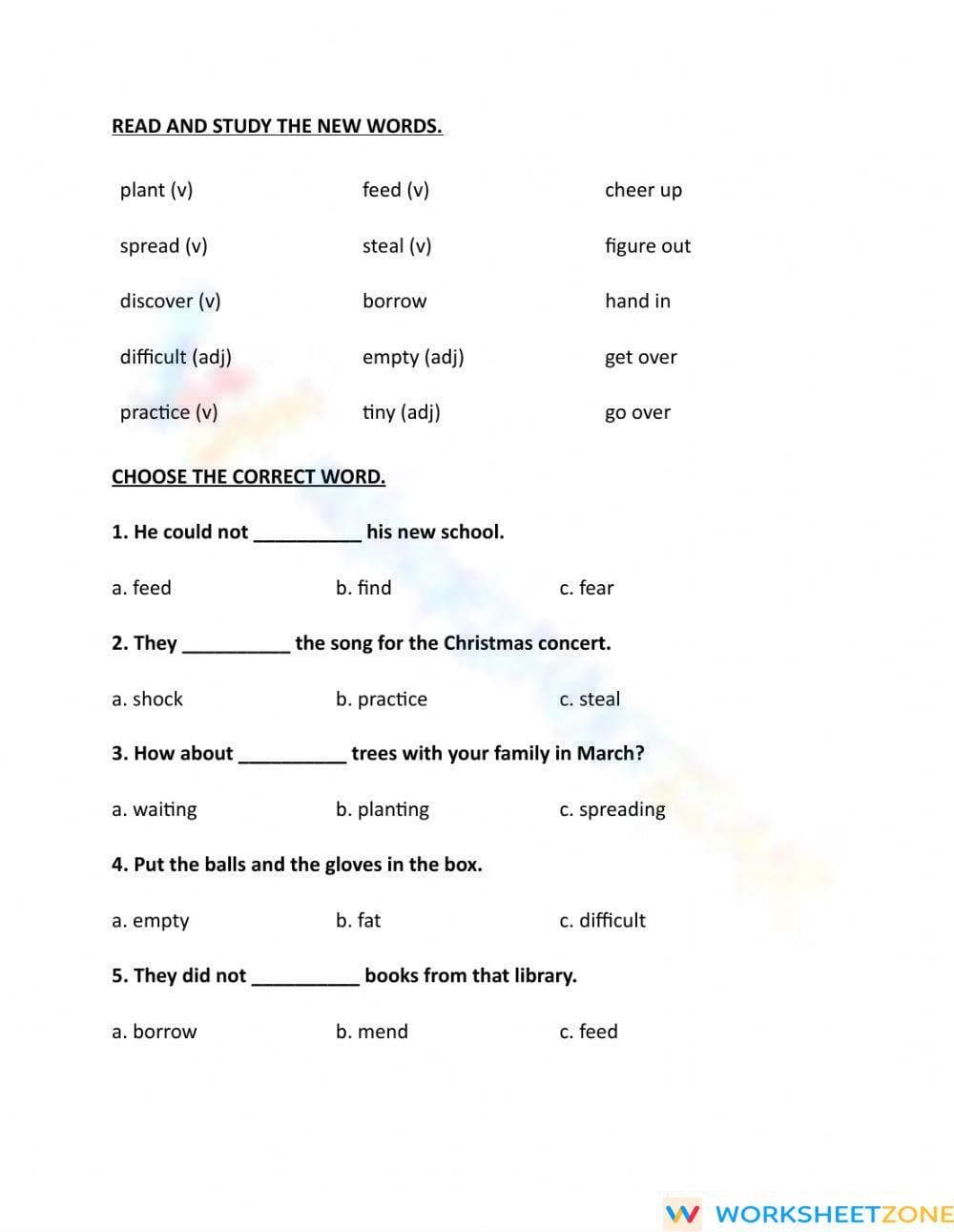
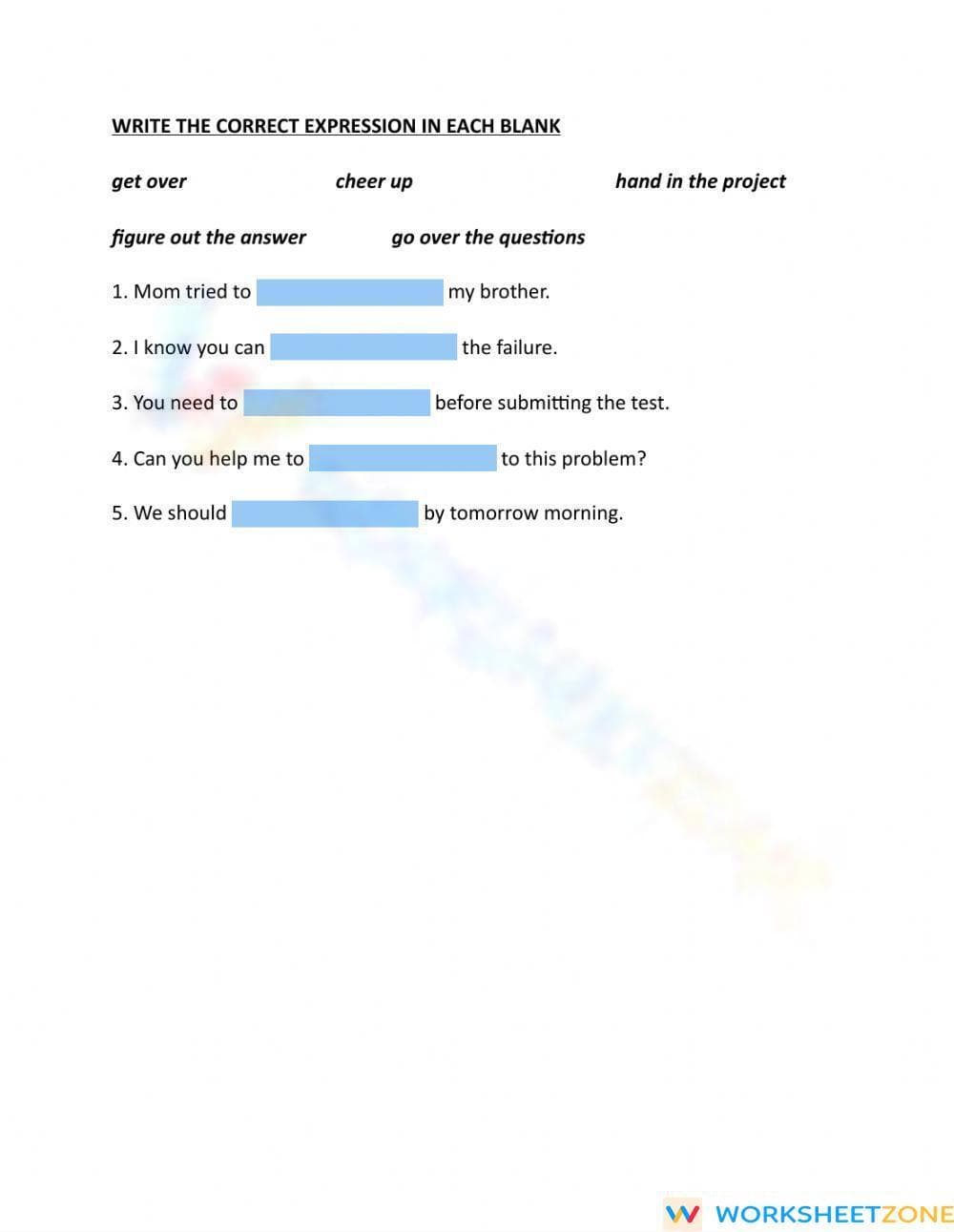
This comprehensive 2-page resource begins with a focused study list containing fifteen key vocabulary words, including "discover," "difficult," and "practice," labeled with their respective parts of speech. The worksheet features five multiple-choice questions to test recognition and five sentence-completion tasks specifically targeting phrasal verb expressions. A full answer key is included to facilitate quick grading and immediate feedback.
- Guided Practice: Students begin by reading and studying a curated list of 15 words and expressions, observing how verbs and adjectives are categorized.
- Supported Practice: Learners tackle 5 multiple-choice questions where they must distinguish between three distinct vocabulary options based on sentence context.
- Independent Practice: The final 5 tasks require students to write the correct phrasal verb expression into blanks, demonstrating mastery of multi-word phrases.
The instructional design follows a gradual-release model, moving from direct observation to recognition and finally to active application of language.
This worksheet is primarily aligned with CCSS.ELA-LITERACY.L.3.6, which requires students to acquire and use general academic and domain-specific words and phrases. It also supports related vocabulary standards in the Common Core. Both standard codes can be copied directly into lesson plans, IEP goals, or district curriculum mapping tools.
Assign this worksheet as a post-instructional activity to reinforce a weekly vocabulary unit or as a "do-now" bell-ringer for morning work. Teachers should observe if students are correctly identifying the part of speech required by the sentence structure, which provides a valuable formative-assessment data point. Most students will complete the ten problems within a 15-to-20-minute window.
This resource is designed for Grade 3 students but is highly effective for Grade 4 review or for English Language Learners working on phrasal verb acquisition. It pairs naturally with a reading passage focusing on character actions or an anchor chart displaying common phrasal verbs and their meanings in narrative contexts.
The CCSS.ELA-LITERACY.L.3.6 standard emphasizes that vocabulary knowledge is the single most important factor in reading comprehension and academic success. This worksheet targets that need by focusing on high-frequency verbs and adjectives that appear across various disciplines. According to Fisher & Frey (2014), the gradual release of responsibility—moving from word study to contextual application—is essential for moving vocabulary from short-term recognition to long-term ownership. By engaging with 10 structured tasks over 2 pages, students build the "word wealth" necessary for navigating complex Grade 3 texts. This resource provides the repetition and contextual clues required for learners to internalize 15 distinct linguistic units, ensuring they can produce these terms accurately in their own writing and speech. The inclusion of phrasal verbs like "figure out" and "get over" addresses a critical gap for many students, particularly those requiring language support or RTI Tier 2 interventions.


