


























Views
Downloads

Printable Tomato Life Cycle Worksheet | Grade 1 Science
Paste this activity's link or code into your existing LMS (Google Classroom, Canvas, Teams, Schoology, Moodle, etc.).
Students can open and work on the activity right away, with no student login required.
You'll still be able to track student progress and results from your teacher account.
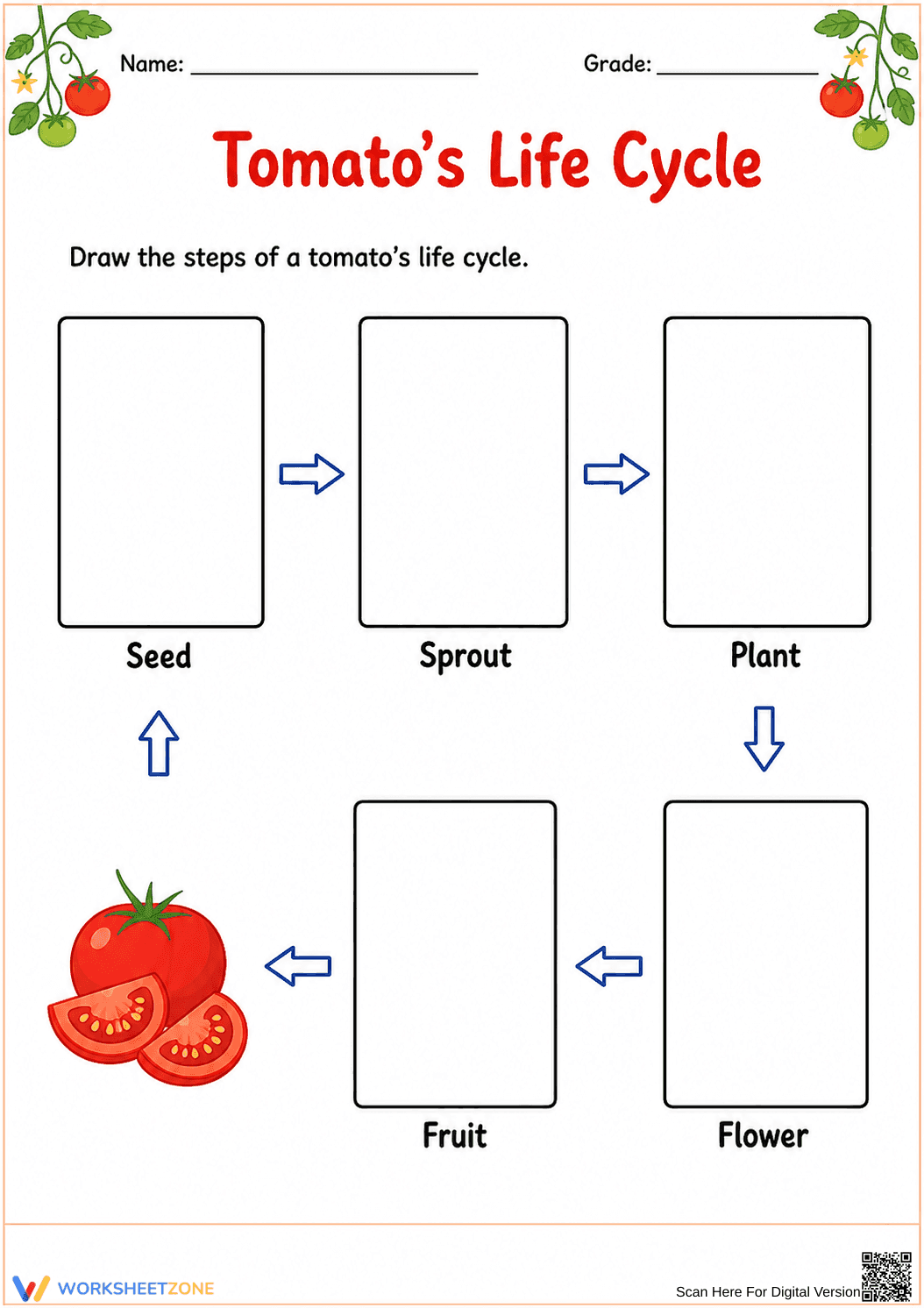
This foundational science worksheet helps early learners visualize and sequence the stages of plant growth. By drawing the progression from seed to fruit, students actively engage with the tomato plant life cycle. This hands-on activity reinforces sequential thinking and basic biological concepts while developing fine motor skills.
At a Glance
- Grade: 1 · Subject: Science
- Standard:
NGSS K-LS1-1— Observe and describe patterns of plant growth and survival.- Skill Focus: Sequencing life cycles
- Format: 1 page · 5 problems · No answer key · PDF
- Best For: Independent practice or science centers
- Time: 15–20 minutes
This single-page resource features a clear graphic organizer with five drawing prompts. Students are guided by directional arrows and bold labels—Seed, Sprout, Plant, Flower, and Fruit—to illustrate each developmental phase. A colorful reference image of a mature tomato anchors the final stage. The open-ended drawing format allows students to demonstrate understanding visually, making it accessible for early readers.
Designed for immediate classroom implementation, this activity requires absolutely no advanced preparation.
- Print (1 minute): The black-and-white design ensures crisp, ink-saving reproduction for your entire class.
- Distribute (1 minute): Hand out the sheets along with crayons or colored pencils. The intuitive layout means students can begin immediately.
- Review (3 minutes): Quickly assess student comprehension by glancing at their sequential drawings during a brief whole-group share.
With a total teacher prep time of under two minutes, this worksheet is an excellent addition to emergency sub plans or spontaneous science extensions.
This activity aligns with NGSS K-LS1-1: Use observations to describe patterns of what plants and animals (including humans) need to survive. By illustrating the growth process, students document the observable patterns of a plant's life cycle. It also builds essential background knowledge for later grades, specifically supporting NGSS 3-LS1-1 regarding unique and diverse life cycles. Both standard codes can be copied directly into lesson plans, IEP goals, or district curriculum mapping tools.
Integrate this worksheet into your spring planting unit. Use it as a formative assessment after reading a picture book about how plants grow; observe whether students accurately place the sprout before the mature plant. Alternatively, place it in an independent science center alongside real seeds for a hands-on observation station. Expect students to complete the drawing tasks within 15 to 20 minutes.
This resource is primarily designed for Kindergarten and Grade 1 students developing their foundational science vocabulary. The drawing-based format provides natural differentiation, allowing students to add as much or as little detail as their fine motor skills permit. It pairs perfectly with a hands-on seed germination activity or a classroom window garden project.
Understanding biological sequences through visual representation is a critical step in early childhood science education. This worksheet targets the core skill of sequencing life cycles, directly supporting NGSS K-LS1-1 by having students observe and describe patterns of plant growth and survival. According to a recent ScienceDirect TpT Analysis, integrating drawing and visual modeling into early science instruction significantly improves long-term retention of biological concepts compared to rote memorization alone. When students actively illustrate the transition from a tiny seed to a sprout, a mature plant, a blooming flower, and finally a ripe fruit, young learners construct their own meaningful understanding of developmental biology. This multimodal approach ensures that abstract scientific concepts become tangible and concrete, providing a highly effective and solid foundation for future scientific inquiry, classroom discussions, and lifelong environmental literacy.


