


























Views
Plays
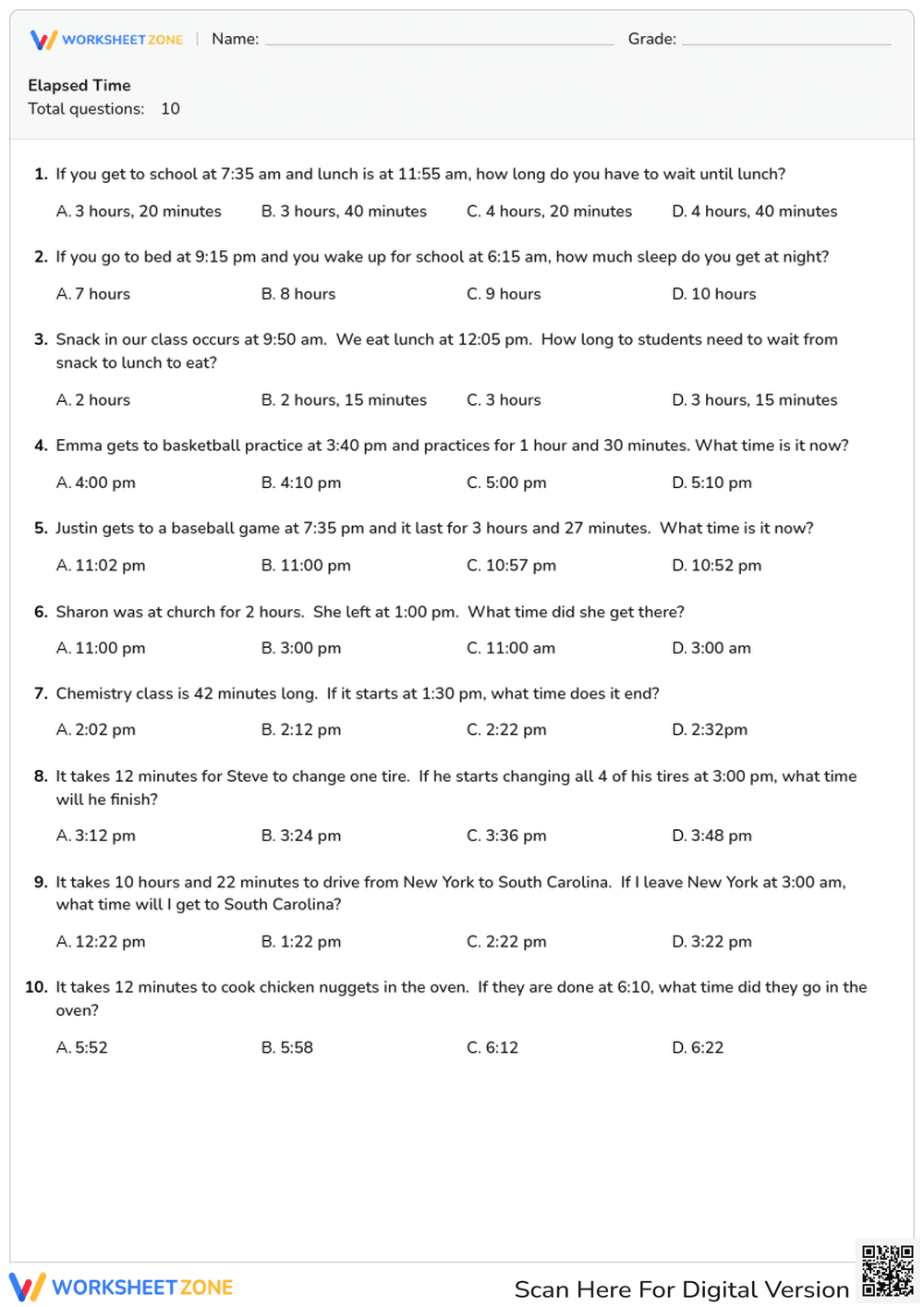

Grade 3-4 Elapsed Time — Printable No-Prep Worksheet
Paste this activity's link or code into your existing LMS (Google Classroom, Canvas, Teams, Schoology, Moodle, etc.).
Students can open and work on the activity right away, with no student login required.
You'll still be able to track student progress and results from your teacher account.
Elapsed time calculation is a critical third and fourth-grade skill that bridges basic clock reading with real-world logic. This worksheet helps students master finding start times, end times, and durations through 10 realistic word problems. By solving these scenarios, learners build the fluency needed for daily scheduling and time management tasks.
At a Glance
- Grade: 3-4 · Subject: Math
- Standard:
CCSS.MATH.CONTENT.3.MD.A.1— Solve word problems involving addition and subtraction of time intervals in minutes- Skill Focus: Elapsed Time Word Problems
- Format: 1 page · 10 problems · Answer key included · PDF
- Best For: Independent practice or quick formative assessment
- Time: 15–25 minutes
What's Inside: This single-page PDF features 10 high-quality multiple-choice questions. Each problem presents a unique scenario, such as calculating sleep duration, determining the end of a chemistry class, or figuring out travel time between cities. The clear layout provides ample white space for students to perform calculations or draw number lines, and a comprehensive answer key is included for rapid grading.
Zero-Prep Workflow: This resource is designed for immediate classroom integration. First, print the single-page PDF (30 seconds). Second, distribute the copies to your students (30 seconds). Finally, review the answers using the provided key (1 minute). With a total teacher preparation time of under 2 minutes, this worksheet is an ideal solution for emergency sub plans, morning work, or unexpected schedule changes.
Standards Alignment: The primary focus is `CCSS.MATH.CONTENT.3.MD.A.1`, which requires students to tell and write time to the nearest minute and measure time intervals. It also supports 4th-grade measurement standards involving distance, intervals of time, and liquid volumes. Both standard codes can be copied directly into lesson plans, IEP goals, or district curriculum mapping tools to ensure instructional compliance.
How to Use It: Use this worksheet as a formative assessment after your direct instruction on time intervals. It works best during the "You Do" phase of a gradual release model. As students work, circulate to observe if they are using additive strategies or T-charts to track minutes. Expect most students to complete the 10 problems within a 20-minute window, making it a perfect exit ticket or mid-lesson check.
Who It's For: This resource is tailored for Grade 3 and Grade 4 students who have mastered basic clock reading but need to apply that knowledge to multi-step problems. It is also an excellent intervention tool for 5th-grade students requiring a refresher. Pair this worksheet with a physical or digital manipulative clock to support visual learners during the problem-solving process.
According to the RAND AIRS 2024 report, high-quality, standards-aligned practice materials are essential for closing achievement gaps in elementary mathematics. This worksheet addresses the specific cognitive demand of CCSS.MATH.CONTENT.3.MD.A.1 by requiring students to translate linguistic scenarios into mathematical operations involving time. Research from Fisher & Frey (2014) emphasizes that structured independent practice with immediate feedback—facilitated here by the multiple-choice format and answer key—is a cornerstone of the gradual release of responsibility. By engaging with these 10 targeted problems, students move beyond rote memorization toward the conceptual understanding of time as a continuous measurement. This resource provides the necessary scaffolding for learners to transition from simple clock reading to complex interval subtraction, a skill frequently assessed in high-stakes state testing. The inclusion of diverse scenarios ensures that the mathematical skill of calculating elapsed time is grounded in practical, real-world application for every student.


