


























Views
Downloads

Printable Telling Time to 5 Minutes Worksheet | Grade 2
Paste this activity's link or code into your existing LMS (Google Classroom, Canvas, Teams, Schoology, Moodle, etc.).
Students can open and work on the activity right away, with no student login required.
You'll still be able to track student progress and results from your teacher account.
This Grade 2 math worksheet provides comprehensive practice for students mastering the clock. Students will transition from reading analog hands to drawing them accurately to represent specific times. By focusing on five-minute intervals, the resource ensures learners build a solid foundation in temporal awareness and measurement, leading to greater mathematical fluency and real-world application.
At a Glance
- Grade: 2 · Subject: Math
- Standard:
2.MD.C.7— Tell and write time from analog and digital clocks to the nearest five minutes- Skill Focus: Telling time to the nearest 5 minutes
- Format: 2 pages · 9 problems · Answer key included · PDF
- Best For: Small group practice or independent work
- Time: 15–20 minutes
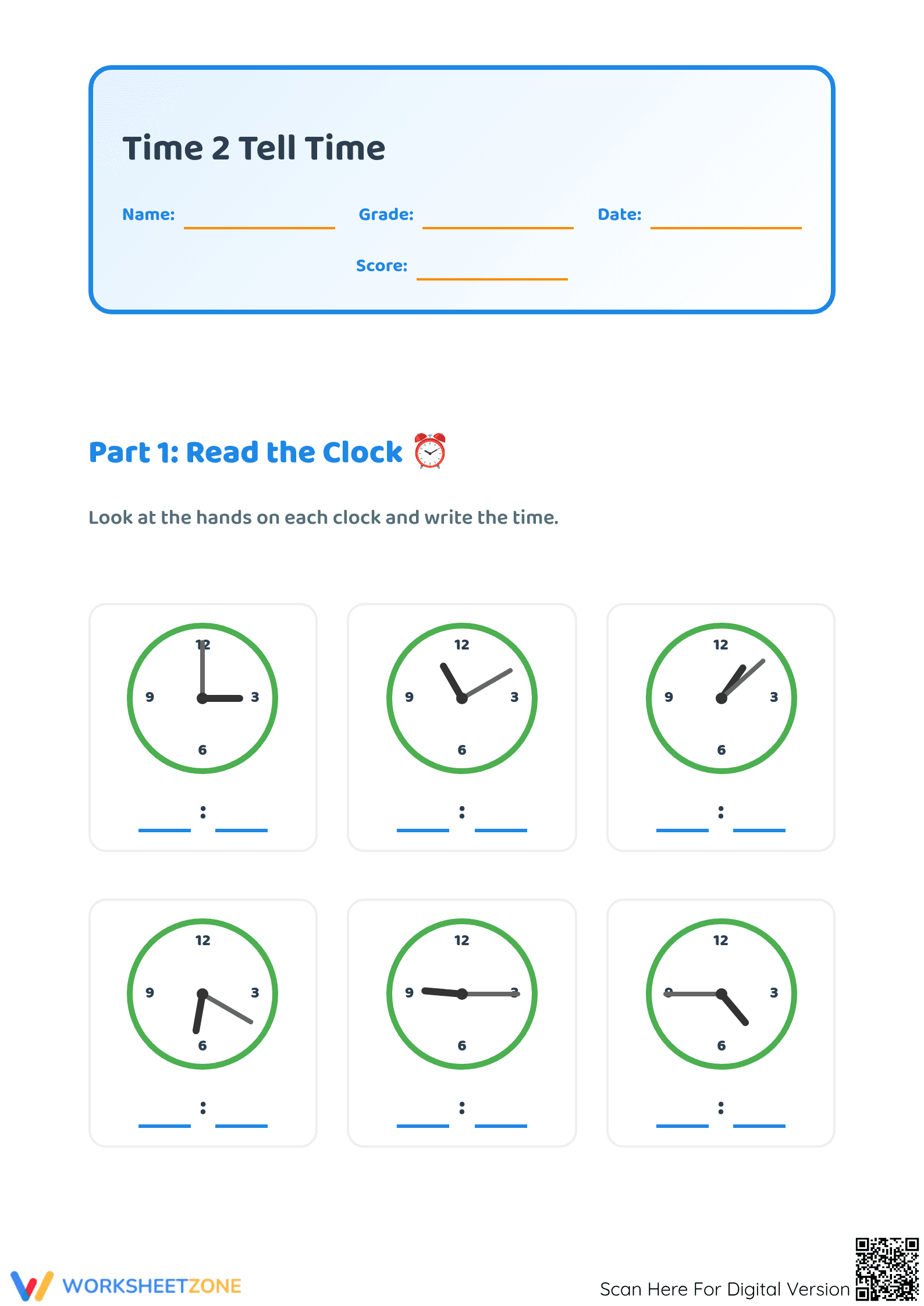
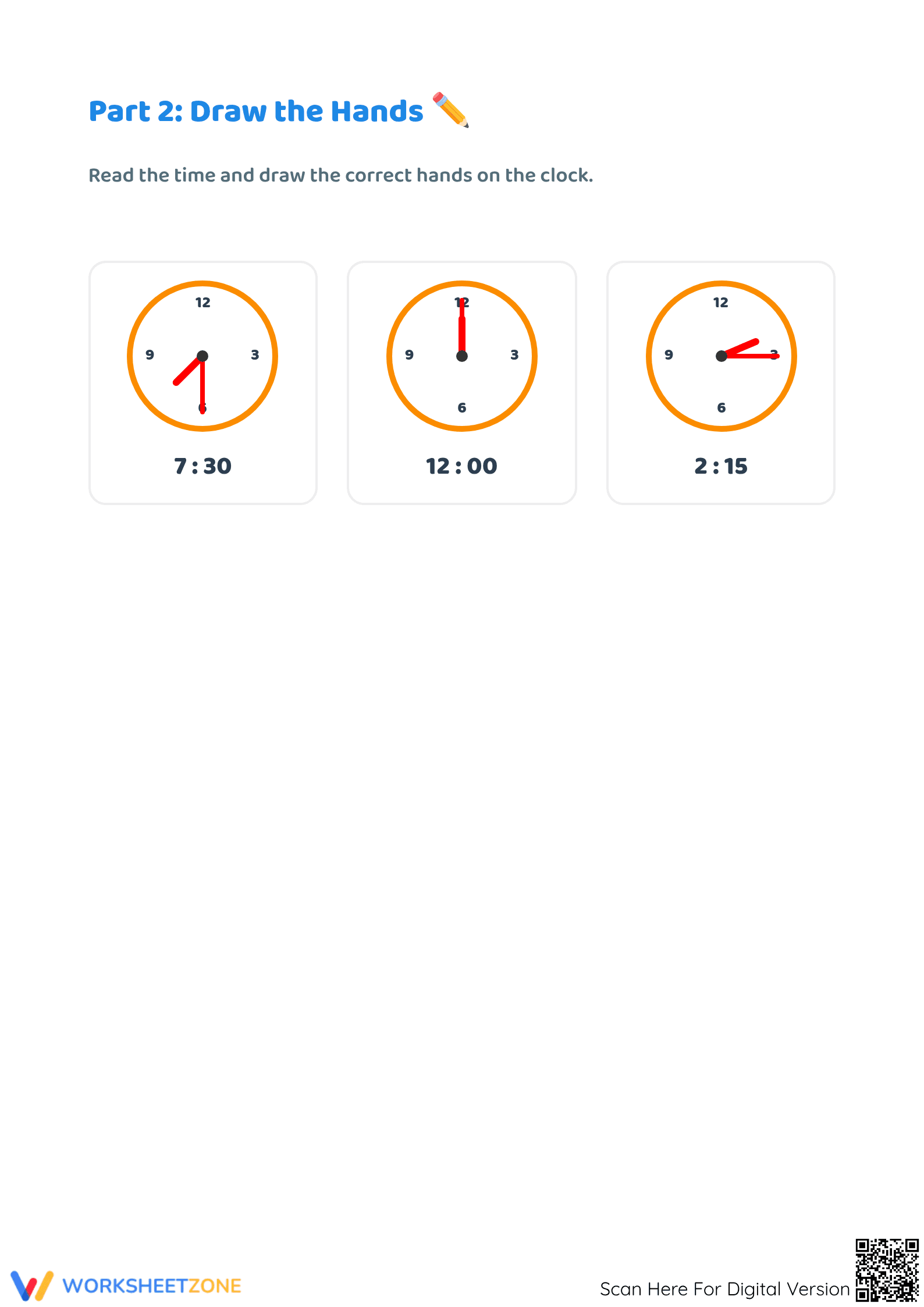
This two-page PDF includes nine tasks designed for Grade 2 students. The first page features six "Read the Clock" problems where learners identify the position of the hands. The second page provides three "Draw the Hands" exercises, requiring students to translate digital time into analog form. A complete answer key is provided for immediate feedback and grading efficiency.
Teachers can implement this resource in under two minutes. Simply print the two pages (1 minute), distribute them to the class (30 seconds), and use the included answer key for a rapid check (30 seconds). The high-contrast, colorful design ensures that every clock face is legible, making it an ideal choice for emergency sub plans or quick morning work.
Primary alignment is to `2.MD.C.7`: "Tell and write time from analog and digital clocks to the nearest five minutes, using a.m. and p.m." This worksheet focuses on the critical skill of interpreting the hour and minute hands' relative positions. Both standard codes can be copied directly into lesson plans, IEP goals, or district curriculum mapping tools.
Assign this worksheet as a formative assessment after introducing the concept of counting by fives around the clock. Observe whether students correctly distinguish between the shorter hour hand and the longer minute hand. It also serves as an excellent center activity where students can work independently or in pairs, typically completing all tasks within 20 minutes.
This resource is designed for Grade 2 students but is also appropriate for Grade 3 learners needing a refresher or Grade 1 students ready for enrichment. It pairs naturally with an interactive demonstration clock or a number line skip-counting activity to reinforce the relationship between minutes and five-unit increments. The visual cues help reduce anxiety during time-telling practice.
Research from RAND AIRS 2024 indicates that frequent, scaffolded practice with analog clock faces is essential for developing spatial-temporal reasoning in early elementary students. This worksheet specifically addresses CCSS.MATH.CONTENT.2.MD.C.7 by requiring learners to perform dual cognitive tasks: decoding analog signals and encoding digital data into visual representations. Mastery of telling time to the nearest five minutes is a high-frequency skill that correlates with success in later measurement and data domains. By providing clear visual anchors and varied task types, this resource minimizes cognitive load while maximizing retention. Educational analysis suggests that moving between reading and drawing time reinforces the mental model of a circular number line. Educators can use these structured problems to identify specific misconceptions regarding hand positions, allowing for targeted intervention that aligns with district-wide numeracy goals and assessment frameworks. This standalone summary highlights the critical role of tactile and visual practice in early measurement education.


