


























Views
Downloads

Grade 2 Telling Time — Printable No-Prep Worksheet
Paste this activity's link or code into your existing LMS (Google Classroom, Canvas, Teams, Schoology, Moodle, etc.).
Students can open and work on the activity right away, with no student login required.
You'll still be able to track student progress and results from your teacher account.
This printable Grade 2 math worksheet helps students master telling time on analog clocks to the nearest five minutes. By bridging analog faces and digital notation, students build the temporal fluency required for real-world scheduling. It provides structured, immediate practice for learners to gain clock-reading confidence through a clear, gradual progression of tasks.
At a Glance
- Grade: 2 · Subject: Math
- Standard:
2.MD.C.7— Read analog and digital clocks to nearest five minutes- Skill Focus: Analog-to-digital time conversion
- Format: 2 pages · 12 problems · Answer key included · PDF
- Best For: Daily warm-ups or independent math centers
- Time: 15–20 minutes
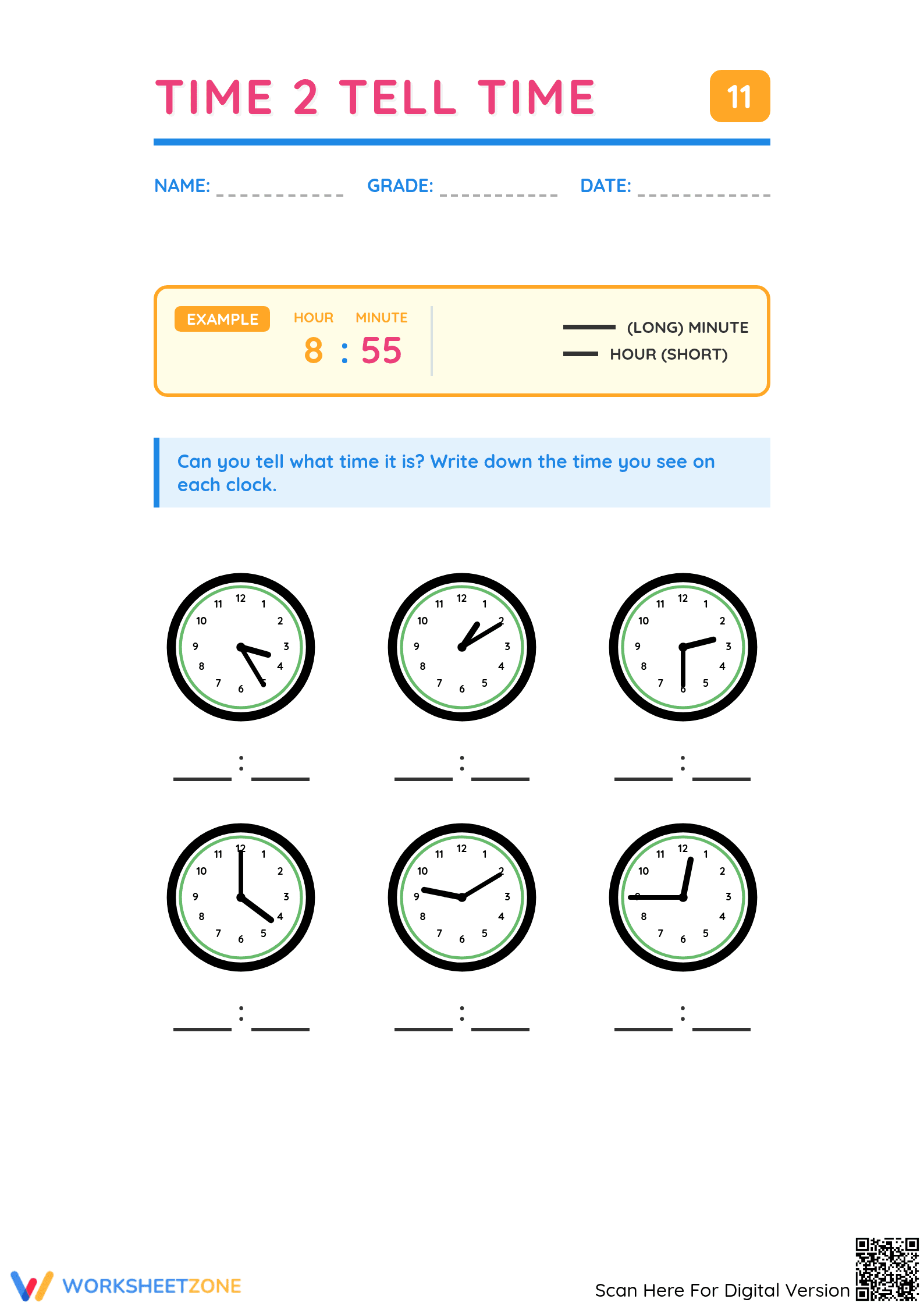
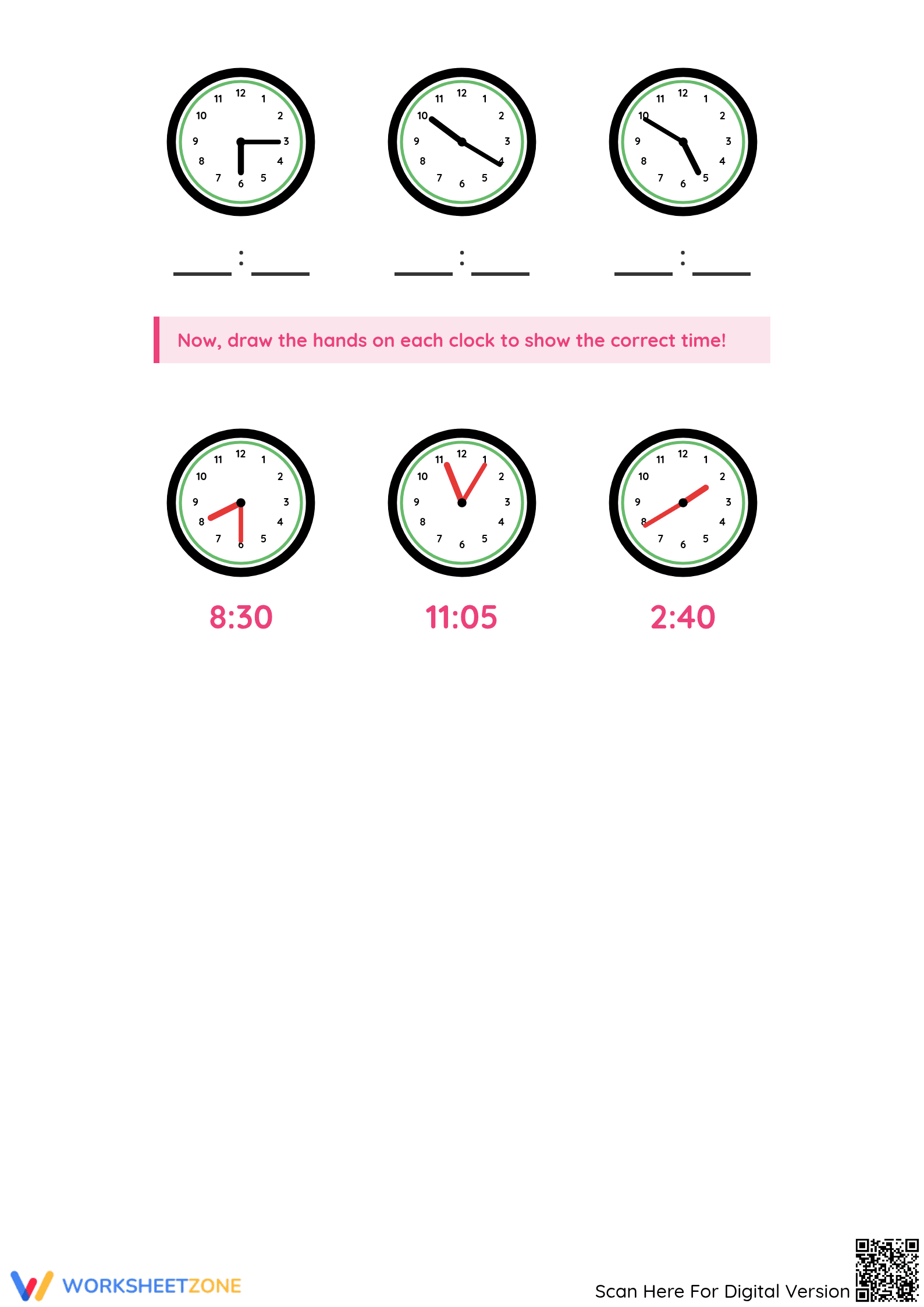
This two-page resource features twelve problems testing time-telling proficiency. Page one presents six analog clocks for digital time decoding. Page two includes three more decoding tasks and three drawing challenges where students place hands on blank faces. A clear example anchors understanding, and the provided answer key ensures rapid, accurate grading for teachers or parents.
Zero-Prep Workflow
Integrating this worksheet into your daily routine is efficient. Print the two-page PDF (30 seconds). Distribute copies; the included example ensures students start immediately without lengthy teacher explanation (1 minute). Use the answer key to review work or facilitate self-correction at a math center (1 minute). Total teacher prep time is under three minutes, making it perfect for busy mornings or sub plans where zero preparation is a priority.
Standards Alignment
This resource aligns to Common Core Standard 2.MD.C.7: "Tell and write time from analog and digital clocks to the nearest five minutes." By requiring students to read clock faces and draw hands, it addresses the dual demands of this measurement anchor. This code can be copied into lesson plans, IEP goals, or curriculum mapping tools to ensure instructional alignment across various educational environments.
How to Use It
Use this as a formative assessment after instruction on five-minute intervals. Assign page one during rotations to observe how students handle "half-past" and "quarter-to" positions. Use page two as an independent exit ticket. During completion, watch for students who confuse hour and minute hands—a common misconception this worksheet is designed to rectify. Expected completion time is roughly 15 to 20 minutes for most Grade 2 learners.
Who It's For
The worksheet is tailored for second-grade students transitioning from hour increments to precise five-minute intervals. It is also an excellent intervention for older students requiring scaffolding in temporal awareness. For best results, pair this printable with physical geared clocks or a classroom anchor chart highlighting the five-minute "secret" numbers corresponding to each clock numeral, providing a multi-sensory approach to a complex mathematical skill.
Temporal reasoning in early elementary is a foundational milestone for mathematical success. According to RAND AIRS 2024, structured practice in converting between analog and digital formats improves a student's ability to conceptualize time as a measurable quantity. This worksheet targets standard 2.MD.C.7 by providing high-repetition practice necessary to internalize 5-minute increments. By engaging with both decoding and encoding tasks—reading hands and drawing them—students develop a robust mental model of the clock. This approach is supported by research into mathematical fluency, ensuring learners move from guided examples to independent mastery. The inclusion of an answer key supports classroom workflow, allowing for the immediate feedback identified as critical for correcting misconceptions. By mastering these 12 tasks, students move beyond simple recognition toward functional time-telling skills applicable in daily life and standardized testing environments.


