


























Views
Downloads
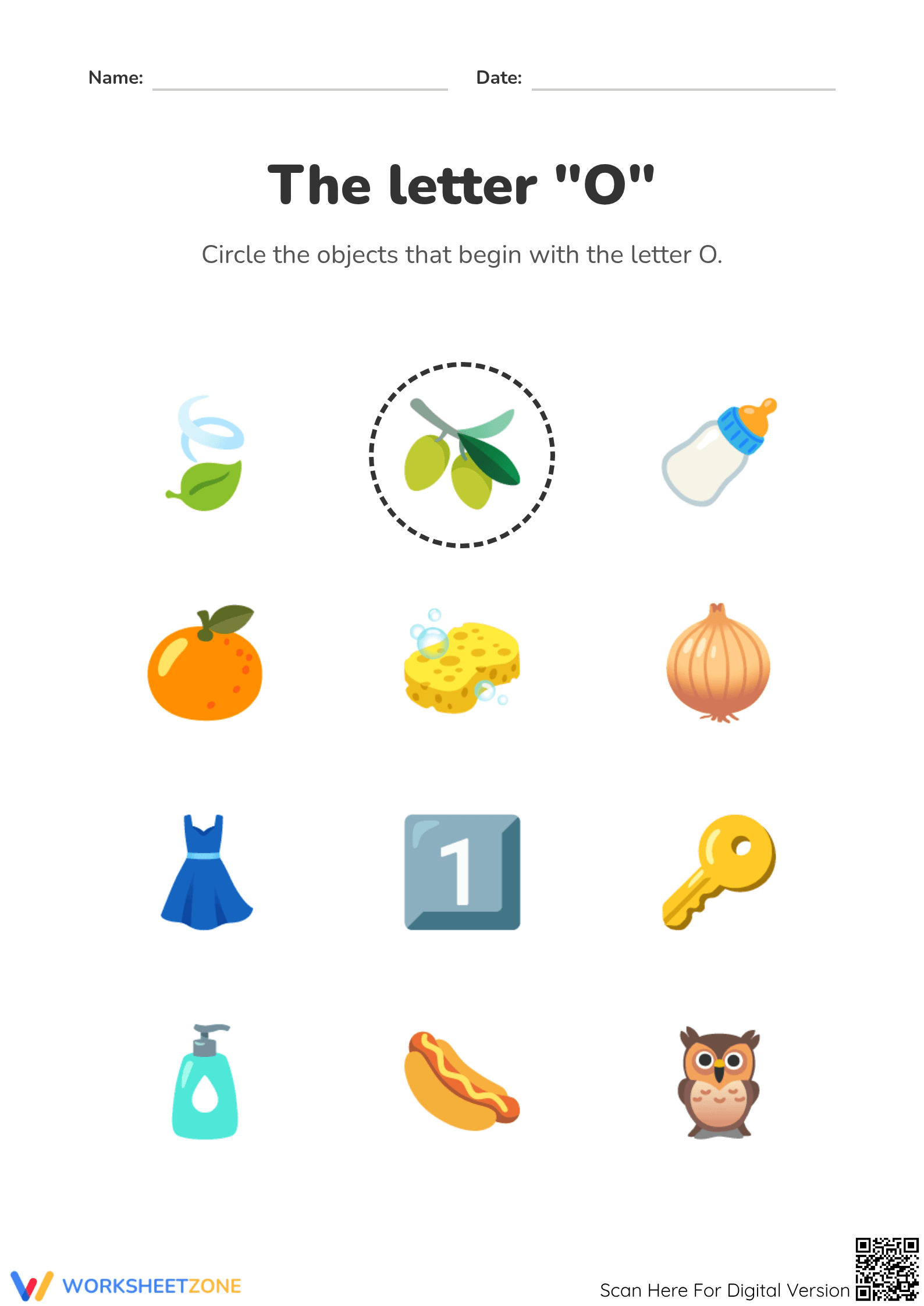

Preschool Letter O Sounds — Printable No-Prep Worksheet
Paste this activity's link or code into your existing LMS (Google Classroom, Canvas, Teams, Schoology, Moodle, etc.).
Students can open and work on the activity right away, with no student login required.
You'll still be able to track student progress and results from your teacher account.
This foundational phonics worksheet helps early learners identify the beginning sounds of the letter O. Students will examine a series of familiar images and circle the objects that start with the target letter, building essential phonemic awareness and letter-sound correspondence skills required for future reading success.
At a Glance
- Grade: Preschool · Subject: English Language Arts
- Standard:
CCSS.ELA-LITERACY.RF.K.3.A— Demonstrate basic knowledge of one-to-one letter-sound correspondences.- Skill Focus: Beginning Sounds (Letter O)
- Format: 1 page · 12 problems · PDF
- Best For: Independent practice or morning work
- Time: 5–10 minutes
Inside this single-page printable, educators will find a straightforward activity for young learners. The page features 12 colorful illustrations of everyday objects, such as an orange, onion, and owl. Students evaluate each image, determine its initial phoneme, and circle the items beginning with the letter O. The clean layout minimizes distractions, allowing children to focus entirely on the phonics task.
This resource offers a highly efficient zero-prep workflow:
- Print (1 minute): Download the PDF and print. The high-contrast images print clearly in color or grayscale.
- Distribute (1 minute): Hand out the worksheets along with crayons or pencils. The instructions are simple enough that students can begin almost immediately.
- Review (3 minutes): Quickly check student work as a whole class by naming each picture aloud and confirming the starting sound.
With a total teacher prep time of under two minutes, this worksheet is an excellent addition to emergency sub plans or last-minute literacy centers.
This activity is aligned to CCSS.ELA-LITERACY.RF.K.3.A, requiring students to demonstrate basic knowledge of one-to-one letter-sound correspondences by producing the primary sound or many of the most frequent sounds for each consonant. It also supports early vocabulary development as students name the objects pictured. Both standard codes can be copied directly into lesson plans, IEP goals, or district curriculum mapping tools.
Use this worksheet during small group literacy rotations to reinforce letter of the week concepts. It serves as excellent independent practice following direct instruction on the letter O. As a formative assessment observation tip, listen as students name pictures aloud to identify if they struggle with vocabulary or phonemic isolation. Expected completion time is 5 to 10 minutes.
This resource is primarily designed for preschool and early kindergarten students developing their foundational phonics skills. It is also highly effective for English Language Learners (ELLs) who benefit from the strong visual supports while building their English vocabulary. For differentiation, teachers can pair this worksheet with a tactile alphabet anchor chart or a hands-on letter sorting activity to provide additional sensory input for students who need extra support.
Developing strong phonemic awareness through targeted practice is a critical component of early literacy instruction. According to a comprehensive EdReports 2024 analysis of foundational reading programs, explicit instruction in letter-sound correspondence significantly improves long-term decoding abilities. This worksheet directly supports that research by providing focused practice aligned to CCSS.ELA-LITERACY.RF.K.3.A, helping students demonstrate basic knowledge of one-to-one letter-sound correspondences. By requiring learners to isolate the initial phoneme in familiar words and match it to the visual representation of the letter O, the activity reinforces the neural pathways necessary for fluent reading. Regular engagement with these visual phonics tasks ensures early learners build the automaticity required to transition from recognizing isolated sounds to blending them into complete words, establishing a robust foundation for future academic success.


