


























1 / 3
0
Views
0
Downloads

0.0
0
Save
0 Likes
Share
Thermodynamics Worksheet 1: Practice Energy
0 Views
0 Downloads
Paste this activity's link or code into your existing LMS (Google Classroom, Canvas, Teams, Schoology, Moodle, etc.).
Students can open and work on the activity right away, with no student login required.
You'll still be able to track student progress and results from your teacher account.
Information
Description
What It Is:
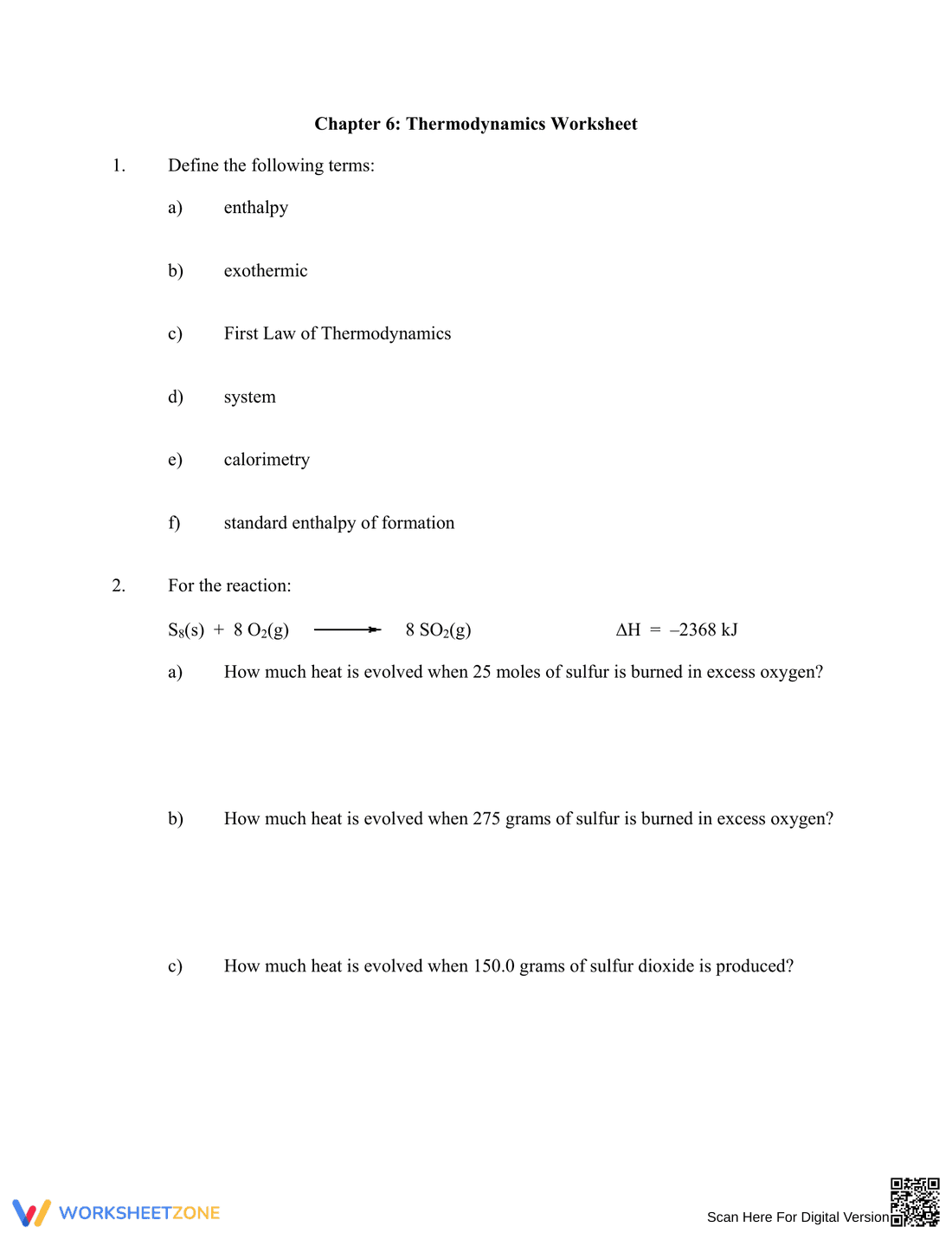
This is a thermodynamics worksheet, specifically Chapter 6. It includes definition questions for terms like enthalpy, exothermic, First Law of Thermodynamics, system, calorimetry, and standard enthalpy of formation. It also presents a chemical reaction (S(s) + O2(g) -> SO2(g) with ΔH = -2368 kJ) and asks students to calculate the heat evolved given different amounts of reactants (sulfur and oxygen) and product (sulfur dioxide).
Grade Level Suitability:
This worksheet is most suitable for high school students, specifically grades 11-12, or introductory college-level chemistry courses. The content requires an understanding of chemical reactions, stoichiometry, and thermodynamics concepts.
Why Use It:
This worksheet reinforces key thermodynamics vocabulary and provides practice in applying thermodynamic principles to calculate heat evolved in chemical reactions. It helps students connect theoretical concepts to practical calculations.
How to Use It:
Students should first define the listed thermodynamics terms. Then, using the provided chemical equation and enthalpy change, they should calculate the heat evolved for each scenario, converting grams to moles as needed. Students will likely need to use stoichiometric calculations and the given ΔH value.
Target Users:
The target users are high school chemistry students or introductory college chemistry students learning about thermodynamics. It is also useful for teachers as a practice or assessment tool.
This is a thermodynamics worksheet, specifically Chapter 6. It includes definition questions for terms like enthalpy, exothermic, First Law of Thermodynamics, system, calorimetry, and standard enthalpy of formation. It also presents a chemical reaction (S(s) + O2(g) -> SO2(g) with ΔH = -2368 kJ) and asks students to calculate the heat evolved given different amounts of reactants (sulfur and oxygen) and product (sulfur dioxide).
Grade Level Suitability:
This worksheet is most suitable for high school students, specifically grades 11-12, or introductory college-level chemistry courses. The content requires an understanding of chemical reactions, stoichiometry, and thermodynamics concepts.
Why Use It:
This worksheet reinforces key thermodynamics vocabulary and provides practice in applying thermodynamic principles to calculate heat evolved in chemical reactions. It helps students connect theoretical concepts to practical calculations.
How to Use It:
Students should first define the listed thermodynamics terms. Then, using the provided chemical equation and enthalpy change, they should calculate the heat evolved for each scenario, converting grams to moles as needed. Students will likely need to use stoichiometric calculations and the given ΔH value.
Target Users:
The target users are high school chemistry students or introductory college chemistry students learning about thermodynamics. It is also useful for teachers as a practice or assessment tool.


