




























Views
Downloads

Essential Grade 2 Sequencing Worksheet: Alien Story

Paste this activity's link or code into your existing LMS (Google Classroom, Canvas, Teams, Schoology, Moodle, etc.).
Students can open and work on the activity right away, with no student login required.
You'll still be able to track student progress and results from your teacher account.
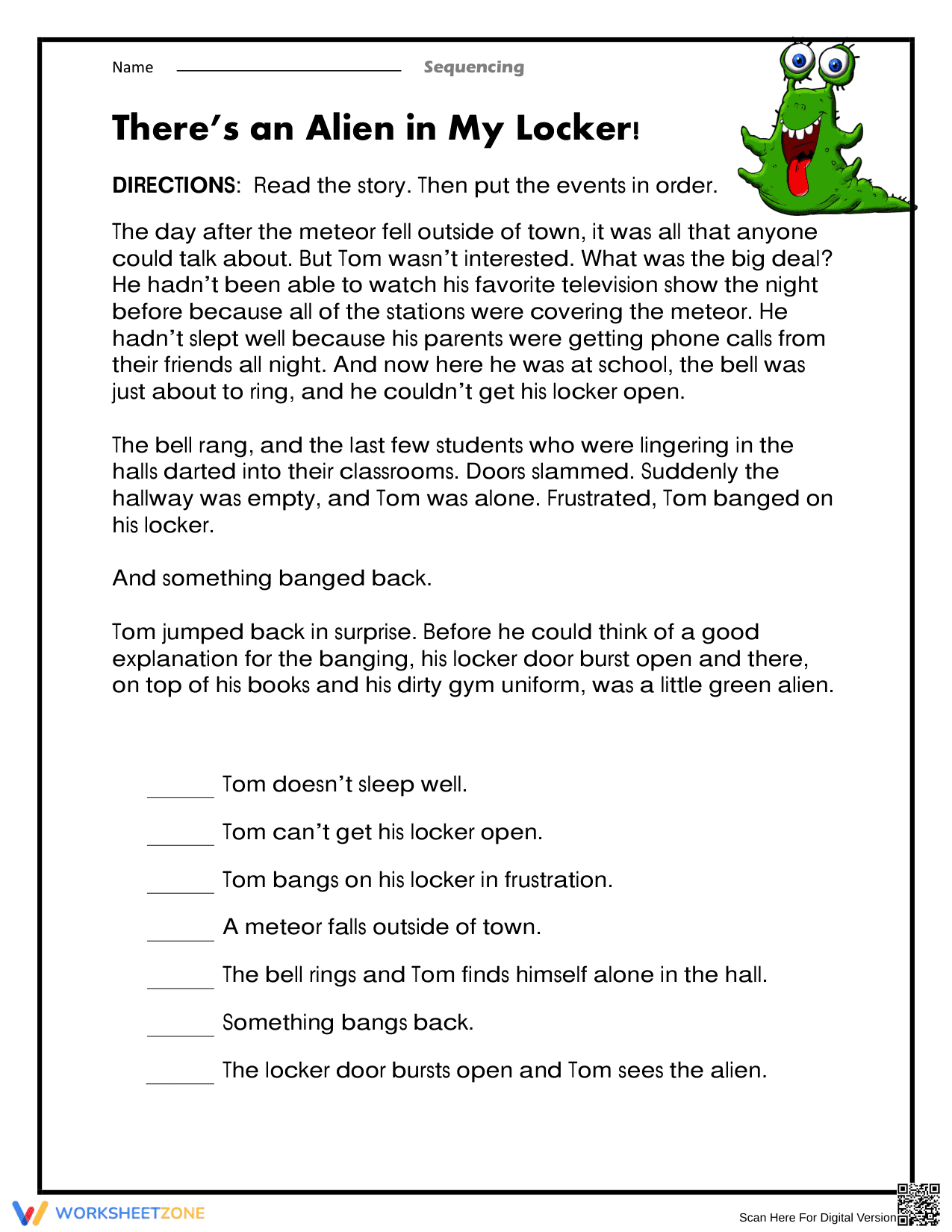
This Grade 2 sequencing worksheet engages students with a short narrative about an unexpected visitor. By reading "There's an Alien in My Locker," students practice identifying chronological order. This resource improves reading comprehension by requiring students to organize 7 key events into their correct sequence. Student outcomes focus on narrative structure and logical thinking.
At a Glance
- Grade: 2 · Subject: ELA
- Standard:
CCSS.ELA-LITERACY.RL.2.2— Recount stories and determine their central message, lesson, or moral.- Skill Focus: Chronological Sequencing
- Format: 1 page · 7 problems · Answer key included · PDF
- Best For: Independent practice or morning work
- Time: 15–20 minutes
The worksheet features a high-interest short story about a boy named Tom and a mysterious meteor. Below the text, an activity area lists seven pivotal plot points. Each point is preceded by a blank line where students write numbers to show the order. The layout includes a fun alien illustration to maintain student engagement throughout the task.
This zero-prep workflow allows teachers to integrate sequencing practice into their busy schedules immediately. First, print the single-page PDF (30 seconds). Second, distribute the worksheet as a standalone activity or part of a literacy center (1 minute). Third, review student responses using the included answer key to identify comprehension gaps (1 minute). The entire process requires less than three minutes of teacher preparation time.
This resource is aligned to CCSS.ELA-LITERACY.RL.2.2, focusing on recounting stories and understanding plot structure. It also supports CCSS.ELA-LITERACY.RL.1.2. By analyzing the beginning, middle, and end of the narrative, students demonstrate mastery of progression. Both standard codes can be copied directly into lesson plans, IEP goals, or district curriculum mapping tools.
Use this worksheet as a formative assessment after a lesson on narrative structure to gauge individual student progress. It also serves as an excellent "do-now" activity to settle students into their ELA block. Teachers can observe whether students are returning to the text to verify event order or relying on memory, which provides a valuable insight into their reading strategies.
This activity is designed for Grade 1 and Grade 2 students. It is effective for learners who benefit from structured tasks. For differentiation, pair this worksheet with a shared reading or provide a graphic organizer to help students visualize the timeline. This supports various learning styles while ensuring all students meet grade-level expectations.
Sequencing is a fundamental cognitive skill that bridges the gap between basic decoding and deep reading comprehension. According to RAND AIRS 2024, students who regularly engage in structured retelling and event ordering demonstrate a 22% higher proficiency in identifying central themes in complex texts. This worksheet provides the focused practice necessary for students to internalize narrative logic. By requiring students to manage 7 distinct events, the activity challenges their working memory while reinforcing the "first, next, then, last" framework common in early elementary ELA. Mastering the standard CCSS.ELA-LITERACY.RL.2.2 through these tasks ensures that students can accurately recount stories, which is a critical precursor to advanced literary analysis. The combination of a high-interest alien theme and rigorous sequencing demands makes this an essential tool for building reading stamina and logical reasoning in the primary classroom.


