


























Views
Downloads
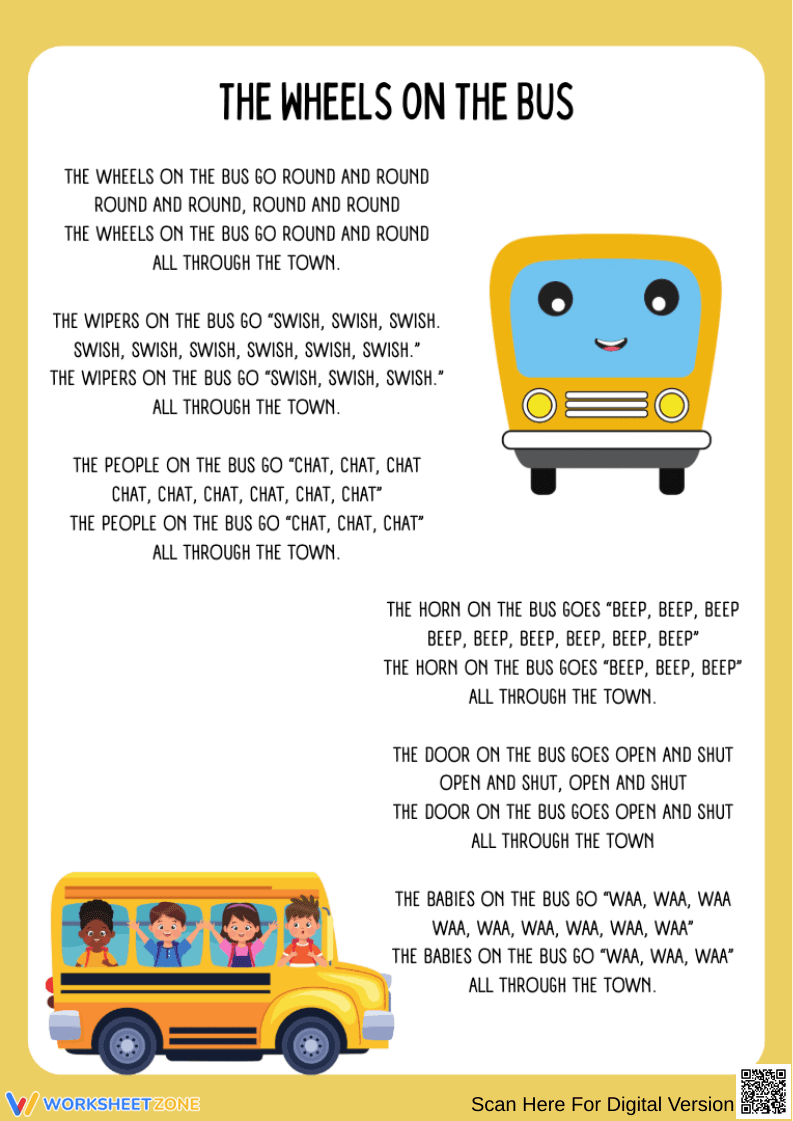

The Wheels on the Bus Lyrics | Printable Grade K Reading
Paste this activity's link or code into your existing LMS (Google Classroom, Canvas, Teams, Schoology, Moodle, etc.).
Students can open and work on the activity right away, with no student login required.
You'll still be able to track student progress and results from your teacher account.
This printable lyric sheet brings "The Wheels on the Bus" into your reading instruction. Students build foundational fluency and recognize repetitive text structures while engaging with familiar verses. This resource transforms a beloved song into an effective tool for early literacy development and choral reading practice.
At a Glance
- Grade: Kindergarten · Subject: ELA
- Standard:
CCSS.ELA-LITERACY.RF.K.4— Read emergent-reader texts with purpose and understanding.- Skill Focus: Reading fluency and repetition
- Format: 1 page · 1 reading task · No answer key required · PDF
- Best For: Choral reading and singalongs
- Time: 10–15 minutes
This single-page resource features six complete verses clearly formatted for early readers. The text includes classic stanzas for the wheels, wipers, people, horn, doors, and babies. Bright bus illustrations provide visual context clues to support emergent readers tracking the text. The layout uses clear typography with appropriate spacing to help young students follow along during group reading.
This resource is designed for immediate classroom implementation with a zero-prep workflow:
- Print (1 minute): Generate enough copies for your reading groups or display the PDF on an interactive whiteboard for whole-class participation.
- Distribute (1 minute): Hand out the lyric sheets to students as they gather on the reading rug.
- Review (10 minutes): Lead the class in a choral reading or sing-along, modeling one-to-one word correspondence.
Total teacher preparation takes under two minutes. This self-explanatory text is an excellent addition to any substitute teacher plan.
This text aligns directly with CCSS.ELA-LITERACY.RF.K.4: Read emergent-reader texts with purpose and understanding. It also supports early phonological awareness by exposing students to rhythm, rhyme, and predictable language patterns. Both standard codes can be copied directly into lesson plans, IEP goals, or district curriculum mapping tools.
Use this lyric sheet during morning meetings to transition students into the academic day with an engaging, shared reading experience. Alternatively, incorporate it into small-group literacy centers where students can practice tracking print with their fingers while listening to an audio recording of the song. As a formative assessment observation tip, watch to see if students accurately point to the repetitive words (like "round and round") as they sing, which indicates developing print awareness. Expected completion time ranges from 10 to 15 minutes depending on the number of verses sung.
This resource is primarily designed for Pre-K, Kindergarten, and first-grade students developing basic print concepts. It serves as an excellent differentiation tool for English Language Learners (ELLs) who benefit from the repetitive vocabulary and musical context. Pair this lyric sheet with a direct instruction lesson on sight words or a shared reading anchor chart focusing on action verbs.
Integrating musical texts like this worksheet into early literacy instruction significantly supports the development of reading fluency and phonemic awareness. By aligning with CCSS.ELA-LITERACY.RF.K.4, which requires students to read emergent-reader texts with purpose and understanding, educators can leverage familiar rhythms to build confidence in young readers. According to Fisher & Frey (2014), utilizing predictable, repetitive texts in shared reading environments lowers the affective filter, allowing students to focus on print concepts and word recognition rather than decoding complex narratives. The structured repetition found in these lyrics provides multiple exposures to high-frequency words, reinforcing visual memory and automaticity. This approach not only meets foundational reading standards but also fosters a highly engaging, multisensory learning environment that promotes long-term retention of early literacy skills.


