


























Views
Downloads

Essential Water Cycle Research Report | Grade 3-4 Writing
Paste this activity's link or code into your existing LMS (Google Classroom, Canvas, Teams, Schoology, Moodle, etc.).
Students can open and work on the activity right away, with no student login required.
You'll still be able to track student progress and results from your teacher account.
This Grade 3-4 writing worksheet provides a structured framework for students to synthesize their knowledge of the hydrologic cycle through a formal research report. By analyzing a detailed diagram and identifying key scientific processes, students learn to summarize complex natural systems with precision and clarity, improving both their scientific literacy and informational writing skills.
At a Glance
- Grade: 3–4 · Subject: Sentences · Writing
- Standard:
CCSS.ELA-LITERACY.W.3.7— Conduct short research projects that build knowledge about a topic- Skill Focus: Informational Writing · Summarizing
- Format: 1 page · 2 tasks · Answer key included · PDF
- Best For: Independent research or science centers
- Time: 25–35 minutes
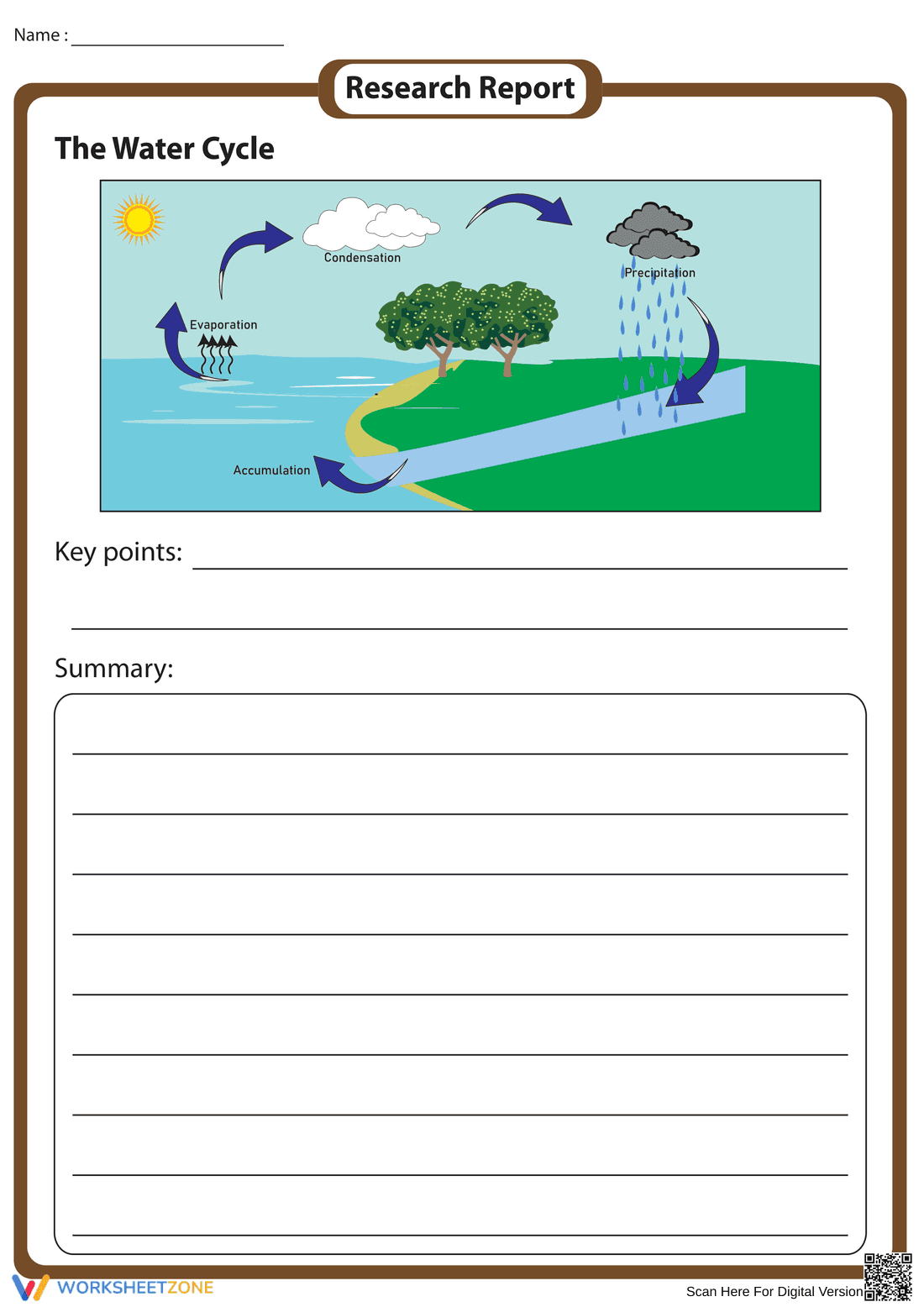
This single-page PDF features a high-quality visual diagram of the water cycle, explicitly labeling evaporation, condensation, precipitation, and accumulation. The document is divided into two distinct pedagogical phases: a bulleted "Key Points" section for fact extraction and a spacious "Summary" box for cohesive paragraph construction. A comprehensive answer key is included to facilitate quick grading or student self-correction.
This resource is designed for immediate classroom implementation with a total teacher preparation time of less than 2 minutes. First, print the required number of copies (1 minute). Second, distribute the worksheets during your science or ELA block with minimal instructions as the diagram and prompts are self-explanatory (30 seconds). Third, review student summaries using the provided key or as part of a peer-review session (30 seconds per student). Its self-contained nature makes it an ideal choice for emergency sub plans or quiet independent work.
The primary alignment for this resource is `CCSS.ELA-LITERACY.W.3.7`, which requires students to conduct short research projects that build knowledge about a specific topic. By requiring students to extract data from a visual model and reformat it into a written report, the worksheet also supports `CCSS.ELA-LITERACY.RI.3.7`, focusing on the interpretation of information from visual representations. Both standard codes can be copied directly into lesson plans, IEP goals, or district curriculum mapping tools.
This worksheet is best used as a summative assessment following a direct instruction lesson on earth's systems. For a formative approach, teachers should observe students during the "Key Points" phase to ensure they are correctly identifying the relationships between the states of water depicted in the diagram. Completion typically takes 30 minutes, making it a perfect fit for a standard literacy rotation or a dedicated science journal entry.
This resource is tailored for third and fourth-grade students developing their informational writing stamina. It is particularly effective for English Language Learners (ELLs) who benefit from the strong visual scaffolding provided by the annotated diagram. It pairs naturally with a short non-fiction passage about weather or an interactive anchor chart illustrating the movement of water through the atmosphere.
According to the RAND AIRS 2024 report on literacy outcomes, the integration of visual models with structured writing prompts significantly enhances a student's ability to retain complex scientific concepts like the hydrologic cycle. This worksheet targets the `CCSS.ELA-LITERACY.W.3.7` standard by bridging the gap between observation and synthesis. Students are tasked with the plain-English skill of gathering information from a provided model and organizing it into a coherent written summary. Research from Fisher & Frey (2014) suggests that this type of scaffolded informational writing is crucial for developing the academic vocabulary required for middle school success. By focusing on the four primary stages—evaporation, condensation, precipitation, and accumulation—students build a robust mental map of water's transition between liquid, vapor, and ice. This resource serves as a reliable tool for classroom teachers seeking to meet rigorous standards while maintaining a high level of student engagement through meaningful, visually-supported tasks.


