


























Views
Downloads
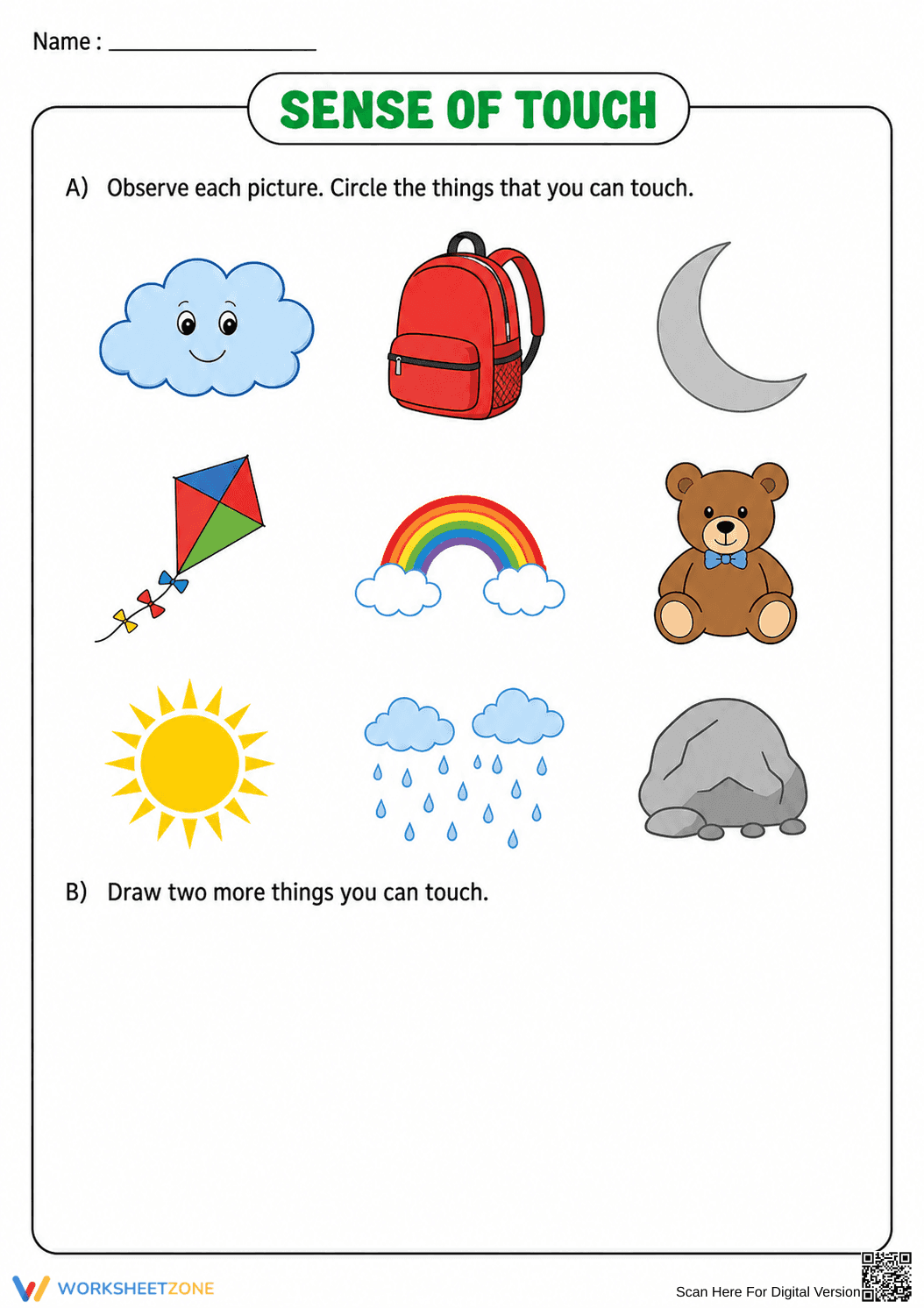

Grade 1-2 Sense of Touch — Printable No-Prep Worksheet
Paste this activity's link or code into your existing LMS (Google Classroom, Canvas, Teams, Schoology, Moodle, etc.).
Students can open and work on the activity right away, with no student login required.
You'll still be able to track student progress and results from your teacher account.
This essential sense of touch worksheet provides Grade 1 and Grade 2 students with a focused, interactive way to explore the five senses. By distinguishing between tangible and intangible objects through observation and creative drawing, learners develop a concrete understanding of how they interact with their environment.
At a Glance
- Grade: 1-2 · Subject: Science
- Standard:
1-LS1-1— Identify and categorize tangible objects using the sense of touch- Skill Focus: Distinguishing tangible vs. intangible objects
- Format: 1 page · 11 problems · Answer key included · PDF
- Best For: Five senses introduction and independent practice
- Time: 15–20 minutes
Inside this single-page PDF, teachers will find a clean, structured layout divided into two primary sections. The first section contains nine colorful illustrations, including everyday items like a backpack and natural phenomena like a rainbow. Students are prompted to observe and circle only the items they can physically touch. The second section provides an open space for students to draw two additional tangible objects from their own environment, reinforcing the concept through creative application.
This worksheet is engineered for a frictionless classroom experience with total teacher prep time under two minutes. First, print the single-page document (30 seconds). Second, distribute it to students as a bell-ringer or independent practice activity (30 seconds). Finally, review the answers collectively using the provided key (1 minute). Its clear instructions and self-contained format make it an ideal choice for emergency sub plans or quick transitions between science blocks.
The primary standard addressed is 1-LS1-1: "Use materials to design a solution to a human problem by mimicking how plants and/or animals use their external parts to help them survive, grow, and meet their needs." In this context, students focus on the skin and hands to understand how humans explore the world. Both standard codes can be copied directly into lesson plans, IEP goals, or district curriculum mapping tools.
Use this worksheet during the "Explain" or "Elaborate" phase of a 5E science lesson on the five senses. Before starting, have students participate in a "feely bag" activity to ground the concepts in physical experience. During the worksheet completion, circulate the room and observe if students can explain why they cannot touch a rainbow or the sun—this provides an immediate formative assessment. Expected completion time is 15 to 20 minutes.
This resource is designed for Grade 1 and Grade 2 classrooms, but it is highly effective for English Language Learners due to the heavy reliance on visual cues. For differentiation, provide a word bank of textures for students to label their drawings. This pairs naturally with a sensory reading passage or a classroom anchor chart displaying the five senses.
According to the RAND AIRS 2024 analysis of primary science education, early exposure to sensory categorization is foundational for developing advanced scientific observation skills. This sense of touch worksheet aligns with best practices in multi-sensory learning by requiring students to bridge the gap between visual representation and tactile memory. By identifying and drawing tangible objects, students fulfill the requirements of standard 1-LS1-1, which emphasizes the role of external parts in exploring the environment. The structured task count of 11 problems ensures sufficient repetitions for skill mastery without causing cognitive overload in young learners. Implementing this zero-prep resource allows educators to provide rigorous, standards-aligned instruction while maintaining a manageable classroom workflow. Early mastery of these foundational biology concepts prepares students for more complex investigations into human anatomy and environmental interactions in later grades.


