


























Views
Downloads
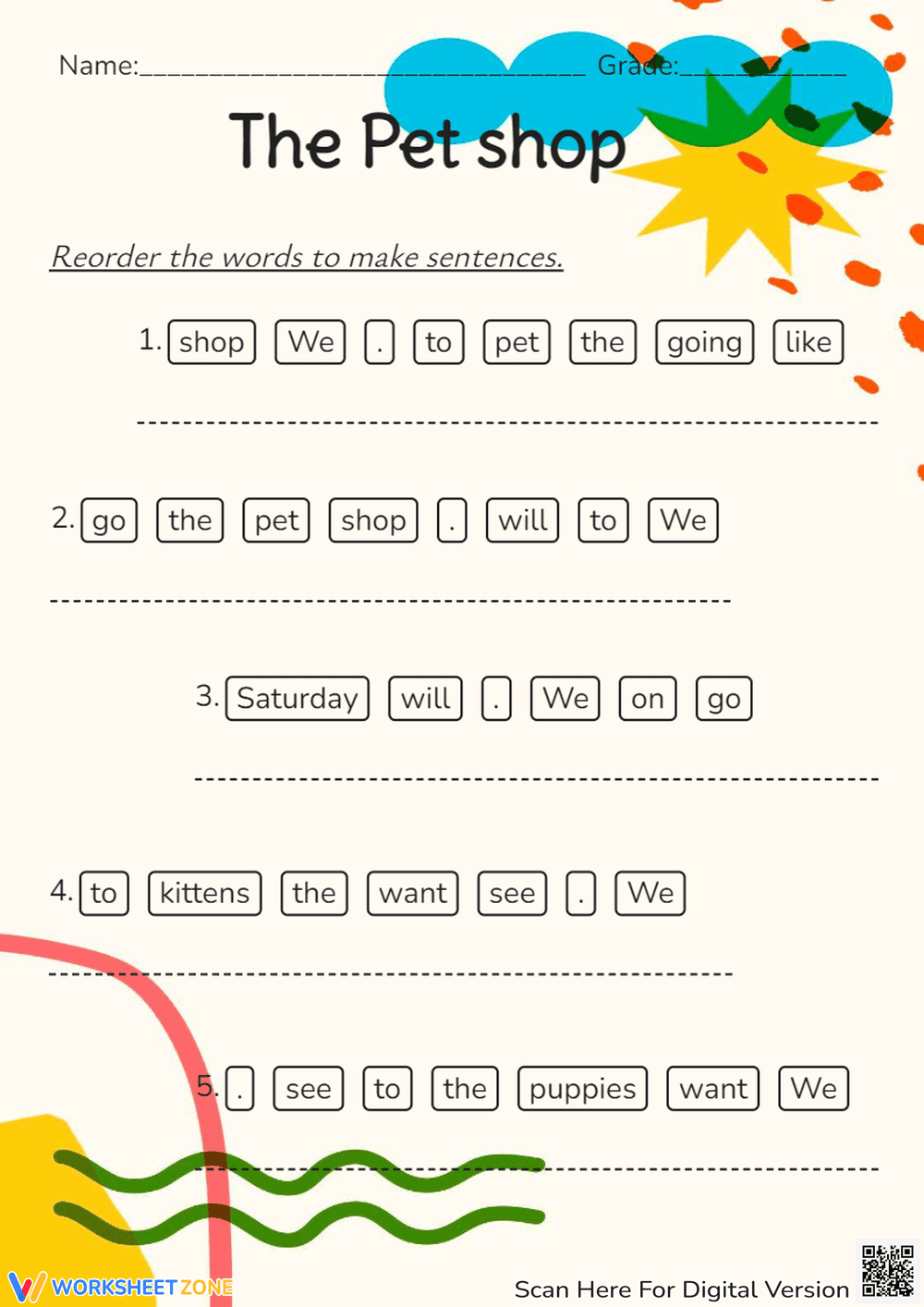

The Pet Shop Sentence Scramble | Essential Grade 1-3 ELA
Paste this activity's link or code into your existing LMS (Google Classroom, Canvas, Teams, Schoology, Moodle, etc.).
Students can open and work on the activity right away, with no student login required.
You'll still be able to track student progress and results from your teacher account.
This Grade 1-3 sentence scramble worksheet helps students master syntax by reordering jumbled words into coherent declarative sentences. By focusing on the "Pet Shop" theme, learners engage with familiar vocabulary while practicing essential grammar rules, including capitalization and terminal punctuation. It provides immediate practice in logical word sequencing and structural awareness.
At a Glance
- Grade: 1-3 · Subject: ELA
- Standard:
CCSS.ELA-LITERACY.L.1.1.J— Produce and expand complete simple and compound sentences in response to prompts- Skill Focus: Sentence structure and syntax
- Format: 1 page · 5 problems · Answer key included · PDF
- Best For: Independent literacy centers or morning work
- Time: 10–15 minutes
This single-page PDF features 5 distinct sentence-building tasks. Each problem presents a set of boxed words and punctuation marks that students must rearrange. The worksheet includes dedicated primary handwriting lines for each response, encouraging neat penmanship alongside grammatical accuracy. A full answer key is provided to facilitate quick grading or student self-correction.
Zero-Prep Workflow
- Print: Select the single-page PDF and print enough copies for your cohort in under 30 seconds.
- Distribute: Hand out the sheets as a warm-up or transition activity during your literacy block.
- Review: Use the included answer key to conduct a whole-class check or peer-review session in about 5 minutes.
This resource is an ideal "grab-and-go" option for substitute folders or unexpected schedule changes, requiring zero teacher setup.
Standards Alignment
The primary focus is `CCSS.ELA-LITERACY.L.1.1.J`, which requires students to produce and expand complete simple and compound sentences. By requiring the inclusion of the period and the capitalized subject, the worksheet also supports L.1.2 standards regarding mechanics. Both standard codes can be copied directly into lesson plans, IEP goals, or district curriculum mapping tools.
How to Use It
Assign this worksheet during the "You Do" phase of a gradual release lesson on sentence parts. It serves as an excellent formative assessment tool; observe if students correctly place the period at the end of the line or if they struggle with the placement of the verb. Expected completion time is 10 to 15 minutes depending on the student's reading level.
Who It's For
This resource is designed for first through third-grade students, but it is particularly effective for English Language Learners (ELLs) who need visual support to understand English word order (SVO). It pairs naturally with a "Pet Shop" themed reading passage or a direct instruction lesson on nouns and verbs.
Research by Fisher & Frey (2014) emphasizes the importance of scaffolded sentence construction in developing literacy, noting that manipulating word order helps students internalize the architecture of language. This worksheet addresses the CCSS.ELA-LITERACY.L.1.1.J standard by providing a controlled environment for students to practice producing complete sentences. By isolating the syntax task from the generation of ideas, students can focus entirely on the logical flow of the English language. According to the RAND AIRS 2024 report, targeted practice with sentence-level mechanics is a significant predictor of later writing fluency. This 5-task resource provides the high-frequency repetition necessary for mastery without overwhelming the learner. Educators can use this tool to bridge the gap between word recognition and paragraph composition, ensuring a solid foundation in grammatical conventions.


