


























Views
Downloads

Printable Insect Life Cycle Worksheet | Grade 3 Science
Paste this activity's link or code into your existing LMS (Google Classroom, Canvas, Teams, Schoology, Moodle, etc.).
Students can open and work on the activity right away, with no student login required.
You'll still be able to track student progress and results from your teacher account.
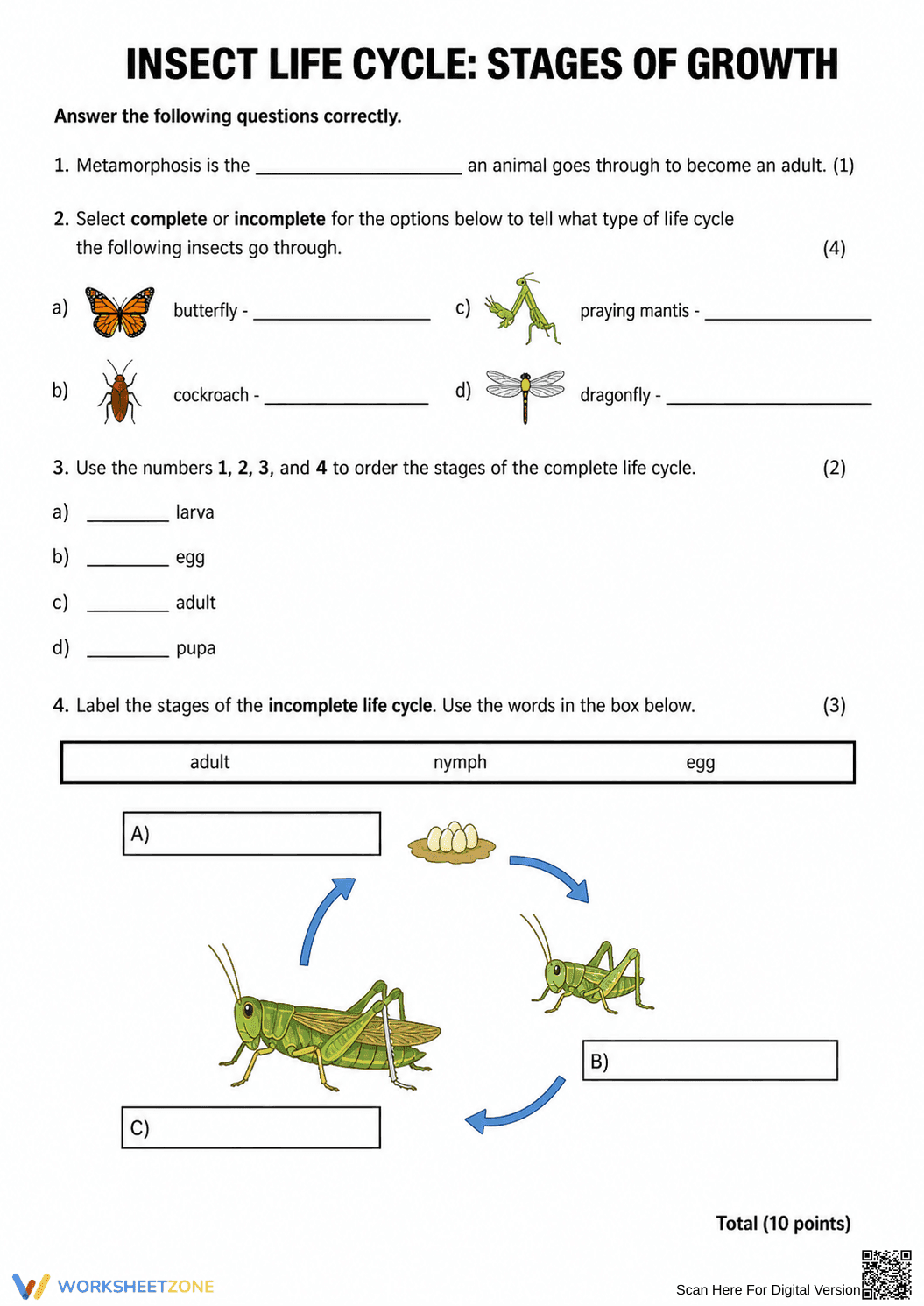
This Grade 3 science worksheet helps students master the stages of complete and incomplete metamorphosis. By identifying, sequencing, and labeling insect growth phases, learners build essential life science vocabulary and conceptual understanding. The clear layout ensures students can independently demonstrate their knowledge of biological life cycles.
At a Glance
- Grade: 3 · Subject: Science
- Standard:
3-LS1-1— Describe that organisms have unique and diverse life cycles.- Skill Focus: Complete and incomplete metamorphosis
- Format: 1 page · 10 problems · Answer key included · PDF
- Best For: Independent practice and review
- Time: 15–20 minutes
This single-page resource features four distinct task types to assess student comprehension. It includes a fill-in-the-blank definition, a categorization exercise for different insect types, a numerical sequencing activity for complete metamorphosis, and a diagram-labeling task for incomplete metamorphosis using a provided word bank. A complete answer key is provided for quick grading.
This resource is designed for immediate classroom implementation with a zero-prep workflow.
- Print (1 minute): Generate enough copies for your roster directly from the PDF.
- Distribute (1 minute): Hand out the single-page assignment as a standalone activity.
- Review (3 minutes): Use the included answer key to quickly check student responses or guide whole-class correction.
Total teacher preparation requires under two minutes, making this an excellent option for emergency sub plans or spontaneous review sessions.
This activity is directly aligned to 3-LS1-1: Develop models to describe that organisms have unique and diverse life cycles but all have in common birth, growth, reproduction, and death. It also supports CCSS.ELA-LITERACY.RI.3.7 by requiring students to use information gained from illustrations. Both standard codes can be copied directly into lesson plans, IEP goals, or district curriculum mapping tools.
Deploy this worksheet as an independent practice activity immediately following direct instruction on insect metamorphosis. Alternatively, use it as a formative assessment at the end of a life science unit to verify retention. While students work, observe their ability to correctly sequence the complete life cycle; confusion between larva and pupa stages often indicates a need for brief reteaching. Expected completion time ranges from 15 to 20 minutes.
This resource is primarily designed for third-grade general education students studying life science. The inclusion of a word bank and clear visual diagrams provides built-in scaffolding, making it highly accessible for English Language Learners and students requiring visual supports. It pairs perfectly with a hands-on butterfly observation kit or an introductory lesson on animal life cycles.
Understanding biological development through structured visual aids significantly improves elementary science literacy. According to a recent ScienceDirect TpT Analysis, integrating diagram-based labeling tasks with sequential ordering exercises enhances long-term retention of complex biological processes. When students interact with materials aligned to 3-LS1-1, they actively describe that organisms have unique and diverse life cycles, moving beyond rote memorization to conceptual application. Differentiating between complete and incomplete metamorphosis requires students to analyze specific morphological changes, a critical cognitive skill in early STEM education. By combining vocabulary reinforcement with visual modeling, educators provide a comprehensive framework for scientific inquiry. This targeted practice ensures learners can accurately categorize natural phenomena while building the foundational knowledge necessary for advanced biological studies in later grades. Structured worksheets that require both textual and visual processing are essential tools for solidifying these core scientific concepts.


