




























Views
Downloads
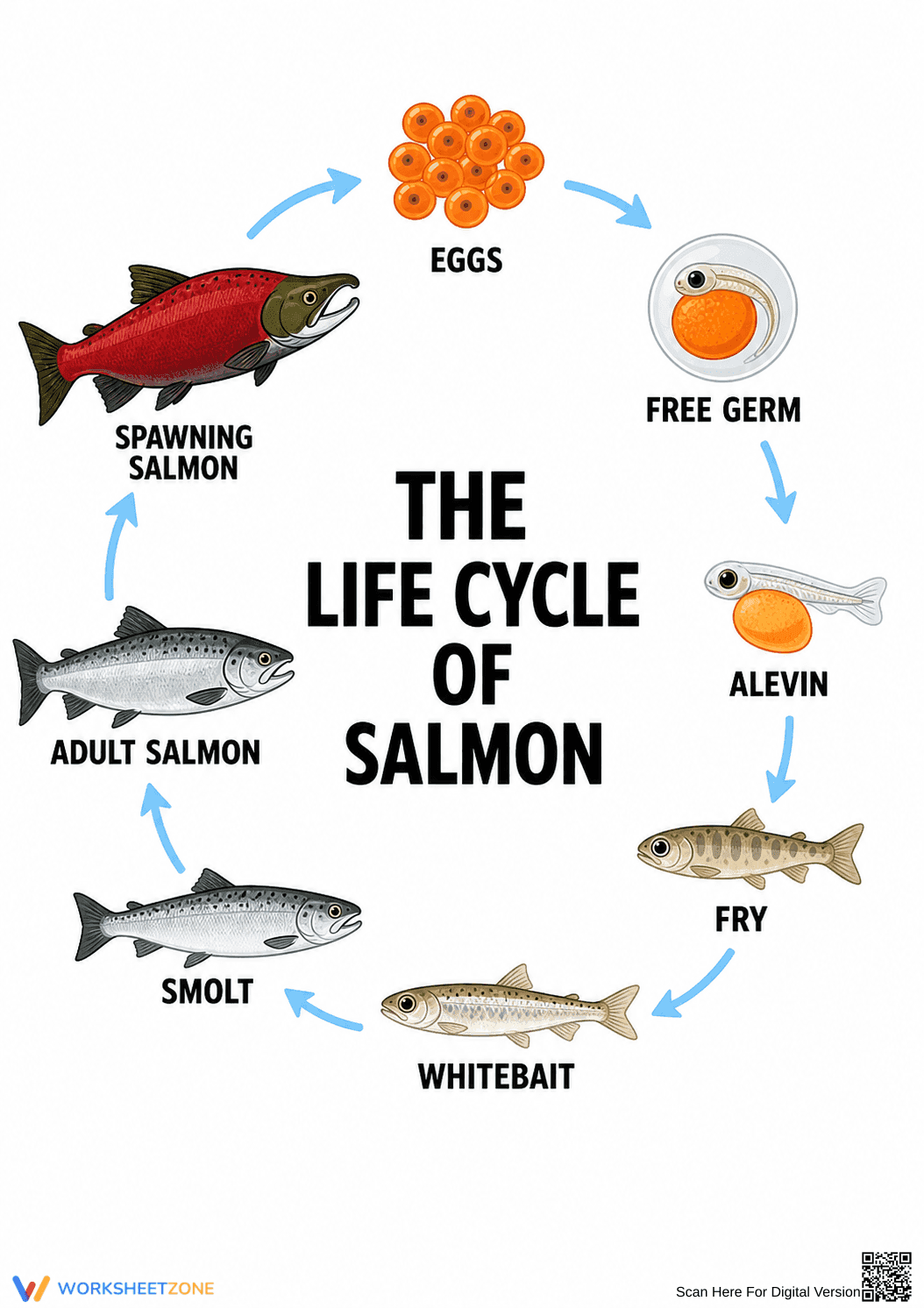

Salmon Life Cycle Diagram | Grade 3 Science Printable

Paste this activity's link or code into your existing LMS (Google Classroom, Canvas, Teams, Schoology, Moodle, etc.).
Students can open and work on the activity right away, with no student login required.
You'll still be able to track student progress and results from your teacher account.
This visual guide introduces students to the fascinating biological journey of a salmon. By examining this clear, circular diagram, learners will easily grasp the continuous nature of animal development. It provides a strong foundation for understanding how organisms grow, reproduce, and survive in their natural aquatic habitats.
At a Glance
- Grade: 3 · Subject: Science
- Standard:
3-LS1-1— Describe unique and diverse animal life cycles.- Skill Focus: Analyzing animal life cycles
- Format: 1 page · 1 visual diagram · PDF
- Best For: Visual reference and science centers
- Time: 10–15 minutes
This single-page resource features a high-quality diagram detailing the eight distinct stages of salmon development. Students follow directional arrows from eggs to free germ, alevin, fry, whitebait, smolt, adult, and spawning salmon. The clear typography and accurate illustrations make complex ecological concepts accessible for elementary learners without requiring extra reading.
This diagram is designed for immediate classroom implementation with zero teacher preparation required.
- Print (1 minute): Simply print the PDF in color or project it directly onto your smartboard for whole-class viewing.
- Distribute (1 minute): Hand out individual copies for students to keep in their science journals or interactive notebooks.
- Review (5 minutes): Walk through the circular path together, pronouncing the scientific terms for each developmental stage.
With under two minutes of total prep time, this resource is an excellent addition to any emergency sub plan or spontaneous science inquiry lesson.
This visual resource aligns to the Next Generation Science Standards, specifically 3-LS1-1: Develop models to describe that organisms have unique and diverse life cycles but all have in common birth, growth, reproduction, and death. Both standard codes can be copied directly into lesson plans, IEP goals, or district curriculum mapping tools.
Introduce this diagram at the beginning of a life science unit to establish foundational vocabulary before reading informational texts about fish or aquatic ecosystems. Alternatively, use it during direct instruction as an anchor chart that remains visible throughout the week. As a formative assessment observation tip, ask students to cover the labels with sticky notes and verbally explain what is happening in each picture to a partner. Expect students to spend about 10 to 15 minutes initially analyzing the chart and discussing the transitions between stages.
This resource is ideal for third-grade general education students, but its highly visual nature makes it exceptionally supportive for English Language Learners and students requiring visual accommodations. The straightforward layout removes reading barriers, allowing all learners to access grade-level science content. It pairs perfectly with a hands-on water cycle lesson or a read-aloud book about river habitats.
Effectively teaching 3-LS1-1 requires resources that help students describe unique and diverse animal life cycles through clear models. According to a ScienceDirect TpT Analysis, visual aids significantly improve retention of biological processes in elementary classrooms by reducing cognitive load. When students trace physical changes along a continuous path, they develop stronger conceptual understanding of growth and reproduction. This salmon diagram serves as a critical scaffold, ensuring learners can accurately sequence developmental stages before moving to comparative biology tasks. Integrating visual models into science instruction fosters deeper ecological awareness and prepares students for advanced topics.


