


























Views
Downloads

Essential -eep Family Worksheet | Grade 1-2 ELA
Paste this activity's link or code into your existing LMS (Google Classroom, Canvas, Teams, Schoology, Moodle, etc.).
Students can open and work on the activity right away, with no student login required.
You'll still be able to track student progress and results from your teacher account.
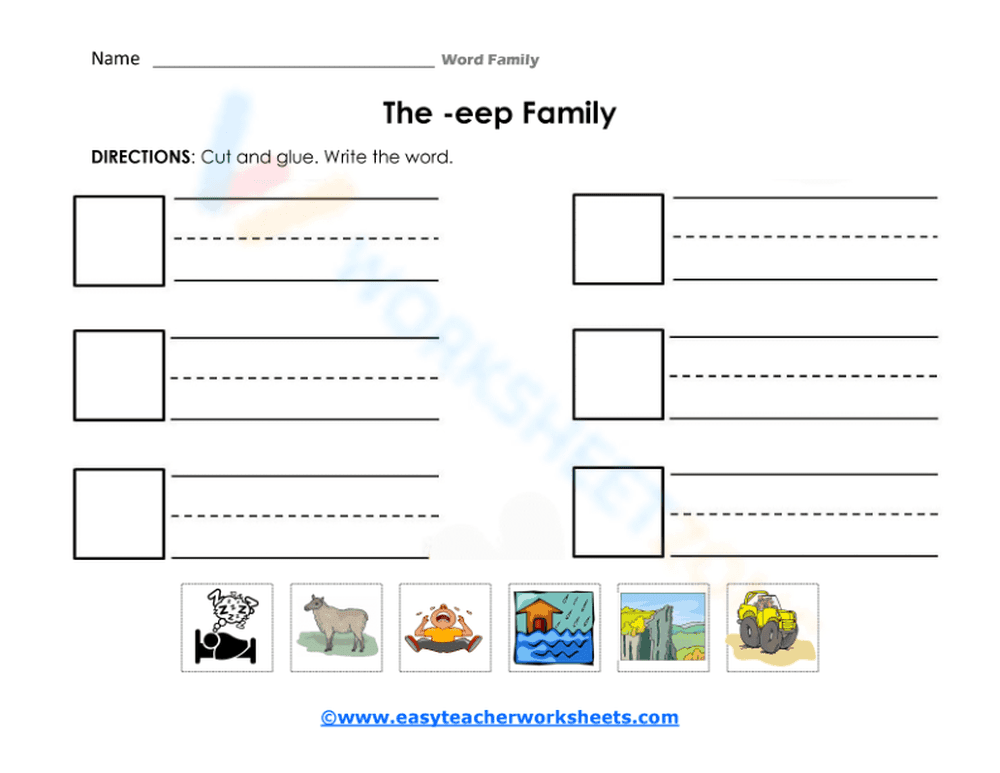
The -eep Family worksheet provides a hands-on phonics activity designed to help early readers master the common long-e vowel team. Students engage in multisensory learning by cutting, sorting, and gluing images before practicing their handwriting by writing the corresponding words. This focused practice builds decoding fluency and phonemic awareness in primary students.
At a Glance
- Grade: 1-2 · Subject: English Language Arts
- Standard:
CCSS.ELA-LITERACY.RF.1.3— Know and apply grade-level phonics and word analysis skills in decoding words- Skill Focus: -eep Word Family Phonics
- Format: 1 page · 6 problems · Answer key included · PDF
- Best For: Literacy centers and phonics reinforcement
- Time: 10–15 minutes
What's Inside
This one-page PDF resource features a structured layout with six dedicated spaces for cut-and-glue activities. At the bottom of the page, students find six high-quality illustrations representing common -eep words like sleep, sheep, weep, and jeep. The worksheet includes primary-ruled lines to support correct letter formation and a comprehensive answer key for quick teacher or parent verification.
Zero-Prep Workflow
The Zero-Prep Workflow for this resource is designed for maximum efficiency in busy classrooms. Teachers can simply print the single-page PDF (30 seconds), distribute the sheets along with scissors and glue sticks (1 minute), and allow students to work independently. Reviewing the completed work takes under 30 seconds per student using the included key. It is an ideal option for morning work or sub plans.
Standards Alignment
This worksheet is primarily aligned to CCSS.ELA-LITERACY.RF.1.3, which requires students to know and apply grade-level phonics and word analysis skills. Specifically, it targets the understanding of vowel teams like "-ee-" to represent long vowel sounds. This standard ensures students develop the foundational skills necessary for fluent reading. Both standard codes can be copied directly into lesson plans, IEP goals, or district curriculum mapping tools.
How to Use It
Use this worksheet as a formative assessment during your phonics block after introducing long-e vowel teams. As students work, observe their ability to correctly match the phonetic sound to the illustration; this provides immediate insight into their decoding progress. It also functions perfectly as an independent station in a literacy center. The expected completion time is 15 minutes, making it a concise reinforcement tool for daily instruction.
Who It's For
This resource is tailored for Grade 1 and Grade 2 students who are developing their phonics skills and fine motor coordination. It is particularly beneficial for kinesthetic learners who thrive on tactile activities. The worksheet pairs naturally with phonics anchor charts or short reading passages featuring the -eep family, providing the necessary repetition for long-term retention of these critical spelling patterns.
The effectiveness of the -eep Family worksheet is supported by research into the science of reading and the importance of phonemic awareness. According to the RAND AIRS 2024 report, multisensory approaches that combine visual, auditory, and kinesthetic-tactile tasks—such as the cut, glue, and write method used here—significantly improve retention rates for early literacy learners. By focusing on the CCSS.ELA-LITERACY.RF.1.3 standard, this resource helps students bridge the gap between recognizing individual sounds and decoding complex vowel teams. Fisher & Frey (2014) emphasize that structured practice with word families allows students to recognize patterns in language, which accelerates reading fluency and spelling accuracy. This worksheet provides that targeted practice, ensuring students can accurately identify and produce words within the -eep family. It serves as a high-utility tool for educators seeking to align their classroom activities with evidence-based instructional strategies while meeting rigorous state and national standards for primary education.


