


























Views
Downloads
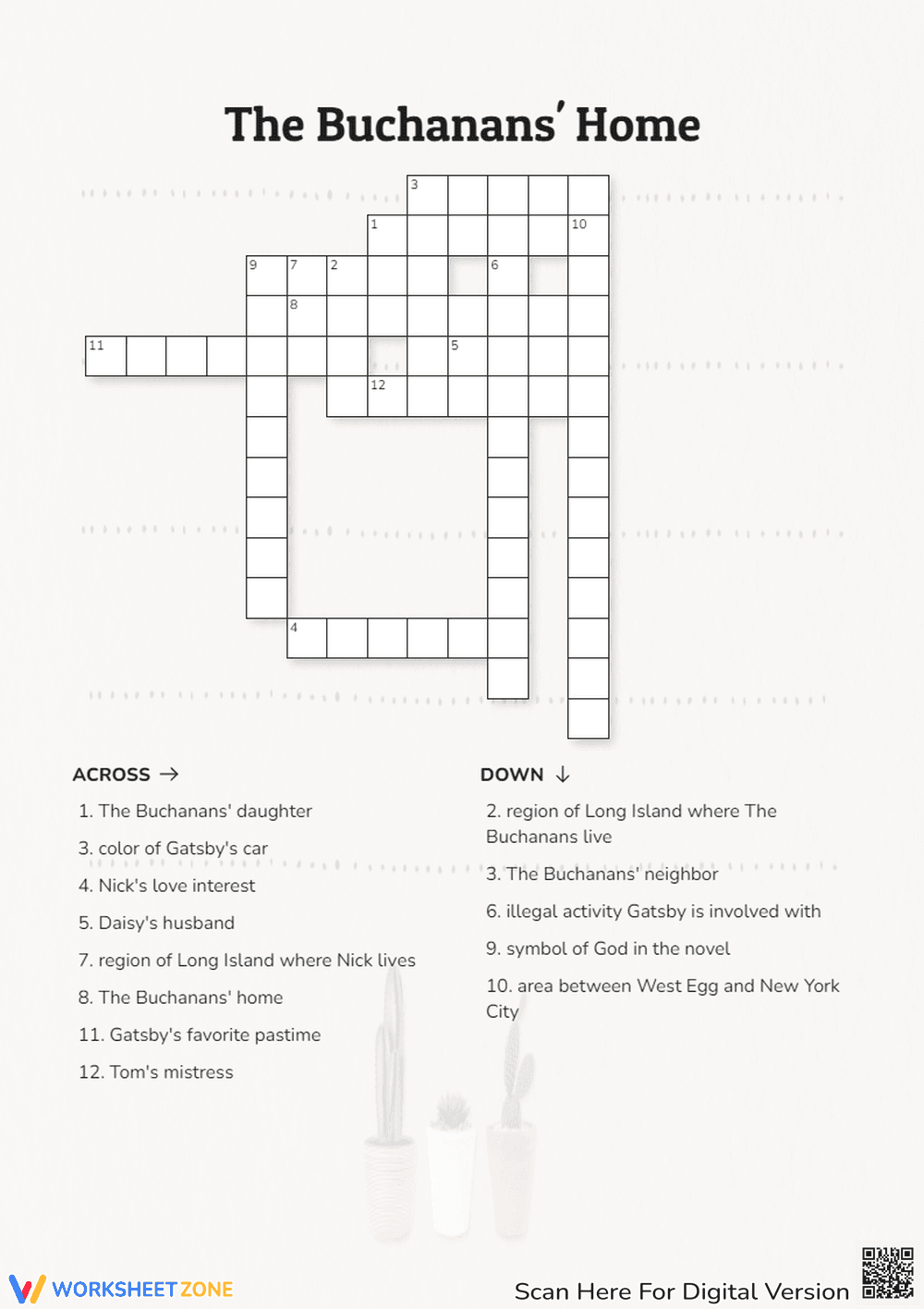

The Buchanans' Home Crossword | Essential Grade 4 ELA
Paste this activity's link or code into your existing LMS (Google Classroom, Canvas, Teams, Schoology, Moodle, etc.).
Students can open and work on the activity right away, with no student login required.
You'll still be able to track student progress and results from your teacher account.
This Grade 4 ELA worksheet provides a focused review of key literary elements from the classic narrative. Students use 13 specific clues to identify characters, settings, and plot points related to the Buchanans' residence. This activity reinforces reading comprehension by requiring students to recall specific details and evidence from the text to complete the puzzle.
At a Glance
At a Glance
- Grade: 4 · Subject: ELA
- Standard:
CCSS.ELA-LITERACY.RL.4.1— Refer to details and examples in a text when explaining what the text says- Skill Focus: Character and Setting Recall
- Format: 1 page · 13 problems · Answer key included · PDF
- Best For: Post-reading review or sub plans
- Time: 15–20 minutes
What's Inside
Inside this resource, you will find a single-page crossword grid accompanied by 13 descriptive clues. Eight clues are oriented horizontally (Across) and five are oriented vertically (Down). The tasks cover essential story elements including character names like Daisy and Tom, specific locations on Long Island, and symbolic details. A full answer key is provided to facilitate quick grading or student self-correction.
Zero-Prep Workflow
This zero-prep workflow is designed for maximum efficiency in the classroom. First, print the single-page PDF (30 seconds). Next, distribute the copies to students as they enter the room or transition to independent work (1 minute). Finally, review the completed puzzles as a whole group to clarify any misconceptions about the text (5 minutes). This resource is an ideal choice for emergency sub plans or unexpected schedule changes.
Standards Alignment
This worksheet aligns with CCSS.ELA-LITERACY.RL.4.1. Students must refer to details and examples in the text to identify the correct terms for the crossword. By connecting clues to specific narrative evidence, learners demonstrate their ability to explain what the text says explicitly. Both standard codes can be copied directly into lesson plans, IEP goals, or district curriculum mapping tools.
How to Use It
Use this worksheet as a formative assessment after completing a chapter or section of the novel. It works well during the independent practice phase of a lesson. While students work, observe which clues cause the most hesitation; this provides a clear signal of which plot points or character relationships require further direct instruction. Expect students to finish within 20 minutes.
Who It's For
This resource is designed for Grade 4 students engaging with complex literature. It is particularly effective for visual learners who benefit from the spatial organization of a crossword. Pair this activity with a character anchor chart or a short passage analysis to provide additional support for struggling readers who may need help identifying specific names or locations from the story.
According to Fisher & Frey (2014), the use of word-play and puzzles like crosswords can significantly improve student engagement with complex texts by providing a low-stakes environment for retrieval practice. This worksheet targets the CCSS.ELA-LITERACY.RL.4.1 standard by requiring students to recall specific details about characters and settings, such as the Buchanans' daughter or the geography of Long Island. Research indicates that structured recall activities help solidify the mental models students build while reading, leading to better long-term retention of narrative structures. By focusing on 13 key terms, this resource ensures that learners are processing the most critical elements of the text rather than getting lost in minor details. This approach is supported by the NAEP framework, which emphasizes the importance of identifying explicit information as a foundational step toward higher-order literary analysis and thematic interpretation in elementary ELA.


