


























Views
Downloads

Essential 5 W's Question Words Worksheet | Grade 1-2
Paste this activity's link or code into your existing LMS (Google Classroom, Canvas, Teams, Schoology, Moodle, etc.).
Students can open and work on the activity right away, with no student login required.
You'll still be able to track student progress and results from your teacher account.
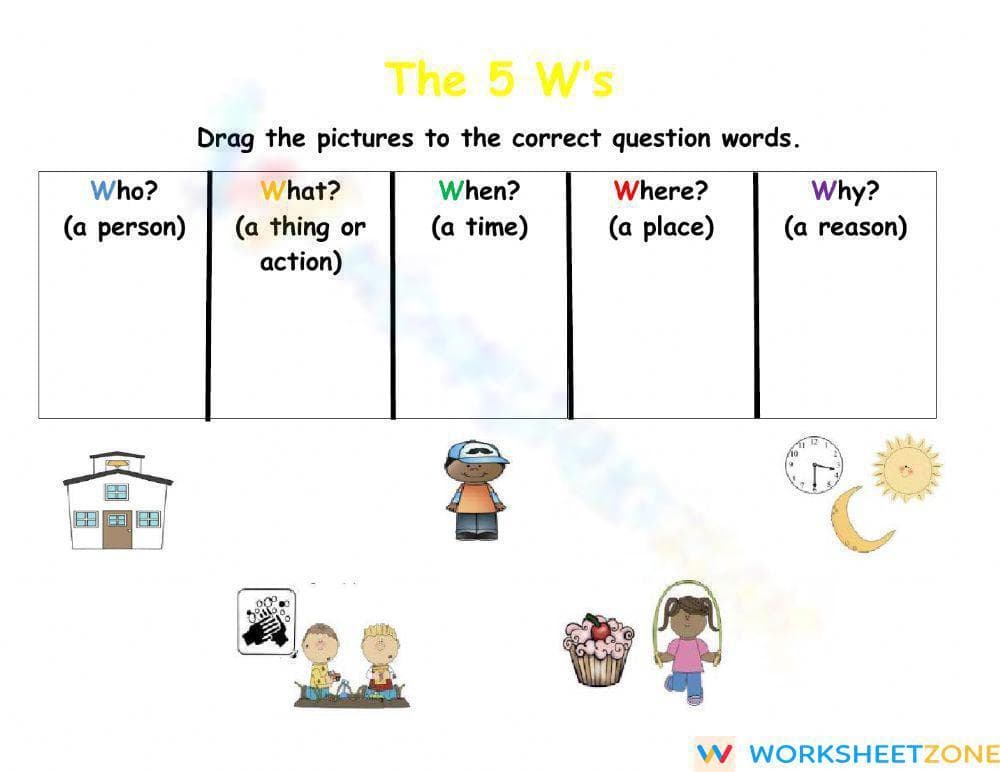
This worksheet helps Grade 1 and 2 students master the fundamental "5 W" question words through a visually engaging categorization activity. By connecting pictures to interrogative prompts, learners build a strong foundation for both reading comprehension and sentence structure. It is an effective tool for helping young students identify key details and understand how questions work.
At a Glance
- Grade: 1–2 · Subject: ELA
- Standard:
CCSS.ELA-LITERACY.L.1.1.D— Use interrogative words such as who, what, where, when, and why- Skill Focus: Question Word Categorization
- Format: 1 page · 7 problems · Answer key included · PDF
- Best For: Independent center work or morning warm-ups
- Time: 10–15 minutes
This single-page PDF includes a clear chart divided into five categories: Who, What, When, Where, and Why. Students are provided with seven colorful illustrations representing various people, actions, times, and locations. The layout is clean and spacious, allowing students to easily match the visual cues to the correct interrogative word. A full answer key is included to facilitate quick checking.
Using this worksheet is effortless. Step 1: Print the page in under 30 seconds. Step 2: Distribute to students for a quick morning warm-up or independent center activity that requires no further explanation. Step 3: Review the answers as a whole group to reinforce the concepts in just 2 minutes. Total teacher preparation time is under two minutes, making it an ideal choice for emergency sub plans or busy classroom days.
This resource is primarily aligned to CCSS.ELA-LITERACY.L.1.1.D, which requires students to use interrogative words including who, what, where, when, why, and how. By practicing matching these words to their definitions (such as "a person" or "a place"), students develop the linguistic awareness needed for higher-level inquiries in later grades. This standard code can be copied directly into lesson plans, IEP goals, or district curriculum mapping tools.
Use this worksheet as a formative assessment after introducing the 5 W's during direct instruction. Observe if students struggle to differentiate between "What" (a thing) and "What" (an action), as both are included in the bank. It also works well as a post-reading activity where students categorize details from a simple story they just finished. Expected completion time for most students is roughly 15 minutes.
This worksheet is designed for Grade 1 and 2 students, including English Language Learners who benefit from visual scaffolding. The picture-to-word matching provides necessary support for emerging readers who are still building their vocabulary. Pair this resource with a simple informational text or an anchor chart that displays the 5 W's to provide students with a comprehensive and supported learning experience.
Research from Fisher & Frey (2014) emphasizes the importance of scaffolding for young learners, particularly when developing interrogative skills that form the basis of reading comprehension. This Grade 1 and 2 ELA resource directly supports CCSS.ELA-LITERACY.L.1.1.D by providing a structured environment for students to practice using question words such as who, what, where, when, and why. By categorizing seven distinct visual prompts, students engage in foundational linguistic analysis that transitions from simple identification to active inquiry. Such targeted practice is a staple of effective early literacy instruction, as noted in the RAND AIRS 2024 report on curriculum alignment. This worksheet serves as a reliable instrument for teachers to gauge student mastery of basic sentence mechanics and detail extraction. The inclusion of an answer key and zero-prep format ensures that this essential skill practice is accessible for various classroom settings, including Tier 1 instruction and small-group interventions.


