


























Views
Downloads
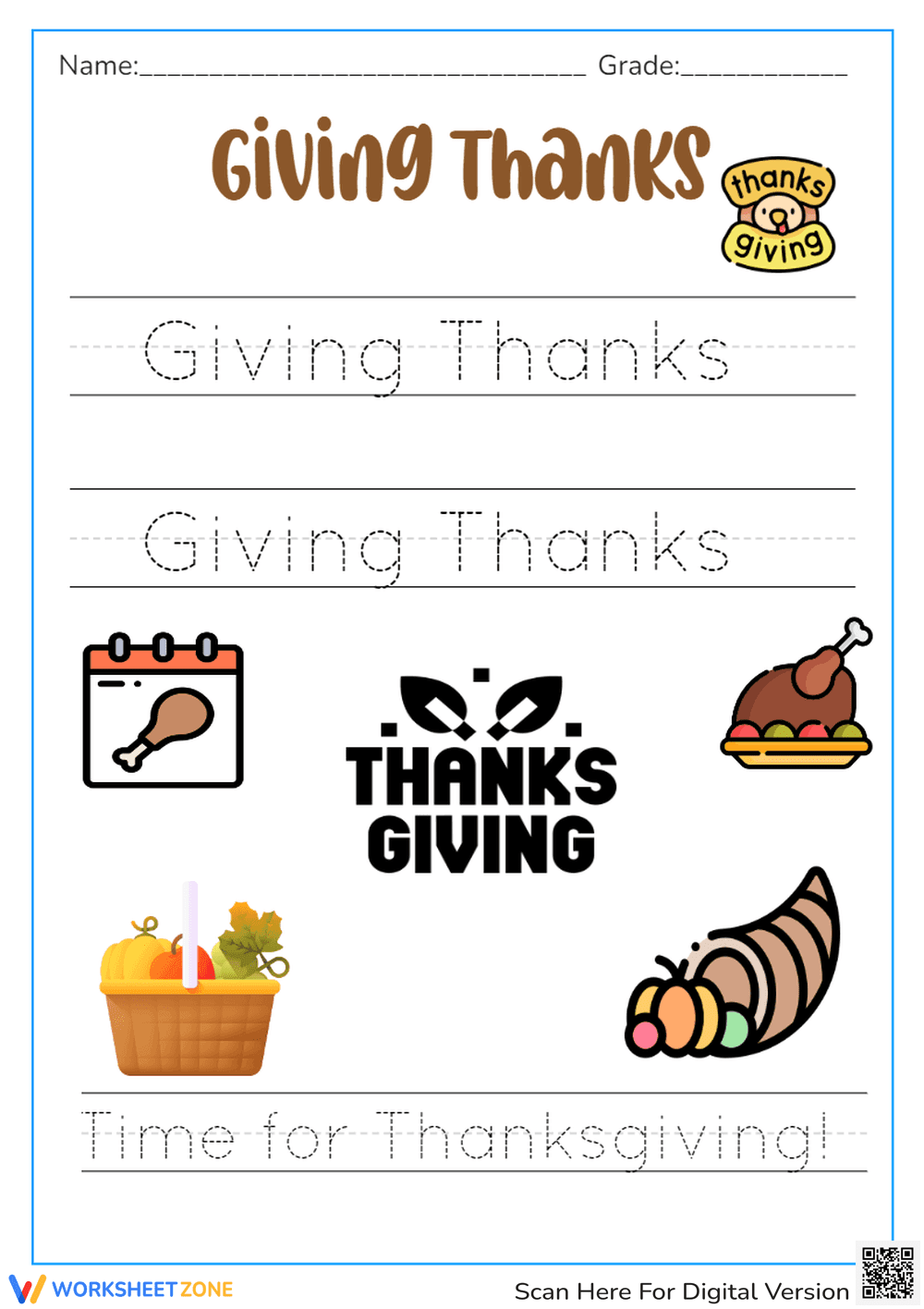

Grade K-1 Thanksgiving Writing — Printable No-Prep Worksheet
Paste this activity's link or code into your existing LMS (Google Classroom, Canvas, Teams, Schoology, Moodle, etc.).
Students can open and work on the activity right away, with no student login required.
You'll still be able to track student progress and results from your teacher account.
This Thanksgiving writing practice worksheet helps early learners master letter formation through holiday-themed tracing. Students develop the muscle memory needed for fluent handwriting while engaging with seasonal vocabulary. By focusing on specific phrases like "Giving Thanks," children connect literacy skills with cultural celebrations, ensuring a meaningful and productive classroom experience during the holiday season.
At a Glance
- Grade: Kindergarten · Subject: Handwriting
- Standard:
CCSS.ELA-LITERACY.L.K.1.A— Print many upper- and lowercase letters with proper form- Skill Focus: Letter formation and fine motor control
- Format: 1 page · 3 tracing tasks · No answer key needed · PDF
- Best For: Morning work or holiday centers
- Time: 10–15 minutes
What's Inside: This single-page PDF features three distinct tracing lines on primary-ruled paper. The first two lines focus on the phrase "Giving Thanks," while the final line introduces a longer sentence: "Time for Thanksgiving!" The worksheet includes festive illustrations of a turkey, cornucopia, and harvest basket to maintain student engagement and provide visual context for the writing prompts.
Zero-Prep Workflow: This resource is designed for immediate use. Print the single-page PDF (30 seconds). Distribute the sheets to students (1 minute). Review student letter formation as they work, providing immediate verbal feedback (ongoing). Total teacher preparation time is under 2 minutes, making it an ideal sub plan or transition activity.
Standards Alignment: The primary standard addressed is `CCSS.ELA-LITERACY.L.K.1.A`, which requires students to print many upper- and lowercase letters. This worksheet supports this by providing dashed-line models for both cases. Additionally, it supports `CCSS.ELA-LITERACY.RF.K.1.B` by reinforcing that spoken words are represented in written language by specific sequences of letters. Both standard codes can be copied directly into lesson plans, IEP goals, or district curriculum mapping tools.
How to Use It: Use this worksheet as a warm-up during the week before Thanksgiving break. It serves as a formative assessment tool; observe if students start letters from the top. Alternatively, place it in a writing center inside a dry-erase pocket for repeated practice. Expected completion time is 10 to 15 minutes.
Who It's For: This resource is tailored for Kindergarten and Grade 1 students who are developing foundational writing skills. It is particularly helpful for students requiring fine motor intervention or English Language Learners (ELLs) building holiday-specific vocabulary. Pair this worksheet with a read-aloud about gratitude or a Thanksgiving-themed anchor chart to provide a comprehensive literacy experience.
Research from Fisher & Frey (2014) emphasizes the importance of guided practice in the gradual release of responsibility model, particularly for foundational skills like handwriting. This worksheet provides the necessary "I Do" and "We Do" scaffolding through clear, dashed-line models that guide the student's hand. According to the NAEP, early mastery of letter formation is a significant predictor of later writing fluency and academic success, as it reduces the cognitive load required for transcription. By integrating seasonal themes, this resource leverages student interest to increase time-on-task. The alignment with CCSS.ELA-LITERACY.L.K.1.A ensures that students are meeting national benchmarks for letter production. This 1-page document offers a high-utility, low-stakes environment for students to refine their grip and stroke precision. Educators can confidently integrate this tool into their curriculum as a research-backed method for improving fine motor control and literacy readiness in early childhood settings.


