


























Views
Downloads

Thanksgiving Turkey Craft | Essential K-2 Printable
Paste this activity's link or code into your existing LMS (Google Classroom, Canvas, Teams, Schoology, Moodle, etc.).
Students can open and work on the activity right away, with no student login required.
You'll still be able to track student progress and results from your teacher account.
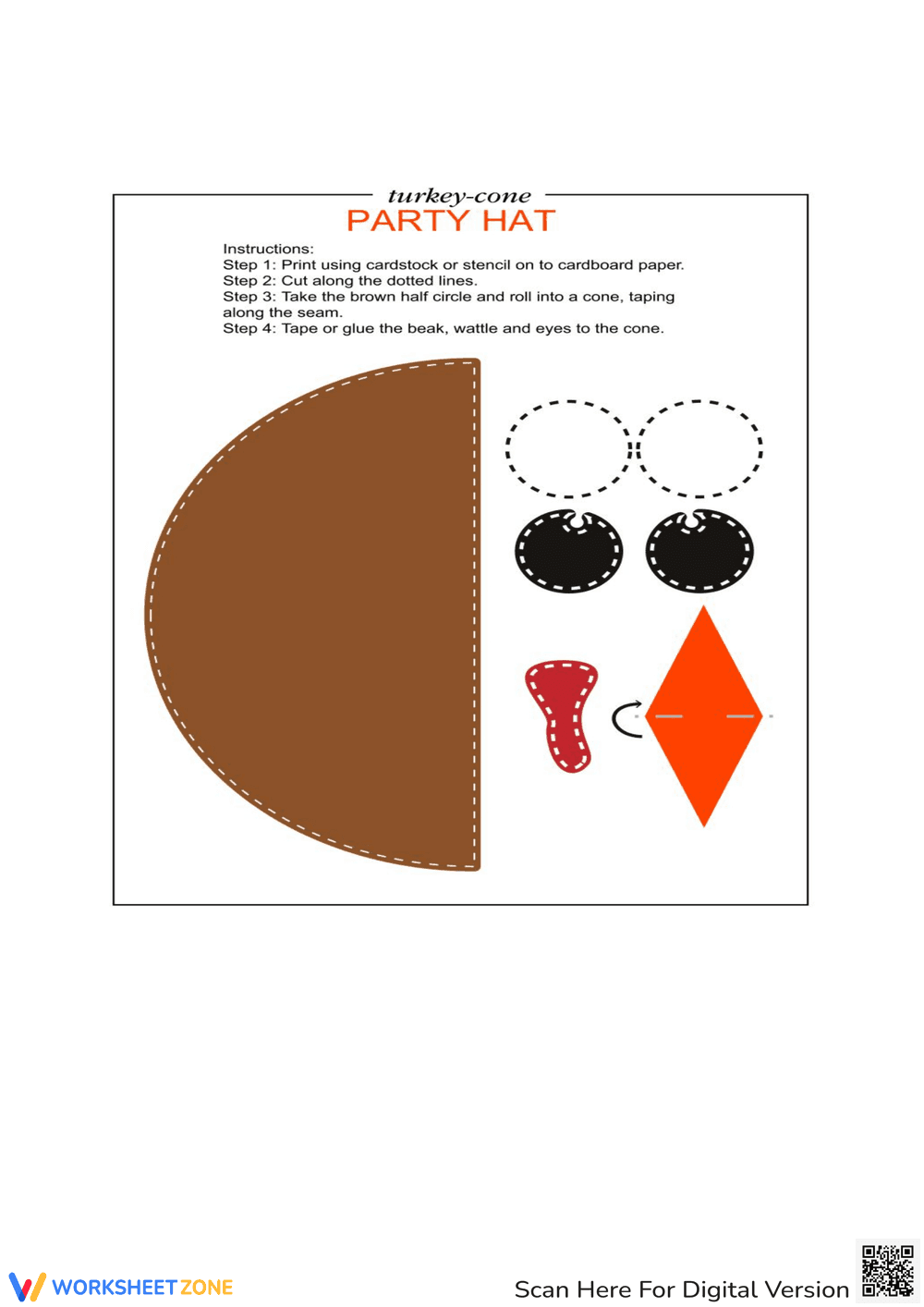
This Thanksgiving turkey craft provides students with a hands-on opportunity to practice fine motor skills and procedural following. By transforming a simple printable into a 3D party hat, learners engage with geometric shapes and sequential instructions. It is an ideal holiday activity that combines creative expression with foundational classroom readiness skills.
At a Glance
- Grade: K-2 · Subject: Arts & Crafts
- Standard:
CCSS.ELA-LITERACY.RI.1.10— Read and comprehend informational texts, including multi-step technical procedures.- Skill Focus: Fine motor cutting and following directions
- Format: 1 page · 4 steps · No answer key needed · PDF
- Best For: Thanksgiving classroom parties or holiday centers
- Time: 15–20 minutes
Inside this resource, you will find a single-page template featuring all the necessary components for a turkey-themed cone hat. The layout includes a large semi-circle for the cone base, dotted lines for precise cutting, and specific shapes for the beak, wattle, and eyes. Clear, numbered instructions guide students through the assembly process from printing to final decoration.
Zero-Prep Workflow
This resource is designed for immediate classroom implementation with minimal overhead. The workflow consists of three simple steps: Print (30 seconds), Distribute (30 seconds), and Review (1 minute) to explain the folding technique. With a total teacher prep time of under 2 minutes, this activity is an excellent choice for holiday sub plans or last-minute seasonal transitions.
Standards Alignment
The primary focus of this activity is CCSS.ELA-LITERACY.RI.1.10, which requires students to read and comprehend informational texts, including multi-step technical procedures, with scaffolding as needed. Additionally, it supports fine motor development necessary for writing and artistic expression. Both standard codes can be copied directly into lesson plans, IEP goals, or district curriculum mapping tools.
How to Use It
This craft is best utilized after direct instruction on Thanksgiving traditions or as a concluding activity for a unit on following directions. One effective use case is as a reward for students who finish their primary ELA tasks early. During the activity, observe how students align the edges of the cone; this serves as a formative assessment of their spatial reasoning and precision. Most students will complete the project within a 15–20 minute window.
Who It's For
This printable is tailored for Kindergarten, Grade 1, and Grade 2 students. While older students can complete the assembly independently, Kindergarteners may require assistance with the rolling and taping step. It pairs exceptionally well with a Thanksgiving-themed anchor chart that lists the steps of the craft to reinforce reading skills. This resource is also suitable for occupational therapy sessions focusing on scissor skills.
According to the RAND AIRS 2024 report on early childhood development, integrating tactile crafts into the curriculum significantly enhances procedural literacy and fine motor control. This Thanksgiving turkey craft, aligned with CCSS.ELA-LITERACY.RI.1.10, requires students to interpret and execute a four-step technical sequence. By engaging in the cut, roll, and glue process, learners bridge the gap between abstract instructions and physical results. Research from Fisher & Frey (2014) emphasizes that following multi-step directions in a creative context fosters higher engagement and better retention of sequencing skills compared to rote worksheet tasks. This resource provides a structured yet festive environment for practicing these essential competencies. Educators can utilize this printable to document student progress in following complex directions, a key indicator of academic readiness in the primary grades. The 1-page design ensures that the cognitive load remains focused on the task at hand.


