


























Views
Downloads

Music Note Turkey Worksheet | Grade 1-2 Essential
Paste this activity's link or code into your existing LMS (Google Classroom, Canvas, Teams, Schoology, Moodle, etc.).
Students can open and work on the activity right away, with no student login required.
You'll still be able to track student progress and results from your teacher account.
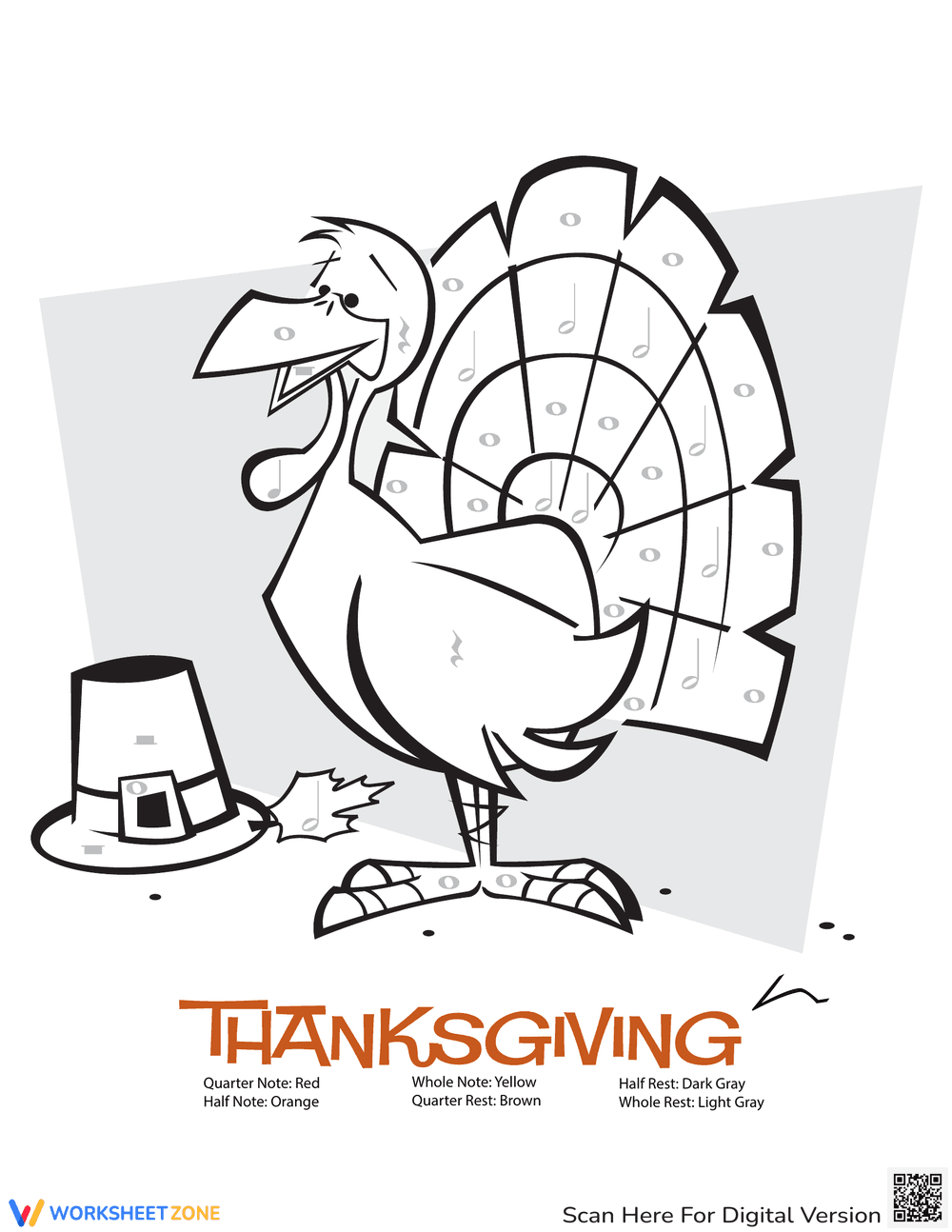
This Grade 1 and Grade 2 music worksheet reinforces notation recognition through an engaging holiday-themed activity. Students identify specific music symbols—including quarter notes, half notes, and various rests—to complete a vibrant Thanksgiving turkey illustration. It transforms rote symbol identification into a creative exercise that builds foundational music literacy and fine motor skills.
At a Glance
- Grade: 1-2 · Subject: Music
- Standard:
MU:Re7.2.1— Identify and describe basic music symbols like notes and rests- Skill Focus: Music notation recognition
- Format: 1 page · 1 coloring task · Answer key included · PDF
- Best For: Holiday music centers and sub plans
- Time: 15–25 minutes
The worksheet features a large, silly turkey illustration divided into sections, each containing a specific musical symbol. A clear color key at the bottom maps six distinct symbols—Quarter Note, Half Note, Whole Note, Quarter Rest, Half Rest, and Whole Rest—to specific colors like red, orange, and brown. This single-page PDF is designed for high-contrast printing and immediate student use.
Zero-Prep Workflow
- Print: Generate copies of the single-page PDF for your entire class in under 30 seconds.
- Distribute: Hand out the sheets along with standard sets of crayons or colored pencils (1 minute).
- Review: Quickly scan completed turkeys to check for symbol recognition accuracy during cleanup (1 minute).
Total teacher preparation time is under three minutes, making it an ideal emergency sub plan or transition activity.
Standards Alignment
This resource aligns with `MU:Re7.2.1`, which requires students to identify and describe basic music symbols. By requiring students to distinguish between rhythmic durations (notes) and silences (rests), the activity supports early rhythmic reading. This standard code can be copied directly into lesson plans, IEP goals, or district curriculum mapping tools.
How to Use It
Use this worksheet as a formative assessment after introducing the concept of rests versus notes. It works exceptionally well during the independent practice phase of a lesson or as a quiet transition activity during a Thanksgiving-themed music rotation. Expect students to take approximately 20 minutes to complete the coloring, providing a window for small-group instruction or individual check-ins.
Who It's For
This activity is tailored for first and second-grade students beginning their journey into formal music notation. It provides necessary scaffolding for visual learners who benefit from color-coding. It pairs naturally with a rhythm-reading lesson using hand drums or a holiday-themed listening map to reinforce the connection between symbols and sound.
Research from Fisher & Frey (2014) emphasizes the importance of visual scaffolding and the gradual release of responsibility when introducing technical symbols to early elementary learners. This Thanksgiving-themed worksheet applies these principles by using a color-by-code system to bridge the gap between abstract music notation and concrete visual identification. By focusing on MU:Re7.2.1, the activity ensures that students are not merely coloring but are actively discriminating between quarter notes, half notes, and rests. Studies in the RAND AIRS 2024 report suggest that integrating seasonal themes into core skill practice increases student engagement and retention of specialized vocabulary. This resource provides a structured environment for students to master 6 distinct musical symbols while developing the fine motor control necessary for later music composition. It serves as a reliable tool for music educators seeking to validate student progress in rhythmic literacy through evidence-based, engaging instructional design.


