


























Views
Downloads
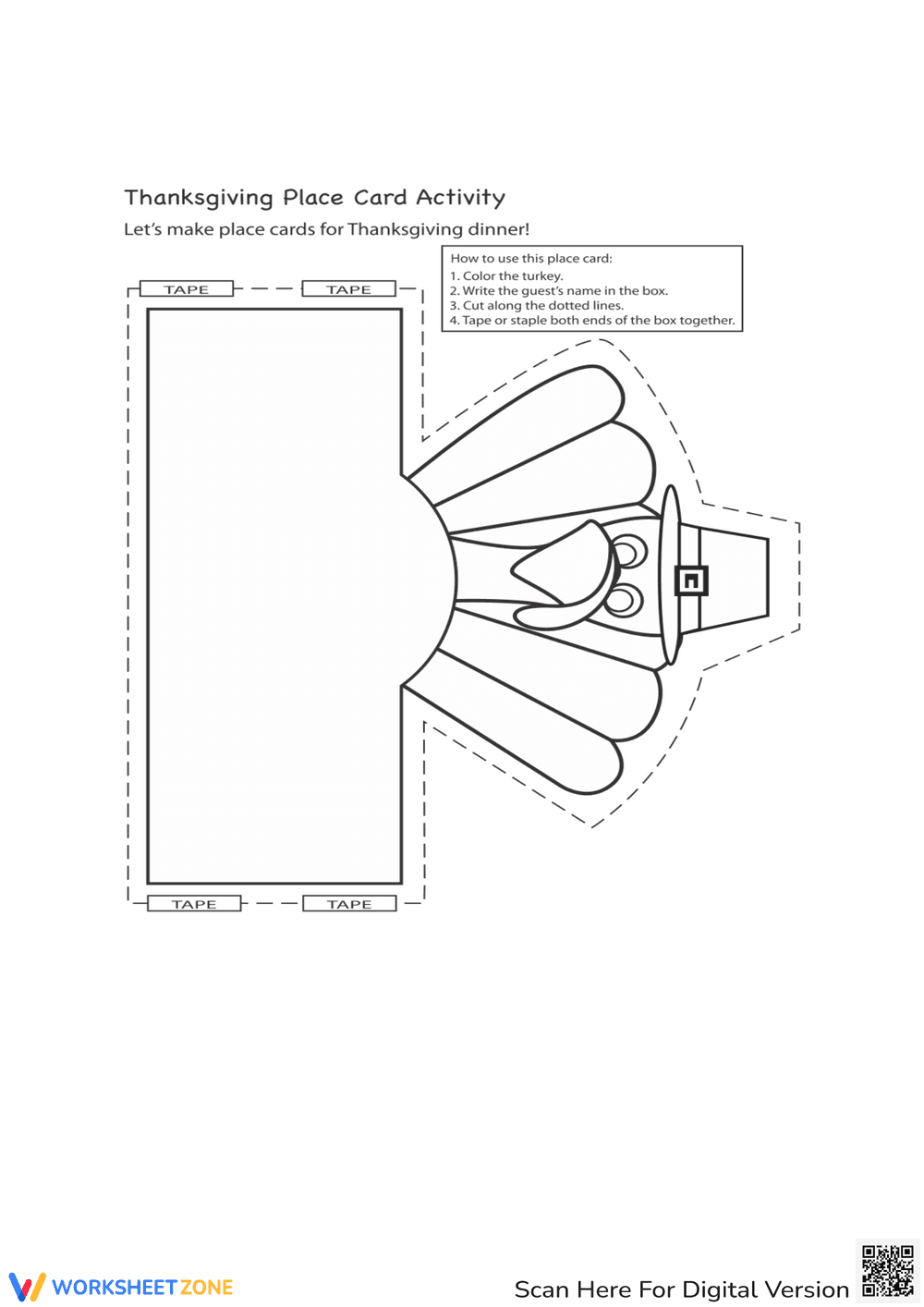

Thanksgiving Place Card Activity | Essential Grade K-2 Craft
Paste this activity's link or code into your existing LMS (Google Classroom, Canvas, Teams, Schoology, Moodle, etc.).
Students can open and work on the activity right away, with no student login required.
You'll still be able to track student progress and results from your teacher account.
This Thanksgiving Place Card Activity provides a hands-on way for early elementary students to contribute to holiday celebrations while practicing essential fine motor skills. By combining coloring, cutting, and writing, students engage in a multi-sensory task that results in a functional item for their family dinner or classroom feast.
At a Glance
- Grade: K-2 · Subject: Arts & Crafts
- Standard:
CCSS.ELA-LITERACY.L.K.1.A— Print many upper- and lowercase letters during name writing tasks- Skill Focus: Fine motor control and following directions
- Format: 1 page · 4 steps · No answer key needed · PDF
- Best For: Holiday classroom parties and family gifts
- Time: 15–20 minutes
This single-page PDF features a large, clear turkey illustration designed for coloring. The template includes a dedicated text box for guest names, dotted lines for precise cutting, and designated "tape" zones for assembly. The four-step instruction block is written in simple language, allowing emerging readers to follow the sequence independently or with minimal teacher support.
The zero-prep workflow for this activity is designed for maximum efficiency in a busy holiday classroom. First, print the required number of copies (30 seconds). Second, distribute the sheets along with crayons, scissors, and tape (1 minute). Third, students complete the four-step process independently, allowing the teacher to facilitate name-writing or assist with stapling (15-20 minutes). Total teacher preparation time is under 2 minutes, making it an ideal choice for the hectic days leading up to school breaks.
The primary standard addressed is CCSS.ELA-LITERACY.L.K.1.A, which focuses on the ability to print upper- and lowercase letters. By writing guest names on the place cards, students apply their handwriting skills in a meaningful, real-world context. Additionally, the activity supports fine motor development necessary for writing. Both standard codes can be copied directly into lesson plans, IEP goals, or district curriculum mapping tools.
Use this activity as a "Friday Fun" project during the week of Thanksgiving or as a quiet-time task during a classroom holiday party. It serves as an excellent formative assessment for observing scissor grip and spatial awareness. Expect students to take approximately 15 to 20 minutes to complete the coloring, writing, and assembly phases. Completed cards can be sent home as a gift for families or used for a school-wide community lunch.
This resource is ideal for Kindergarten through 2nd-grade students, including those requiring occupational therapy support for fine motor coordination. It pairs naturally with a read-aloud about Thanksgiving traditions or a social studies lesson on community and family gatherings. The simple design ensures that all students, regardless of artistic ability, can produce a finished product they are proud to display.
According to the Fisher & Frey (2014) framework for gradual release of responsibility, activities that combine following multi-step directions with creative output reinforce cognitive sequencing in early learners. This Thanksgiving Place Card Activity aligns with CCSS.ELA-LITERACY.L.K.1.A by requiring students to print letters within a functional, decorative context. Research from the NAEP highlights the importance of integrating fine motor tasks like cutting and coloring into the early elementary curriculum to support the physical mechanics of writing. By engaging in this 4-step process, students demonstrate mastery of basic assembly while practicing the social-emotional skill of contributing to a group event. This printable resource provides a structured yet creative outlet that meets developmental milestones for children aged 5 to 8. The inclusion of clear visual cues and simple text ensures that the activity remains accessible to diverse learners in inclusive classroom settings.


