


























Views
Downloads

Grade K-2 Thanksgiving Patterns: Printable No-Prep Worksheet
Paste this activity's link or code into your existing LMS (Google Classroom, Canvas, Teams, Schoology, Moodle, etc.).
Students can open and work on the activity right away, with no student login required.
You'll still be able to track student progress and results from your teacher account.
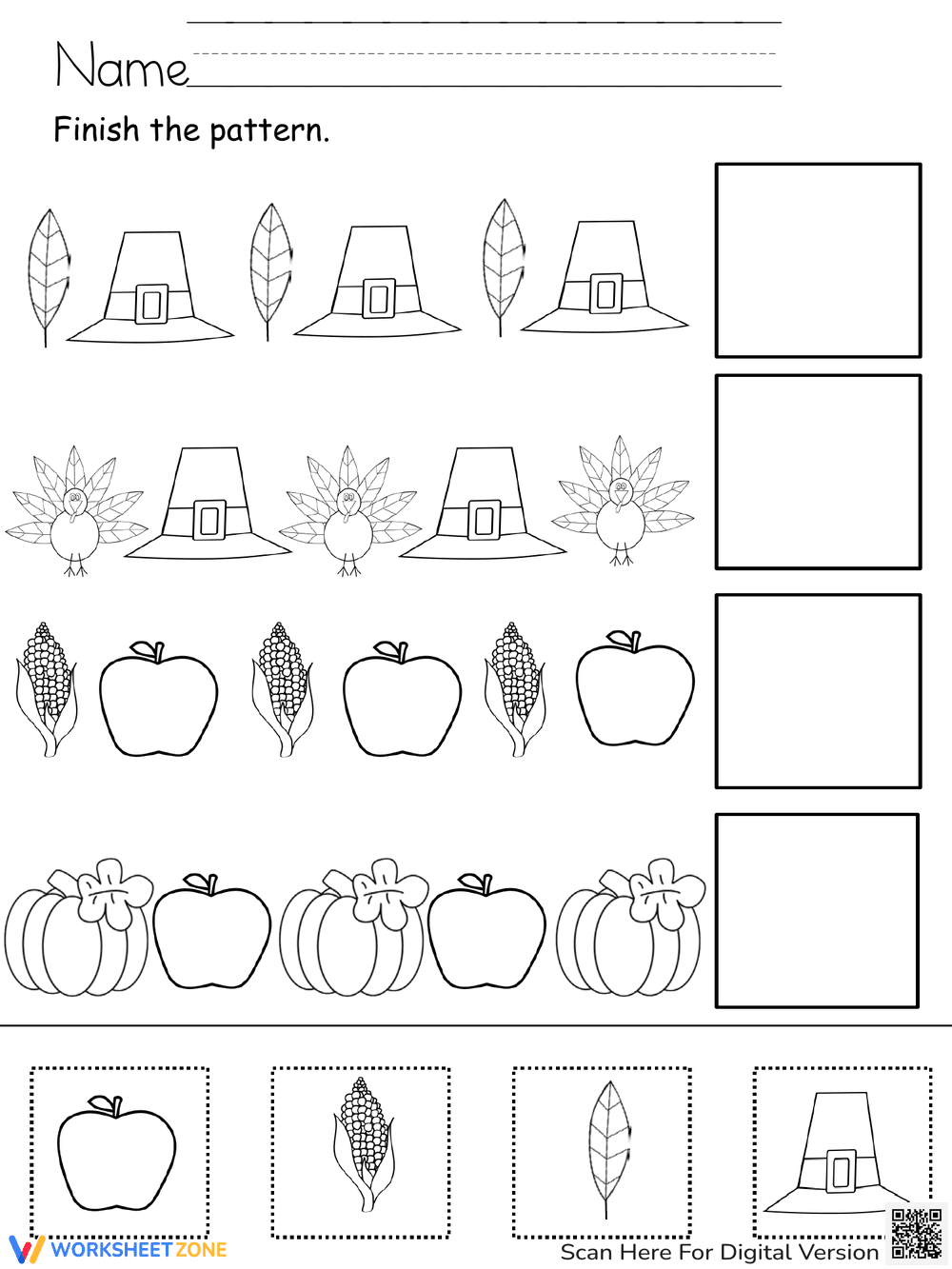
This Thanksgiving-themed math worksheet helps early learners master basic AB patterns through interactive cut-and-paste engagement. Students identify the repeating sequence of seasonal icons like turkeys, pumpkins, and corn to determine the next logical step. This activity strengthens algebraic thinking foundations while simultaneously developing the fine motor precision necessary for successful classroom tasks.
At a Glance
- Grade: Kindergarten – Grade 2 · Subject: Math & Fine Motor
- Standard:
CCSS.MATH.CONTENT.K.MD.B.3— Classify objects into categories and identify logical sequences in patterns- Skill Focus: AB Pattern Completion
- Format: 1 page · 4 problems · Answer key included · PDF
- Best For: Morning work or seasonal math centers
- Time: 10–15 minutes
The worksheet features four distinct horizontal pattern rows, each utilizing high-contrast line art perfect for coloring. Below the main workspace, four corresponding cut-out squares provide the missing pieces for the sequence. The layout includes a clear name line and simple instructions, ensuring students can work independently with minimal teacher intervention. The black-and-white design is optimized for high-volume school printing.
This resource follows a strict zero-prep workflow designed for busy educators. First, print the single-page PDF in under 30 seconds. Second, distribute the sheets along with scissors and glue sticks to your small group or whole class. Third, review the completed patterns as a group to provide immediate feedback on logical reasoning. Total teacher preparation time is under two minutes, making it an ideal emergency sub plan or transition activity.
This activity aligns with `CCSS.MATH.CONTENT.K.MD.B.3`, focusing on the classification and sorting of objects which serves as the precursor to algebraic pattern recognition. By identifying the attributes of the Thanksgiving symbols, students practice the mathematical practice of looking for and making use of structure. This standard code can be copied directly into lesson plans, IEP goals, or district curriculum mapping tools.
Use this worksheet during the week before Thanksgiving break as a thematic math center. It serves as an excellent formative assessment for fine motor control; observe how students handle scissors and apply glue to gauge manual dexterity. For an extension, ask students to color the patterns using a specific color code to add an extra layer of following directions. Completion typically takes 12 minutes.
This resource is designed for Kindergarten through 2nd-grade students, particularly those requiring tactile learning opportunities. It is highly effective for Occupational Therapy push-in sessions or for English Language Learners who benefit from visual-heavy, low-text instructions. Pair this worksheet with a seasonal anchor chart showing different pattern types like AAB or ABC to scaffold the learning experience.
According to the RAND AIRS 2024 report, integrating tactile cut and paste activities into early mathematics significantly improves retention of abstract logical concepts compared to purely digital instruction. This worksheet targets the specific skill of AB pattern recognition, a foundational block for later algebraic reasoning and functional literacy. By requiring students to physically manipulate the pattern pieces, the resource engages multiple neural pathways, supporting the Fisher & Frey (2014) model of gradual release and scaffolded independence. The use of seasonal imagery like turkeys and corn husks reduces cognitive load by using familiar schemas, allowing the brain to focus entirely on the mathematical sequence. Educators can cite CCSS.MATH.CONTENT.K.MD.B.3 when documenting this activity for progress monitoring. This structured approach ensures that students move from simple identification to active construction of logical sequences, meeting essential developmental milestones in early childhood education frameworks.


