


























Views
Downloads
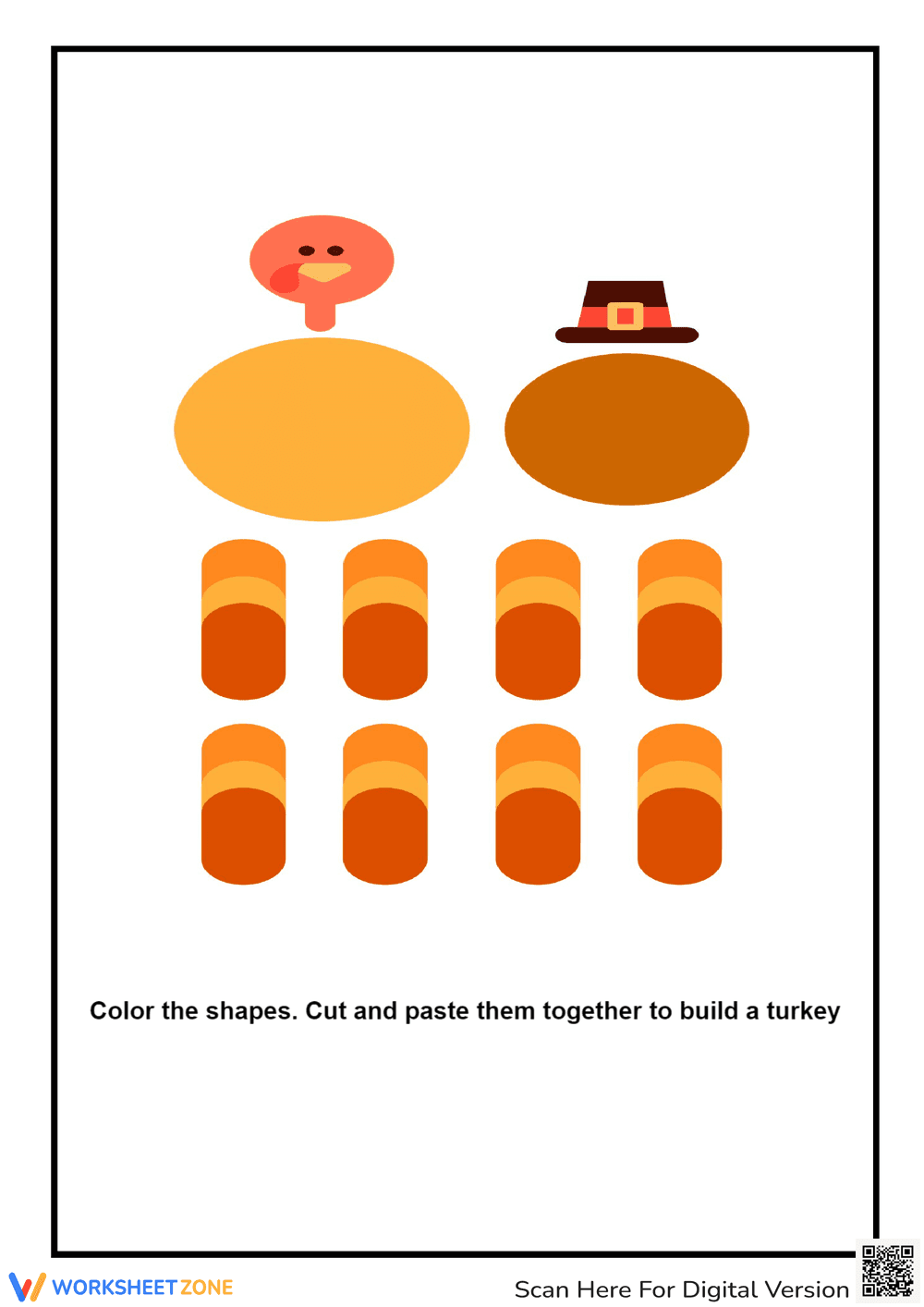

Essential Thanksgiving Turkey Craft | Grades K-2
Paste this activity's link or code into your existing LMS (Google Classroom, Canvas, Teams, Schoology, Moodle, etc.).
Students can open and work on the activity right away, with no student login required.
You'll still be able to track student progress and results from your teacher account.
This Thanksgiving craft template helps early elementary students develop essential fine motor skills while celebrating the holiday. By coloring, cutting, and assembling various geometric components, learners create a complete turkey. This activity bridges the gap between creative expression and spatial reasoning, ensuring students remain engaged while practicing precision and following multi-step directions.
At a Glance
- Grade: Kindergarten to Grade 2 · Subject: Arts & Crafts
- Standard:
CCSS.MATH.CONTENT.K.G.B.6— Compose simple shapes to form larger shapes and recognizable figures for spatial reasoning- Skill Focus: Fine motor coordination, scissor skills, and spatial assembly
- Format: 1 page · 10 individual components · No-prep · PDF format
- Best For: Holiday centers, morning work, and fine motor practice
- Time: 20–30 minutes
The worksheet features a comprehensive set of turkey components, including the head, body, pilgrim hat, and multiple feathers or limbs. Each shape is clearly outlined to facilitate easy cutting for small hands. The layout is designed for a single-page printout, minimizing paper waste while providing all necessary elements for a successful craft project. Students can personalize their turkey with unique colors before the assembly phase.
This resource follows a streamlined zero-prep workflow. First, print the single-page PDF for your entire class (1 minute). Second, distribute the templates along with crayons, scissors, and glue sticks (1 minute). Third, allow students to work independently or in small groups while you provide targeted support for cutting techniques (20 minutes). It is an ideal solution for busy holiday weeks or unexpected sub plans where instructional time is limited.
This activity aligns with `CCSS.MATH.CONTENT.K.G.B.6`, which requires students to compose simple shapes to form larger, recognizable figures. By identifying how the ovals and rectangles fit together to create a turkey, students demonstrate foundational geometry and spatial awareness. Both standard codes can be copied directly into lesson plans, IEP goals, or district curriculum mapping tools to document student progress in fine motor and cognitive domains.
Use this template as a quiet-time activity following a Thanksgiving-themed read-aloud. It serves as an excellent formative assessment for fine motor development; observe how students handle scissors and apply glue to gauge their manual dexterity. Expected completion time ranges from 20 to 30 minutes depending on the level of coloring detail and the student's proficiency with cutting tools.
This resource is designed for Kindergarten through Grade 2 students, particularly those needing extra practice with bilateral coordination. It pairs naturally with a holiday-themed anchor chart or a short informational text about Thanksgiving traditions. The simple design allows for easy differentiation by providing pre-colored versions for students with significant motor delays or requiring advanced students to add their own background details.
Research by Fisher & Frey (2014) emphasizes the importance of integrating fine motor tasks with thematic content to improve student engagement and retention. This Thanksgiving craft utilizes the CCSS.MATH.CONTENT.K.G.B.6 standard to transform a simple art project into a meaningful geometry exercise. By composing a recognizable figure from basic shapes, students strengthen their spatial reasoning and visual-motor integration. Studies from the RAND AIRS 2024 report suggest that hands-on activities in early childhood education significantly contribute to the development of executive function and task persistence. This worksheet provides a structured environment for students to practice these skills while producing a tangible result. The inclusion of clear visual cues and a manageable number of components ensures that the activity remains accessible to diverse learners while meeting rigorous developmental milestones in the K-2 classroom setting.


