




























Views
Downloads

Thanksgiving Counting Worksheet | Essential Grade K-1

Paste this activity's link or code into your existing LMS (Google Classroom, Canvas, Teams, Schoology, Moodle, etc.).
Students can open and work on the activity right away, with no student login required.
You'll still be able to track student progress and results from your teacher account.
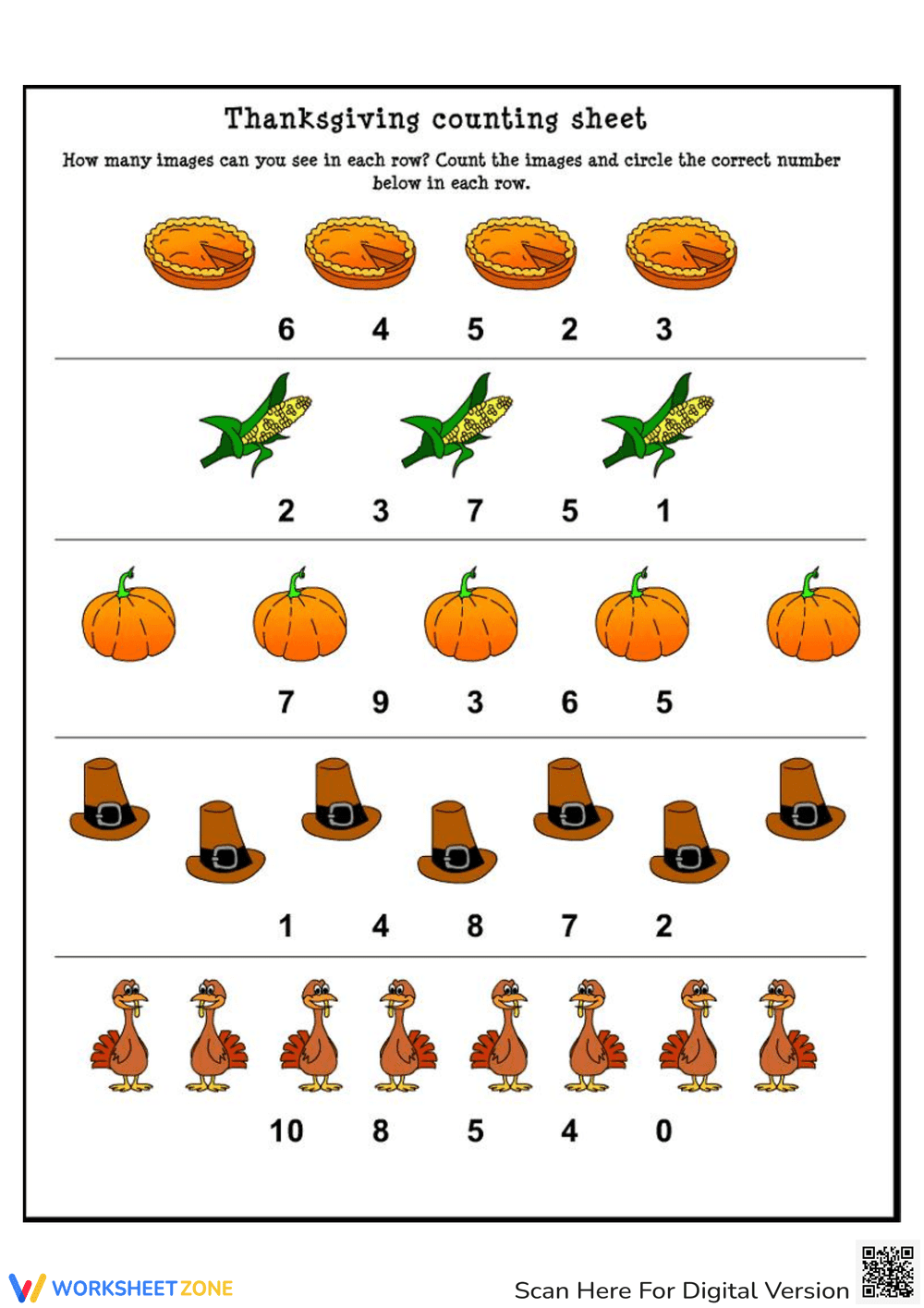
This Thanksgiving counting worksheet helps early learners master one-to-one correspondence and number recognition through festive holiday imagery. Students count groups of seasonal items like pies, pumpkins, and turkeys, then identify the matching numeral from a multiple-choice set. It provides immediate practice in cardinality and basic quantity assessment for Kindergarten and first-grade students.
At a Glance
- Grade: K–1 · Subject: Math
- Standard:
CCSS.MATH.CONTENT.K.CC.B.4— Understand the relationship between numbers and quantities; connect counting to cardinality- Skill Focus: Counting 1–10 and number identification
- Format: 1 page · 5 problems · Answer key included · PDF
- Best For: Morning work or holiday math centers
- Time: 5–10 minutes
This single-page PDF features five rows of Thanksgiving-themed illustrations, including pies, corn, pumpkins, pilgrim hats, and turkeys. Each row contains a set of objects ranging from 3 to 8 items. Below each group, students are presented with five numerical options, encouraging careful counting and visual discrimination between digits. The clear layout ensures that young learners can focus entirely on the mathematical task without distraction.
This resource is designed for immediate classroom implementation with a total teacher prep time of under 2 minutes. First, print the copies. Second, distribute the sheets for circling. Third, review the answers as a whole group or use the key for quick grading. It is an ideal sub-plan filler or holiday morning work that requires no additional materials beyond a pencil or crayon.
The primary focus is `CCSS.MATH.CONTENT.K.CC.B.4`, which requires students to understand that the last number name said tells the number of objects counted. It also supports `CCSS.MATH.CONTENT.K.CC.B.5` by asking students to count objects in a linear arrangement. Both standard codes can be copied directly into lesson plans, IEP goals, or district curriculum mapping tools.
Use this as a formative assessment during a Thanksgiving-themed math rotation to observe if students are touching each object as they count. Alternatively, assign it as a fast-finisher activity for students who complete their primary lesson early. The expected completion time is 5 to 10 minutes, making it a perfect transition tool between subjects during the busy holiday season.
This worksheet is tailored for Kindergarten students building foundational numeracy and first graders requiring a seasonal review of basic counting. It is particularly effective for English Language Learners (ELLs) due to the heavy visual support and minimal text requirements. Pair this with a physical counting manipulative like plastic corn kernels or small blocks for extra tactile support for struggling learners.
According to the RAND AIRS 2024 report on early childhood numeracy, the integration of thematic, high-interest visuals in math practice significantly increases student engagement and retention of cardinality concepts. This worksheet aligns with these findings by utilizing recognizable Thanksgiving symbols to anchor the abstract concept of number-quantity relationships. By focusing on CCSS.MATH.CONTENT.K.CC.B.4, the resource ensures that students are not merely reciting numbers in order but are actively connecting the verbal count to the physical set of objects. Research from Fisher & Frey (2014) emphasizes that such structured, visual tasks are essential for the gradual release of responsibility, moving students from guided counting to independent mastery. This 1-page PDF provides the necessary repetition for students to internalize the principle that the final number counted represents the total quantity, a critical milestone in early mathematical development and future algebraic thinking.


