


























Views
Plays

Text Organization Worksheet | Grade 3 Essential
Paste this activity's link or code into your existing LMS (Google Classroom, Canvas, Teams, Schoology, Moodle, etc.).
Students can open and work on the activity right away, with no student login required.
You'll still be able to track student progress and results from your teacher account.
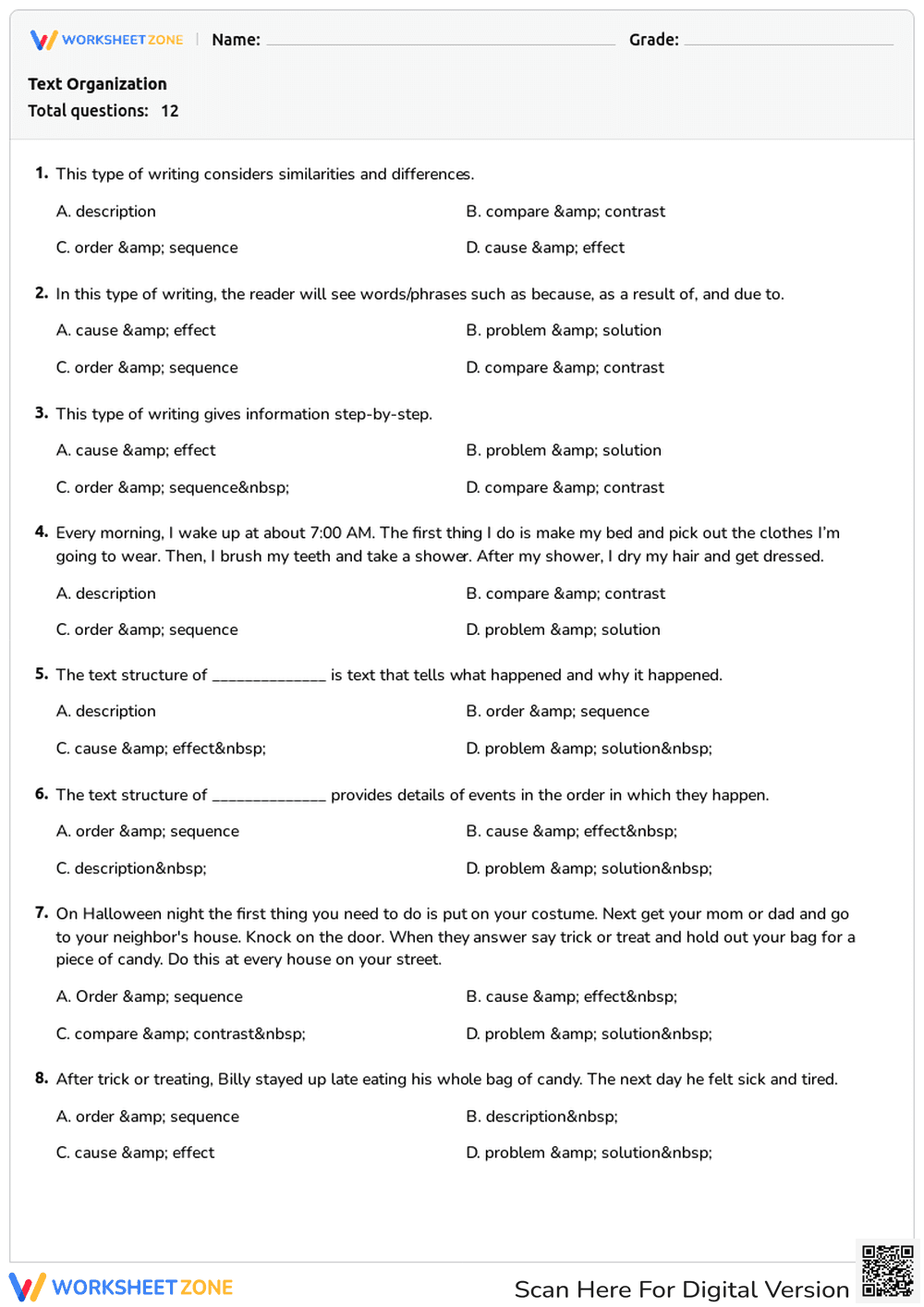
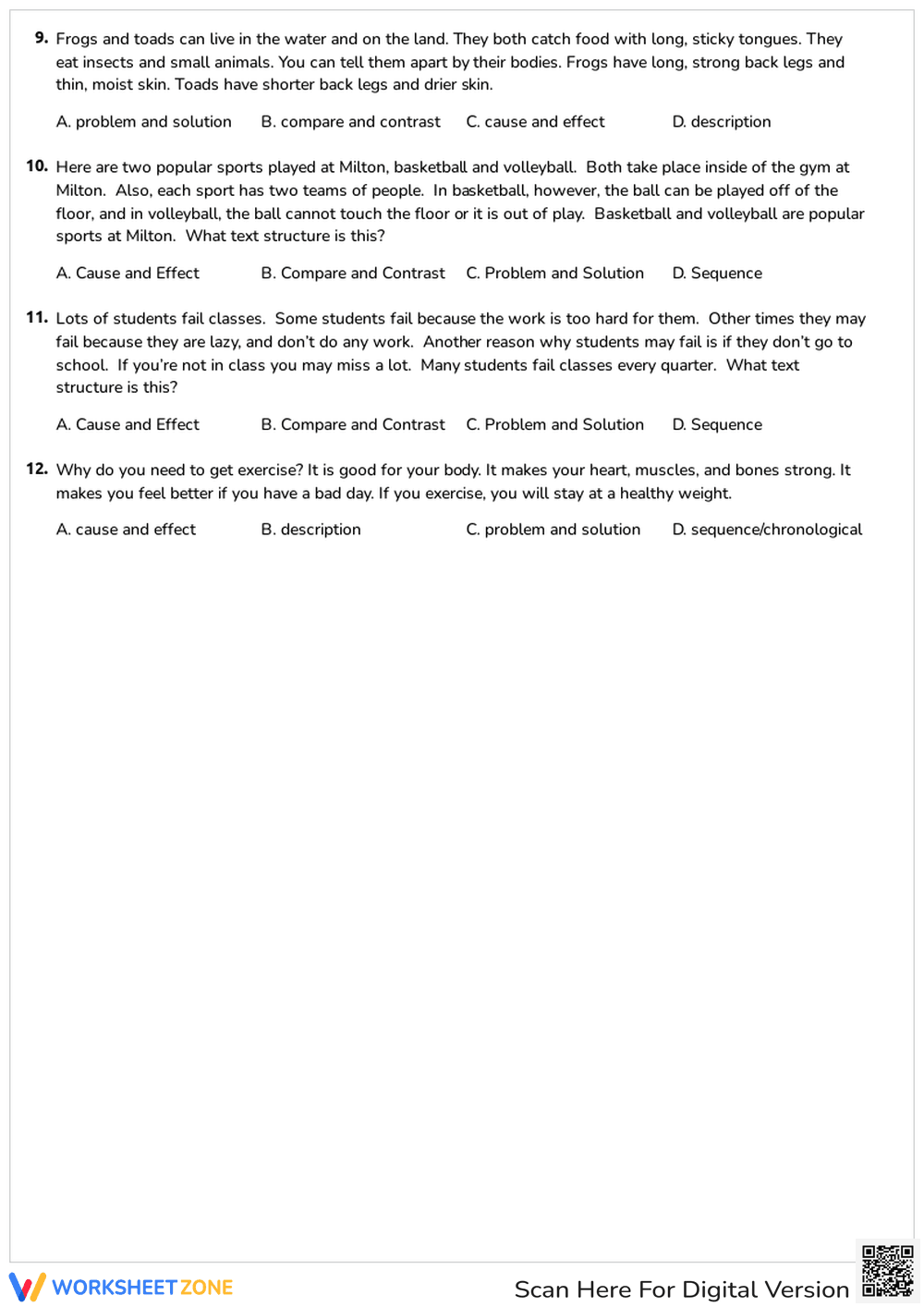
This Grade 3 text organization worksheet helps students identify informational text structures through 12 targeted multiple-choice questions. By analyzing short passages, learners distinguish between cause and effect, comparison, and sequential order. This resource ensures students can recognize how authors organize ideas to convey meaning effectively in non-fiction texts.
At a Glance
- Grade: 3 · Subject: ELA
- Standard:
CCSS.ELA-LITERACY.RI.3.8— Describe logical connections between sentences and paragraphs in a text- Skill Focus: Text Structure Identification
- Format: 2 pages · 12 problems · Answer key included · PDF
- Best For: Formative assessment or reading centers
- Time: 15–20 minutes
This 2-page PDF features 12 multiple-choice questions designed for quick assessment. The first half focuses on defining text structures like "compare and contrast" or "problem and solution," while the second half provides short reading passages where students must apply their knowledge to identify the specific organizational pattern used by the author.
Zero-Prep Workflow
- Print: Select the 2-page PDF and print enough copies for your class (30 seconds).
- Distribute: Hand out the worksheets as a warm-up or exit ticket (30 seconds).
- Review: Use the included answer key to grade or review answers as a whole group (1 minute).
Total teacher prep time is under 2 minutes, making this an ideal sub plan or last-minute assessment.
Standards Alignment
This resource aligns with `CCSS.ELA-LITERACY.RI.3.8`, which requires students to describe the logical connection between particular sentences and paragraphs in a text (e.g., comparison, cause/effect, first/second/third in a sequence). Both standard codes can be copied directly into lesson plans, IEP goals, or district curriculum mapping tools.
How to Use It
Use this worksheet as a formative assessment after a direct instruction lesson on informational text features. It works well during the independent practice phase of a lesson. Teachers should observe if students struggle more with the definitions or the application in context to guide future small-group instruction. Completion typically takes 15 to 20 minutes.
Who It's For
This is designed for Grade 3 students but serves as an excellent review for Grade 4 or an enrichment activity for advanced Grade 2 readers. It pairs naturally with an anchor chart displaying signal words for each text structure to support English Language Learners or students with specific learning needs.
According to the RAND AIRS 2024 report, explicit instruction in text structure significantly improves reading comprehension by providing students with a mental framework for organizing new information. This worksheet targets CCSS.ELA-LITERACY.RI.3.8 by requiring students to identify logical connections such as cause and effect or sequence within short, manageable passages. By mastering these 12 tasks, students develop the ability to navigate complex informational texts more efficiently. Research from Fisher & Frey (2014) emphasizes that recognizing organizational patterns is a foundational skill for disciplinary literacy. This resource provides the structured practice necessary for students to move from basic identification to deep analysis of authorial intent. It is a reliable tool for teachers seeking to align their classroom activities with evidence-based literacy practices and national standards.


