


























Views
Downloads

10 More 10 Less Worksheet | Grade 2 Math Printable
Paste this activity's link or code into your existing LMS (Google Classroom, Canvas, Teams, Schoology, Moodle, etc.).
Students can open and work on the activity right away, with no student login required.
You'll still be able to track student progress and results from your teacher account.
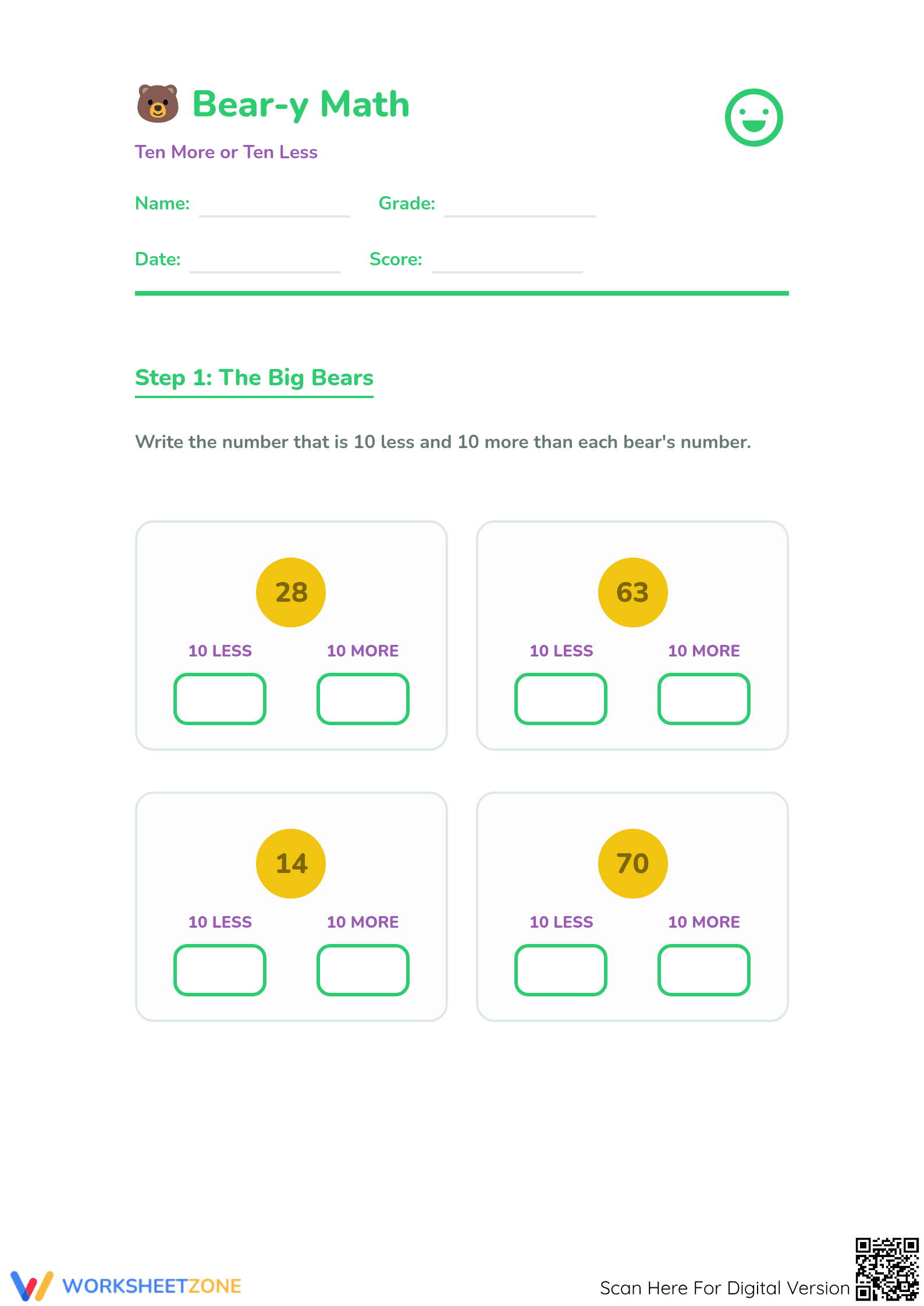
This focused math worksheet helps students master mental math by finding ten more and ten less than a given two-digit number. By practicing these foundational base-ten skills, learners build the number sense required for fluent addition and subtraction, setting the stage for more complex arithmetic operations.
At a Glance
- Grade: 2 · Subject: Math
- Standard:
CCSS.MATH.CONTENT.2.NBT.B.8— Mentally add or subtract 10 from a given number- Skill Focus: 10 More and 10 Less
- Format: 2 pages · 13 problems · Answer key included · PDF
- Best For: Independent practice and review
- Time: 10–15 minutes
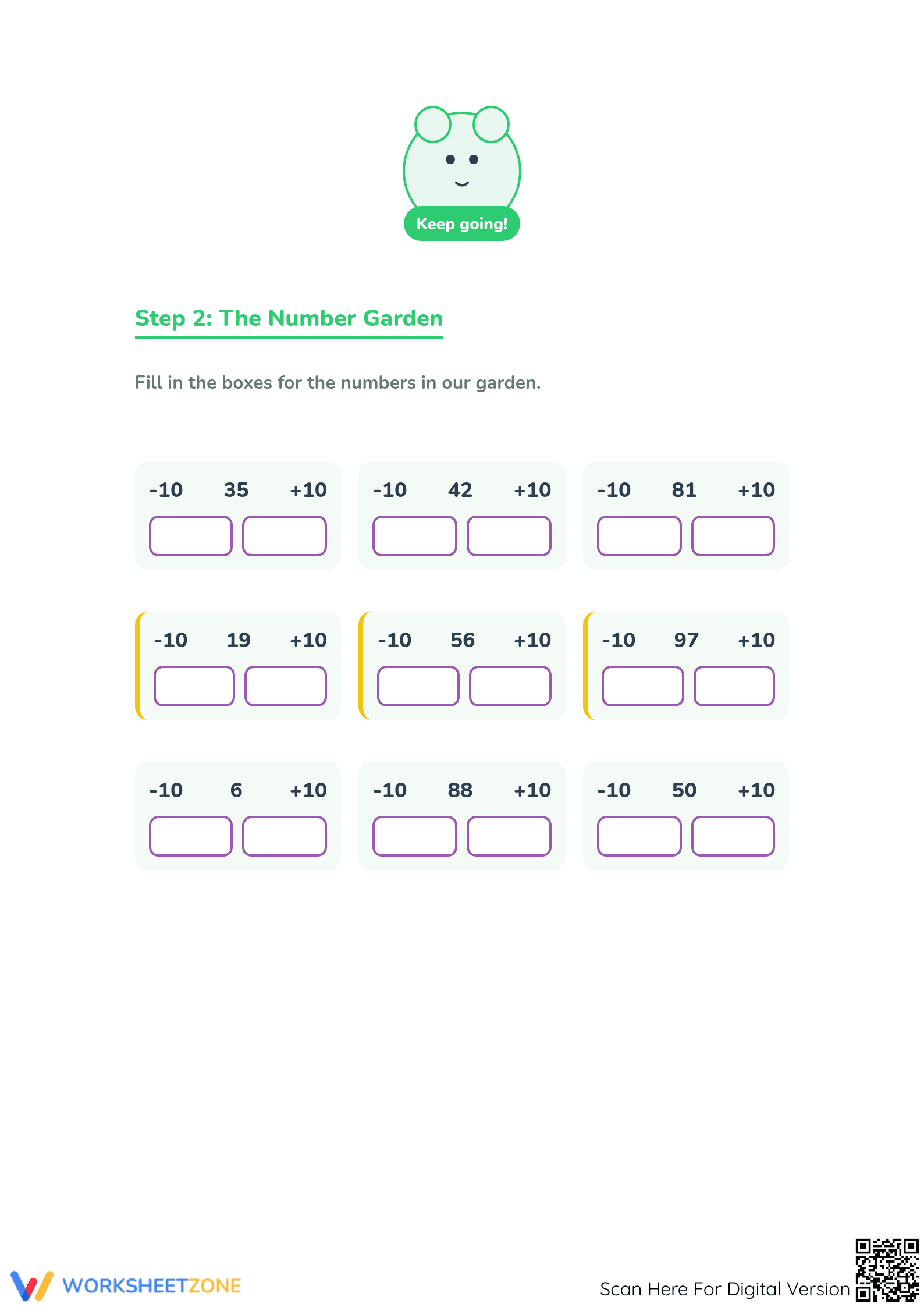
This two-page printable features an engaging, animal-themed design to keep students motivated. The first page introduces the concept with four large problems where students write the numbers 10 less and 10 more than a target number. The second page, "The Number Garden," provides nine additional practice problems in a streamlined format to reinforce the skill. A complete answer key is included to make grading quick and accurate.
Skill Progression
- Guided practice: The first page offers four highly visual, spaced-out problems that are perfect for modeling the concept on a smartboard or working through together as a class.
- Supported practice: The second page transitions into a slightly denser layout with nine problems, encouraging students to apply the pattern more independently.
- Independent practice: By the end of the worksheet, students will have repeatedly applied the plus-ten and minus-ten rules, solidifying their mental math fluency.
This layout supports a gradual-release (I Do, We Do, You Do) model.
Standards Alignment
This resource is directly aligned to CCSS.MATH.CONTENT.2.NBT.B.8: Mentally add 10 or 100 to a given number 100-900, and mentally subtract 10 or 100 from a given number 100-900. It also reinforces foundational place value understanding for two-digit numbers. Both standard codes can be copied directly into lesson plans, IEP goals, or district curriculum mapping tools.
How to Use It
This worksheet is versatile for primary classrooms. Use it as an independent practice activity immediately following direct instruction on place value and mental math strategies. Alternatively, it serves as an excellent morning work assignment or math center station. As a formative assessment tip, observe whether students are counting up and down by ones or if they are efficiently changing the digit in the tens place. Most students will complete this activity in 10 to 15 minutes.
Who It's For
Designed primarily for second-grade students, this resource also serves as excellent review for third and fourth graders needing support with mental math. For students requiring differentiation, provide a hundreds chart or base-ten blocks to help them visualize the jumps of ten. This worksheet pairs perfectly with hands-on place value lessons or interactive anchor charts demonstrating the hundreds grid.
Developing mental math fluency with base-ten concepts is a critical milestone in early elementary mathematics. According to a 2024 report by EdReports, instructional materials that emphasize place value patterns—such as finding ten more and ten less—significantly improve students' ability to perform multi-digit arithmetic in later grades. This targeted worksheet directly addresses CCSS.MATH.CONTENT.2.NBT.B.8, helping students mentally add or subtract 10 from a given number without relying on standard algorithms or counting by ones. By isolating this specific skill, educators can ensure learners fully internalize the structure of the base-ten number system. Providing focused, repeated practice on these mental math operations reduces cognitive load during more complex problem-solving tasks, ultimately fostering greater mathematical confidence, stronger number sense, and long-term academic success in elementary classrooms.


