


























Views
Downloads

Ready Ten Busy Buzzy Bugs Comprehension Check — Grade 1
Paste this activity's link or code into your existing LMS (Google Classroom, Canvas, Teams, Schoology, Moodle, etc.).
Students can open and work on the activity right away, with no student login required.
You'll still be able to track student progress and results from your teacher account.
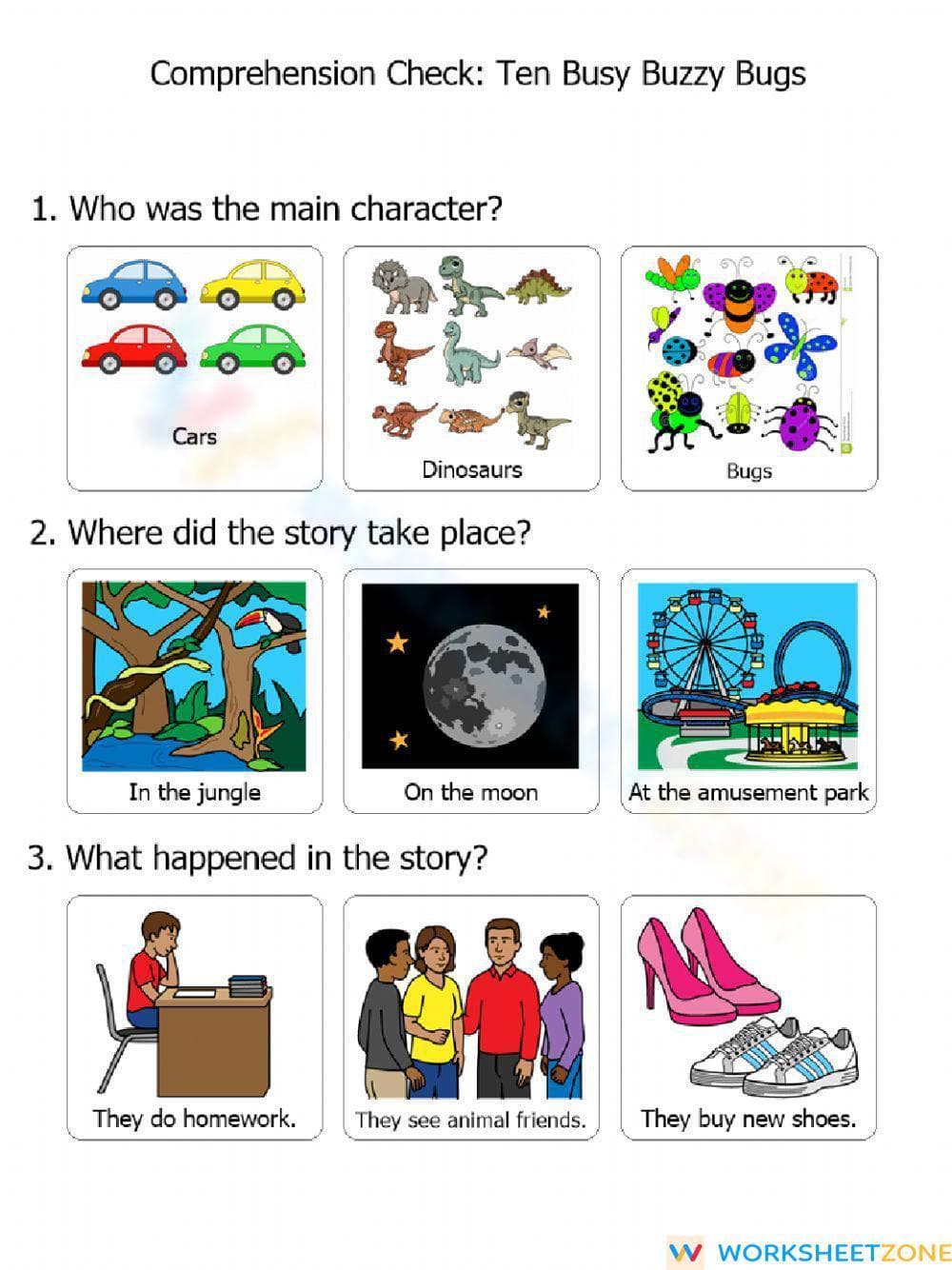
This Grade 1 reading comprehension worksheet provides an essential tool for assessing student understanding after reading "Ten Busy Buzzy Bugs." By focusing on key story elements through visual prompts, students can demonstrate their mastery of character, setting, and plot without the barrier of complex writing. It is the perfect check for early readers.
At a Glance
- Grade: 1 · Subject: English Language Arts (ELA)
- Standard:
CCSS.ELA-LITERACY.RL.1.3— Describe characters, settings, and major events in a story using key details- Skill Focus: Key Ideas and Story Elements
- Format: 1 page · 3 problems · Answer key included · PDF
- Best For: Post-reading formative assessment and comprehension checks
- Time: 5–10 minutes
What's Inside
The worksheet consists of a single-page comprehension check featuring three multiple-choice questions. Each question is supported by vibrant illustrations that represent the choices, making it highly accessible for Kindergarten and Grade 1 students. The tasks cover identifying the main character, the story's setting, and a primary plot event. A clear answer key is provided for quick grading.
Zero-Prep Workflow
The zero-prep design allows teachers to implement this assessment in under two minutes. First, print the single-page PDF for your class or small group (60 seconds). Next, distribute the sheets to students immediately following your read-aloud session (30 seconds). Finally, review the visual answers together or use the provided key for an instant check on student understanding (30 seconds). It is ideal for emergency sub plans.
Standards Alignment
The primary focus is CCSS.ELA-LITERACY.RL.1.3: "Describe characters, settings, and major events in a story, using key details." This worksheet directly maps to each component of the standard by asking students to identify who, where, and what. Both standard codes can be copied directly into lesson plans, IEP goals, or district curriculum mapping tools to ensure instructional alignment.
How to Use It
Use this resource immediately after a direct instruction read-aloud to capture student impressions while the story is fresh. It serves as an excellent formative-assessment tool; observe if students rely on the pictures or require verbal repetition of the choices. Expected completion time is roughly seven minutes, making it a perfect "exit ticket" before transitioning to the next literacy center.
Who It's For
This resource is designed for Kindergarten and Grade 1 students, including English Language Learners who benefit from the heavy visual scaffolding. It naturally pairs with any animal-themed literature unit or a specific lesson on "Ten Busy Buzzy Bugs." The simplified format also supports students with processing delays who need a focused, low-distraction environment to showcase their comprehension skills.
Effective literacy instruction in the early grades requires frequent, low-stakes opportunities for students to engage with key ideas and details. According to the RAND AIRS 2024 report on foundational reading skills, visual scaffolding in comprehension assessments significantly reduces cognitive load for emergent readers, allowing them to focus on the core skill of identifying characters, settings, and major events. This worksheet aligns with CCSS.ELA-LITERACY.RL.1.3 by providing three targeted tasks that build a bridge between listening and analytical thinking. Research from Fisher & Frey (2014) emphasizes the importance of the gradual release of responsibility, where simple checks like this one serve as essential checkpoints before independent practice. By using this ready-to-print tool, educators ensure that every student has a clear pathway to mastery of story elements. This resource is an essential component of a research-based, classroom-ready literacy curriculum for Grade 1 students.


