


























Views
Downloads
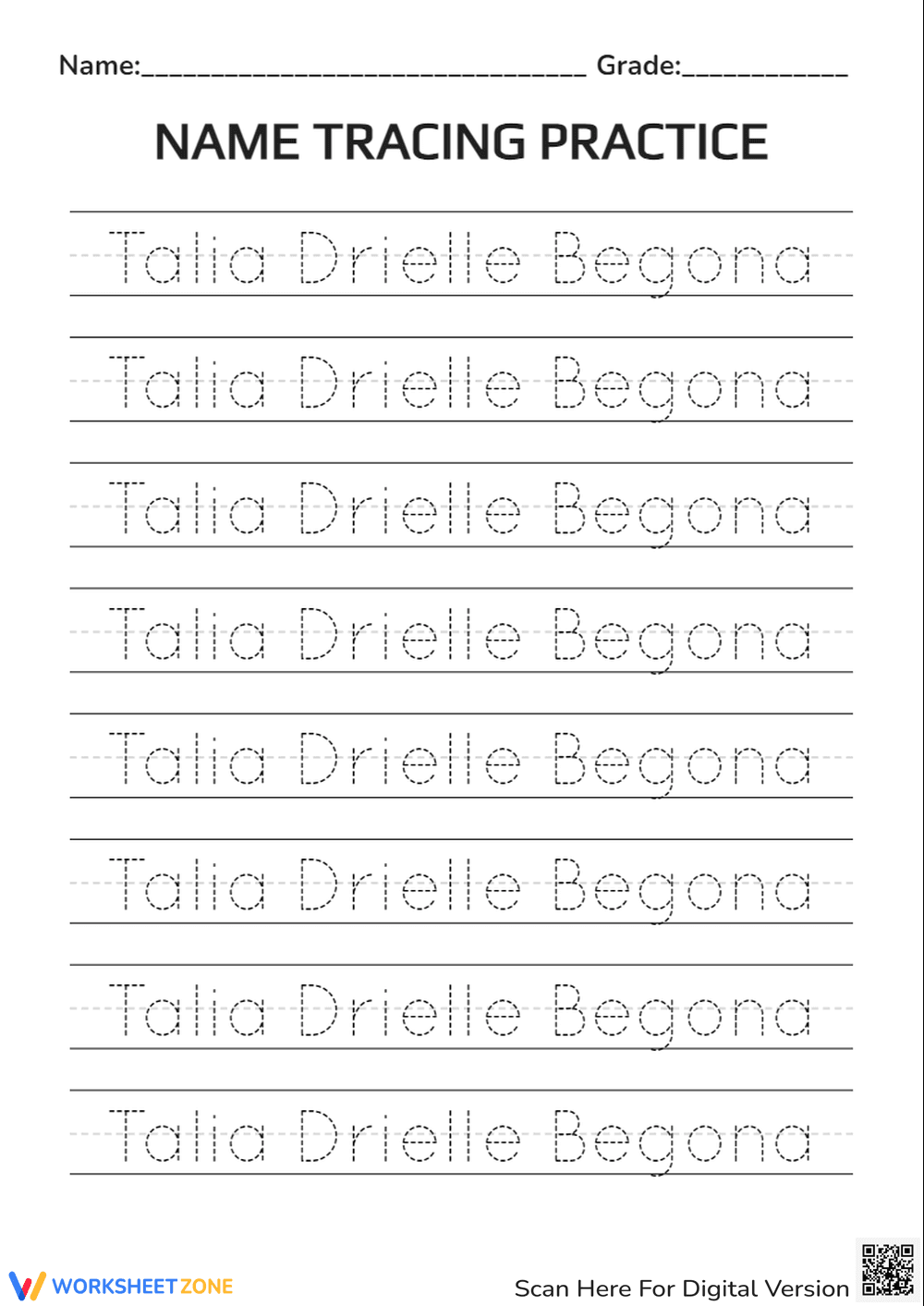

Essential Name Tracing Practice | Grade 1 Handwriting
Paste this activity's link or code into your existing LMS (Google Classroom, Canvas, Teams, Schoology, Moodle, etc.).
Students can open and work on the activity right away, with no student login required.
You'll still be able to track student progress and results from your teacher account.
This Grade 1 handwriting worksheet provides targeted practice for students learning to write the name Talia Drielle Begona. By focusing on repetitive tracing, students develop the muscle memory required for fluid letter formation and proper spacing. This resource ensures that early learners gain confidence in their personal identity through clear, structured writing exercises.
At a Glance
- Grade: 1 · Subject: Handwriting
- Standard:
CCSS.ELA-LITERACY.L.1.1.A— Print all upper- and lowercase letters correctly- Skill Focus: Name recognition and letter formation
- Format: 1 page · 8 problems · Answer key N/A · PDF
- Best For: Morning work or daily handwriting practice
- Time: 5–10 minutes
What's Inside
Inside this single-page PDF, you will find 8 identical lines of the name Talia Drielle Begona. Each line features a dashed tracing font set against standard primary ruled lines, which include a top line, dotted midline, and baseline. This layout helps students understand letter height and placement while providing ample repetition to solidify their handwriting skills.
Zero-Prep Workflow
The zero-prep workflow for this worksheet is designed for maximum efficiency. First, print the single-page document (30 seconds). Second, distribute the sheets to students during morning arrival or transition periods (1 minute). Third, provide a quick visual review of student grip and letter strokes as they work (under 1 minute). Total teacher preparation time is less than 2 minutes.
Standards Alignment
This resource aligns with `CCSS.ELA-LITERACY.L.1.1.A`, which requires students to print all upper- and lowercase letters. By practicing a specific name, students engage with a variety of letter shapes and connections. This standard code can be copied directly into lesson plans, IEP goals, or district curriculum mapping tools to document foundational literacy progress.
How to Use It
Use this worksheet as a "bell-ringer" activity to start the school day or as a quiet-time task after recess. For formative assessment, observe if the student starts letters from the top down and maintains consistent spacing between the three parts of the name. Completion typically takes between 5 and 10 minutes depending on the student's fine motor development.
Who It's For
This worksheet is ideal for first-grade students or kindergarteners ready for multi-word tracing. It serves as an excellent tool for students with fine motor delays or those requiring extra support in name recognition. Pair this with a name-tag anchor chart or a direct instruction lesson on proper pencil grip for the best results.
Research from Fisher & Frey (2014) emphasizes the importance of the gradual release of responsibility, which begins with highly supported tasks like tracing. This worksheet addresses CCSS.ELA-LITERACY.L.1.1.A by providing 8 structured opportunities for students to practice printing upper- and lowercase letters within the context of a meaningful proper noun. According to the RAND AIRS 2024 report, repetitive handwriting practice in early childhood is a significant predictor of later reading fluency and orthographic mapping success. By focusing on a specific name, the worksheet reduces cognitive load, allowing the student to concentrate entirely on the physical mechanics of writing. This targeted approach ensures that foundational motor skills are internalized before students move toward independent composition. Educators can utilize this resource to provide the high-frequency practice necessary for mastery in early elementary settings, ensuring all students meet literacy benchmarks.


