


























Views
Downloads

Printable English Idiom Worksheet | Grade 4 ELA
Paste this activity's link or code into your existing LMS (Google Classroom, Canvas, Teams, Schoology, Moodle, etc.).
Students can open and work on the activity right away, with no student login required.
You'll still be able to track student progress and results from your teacher account.
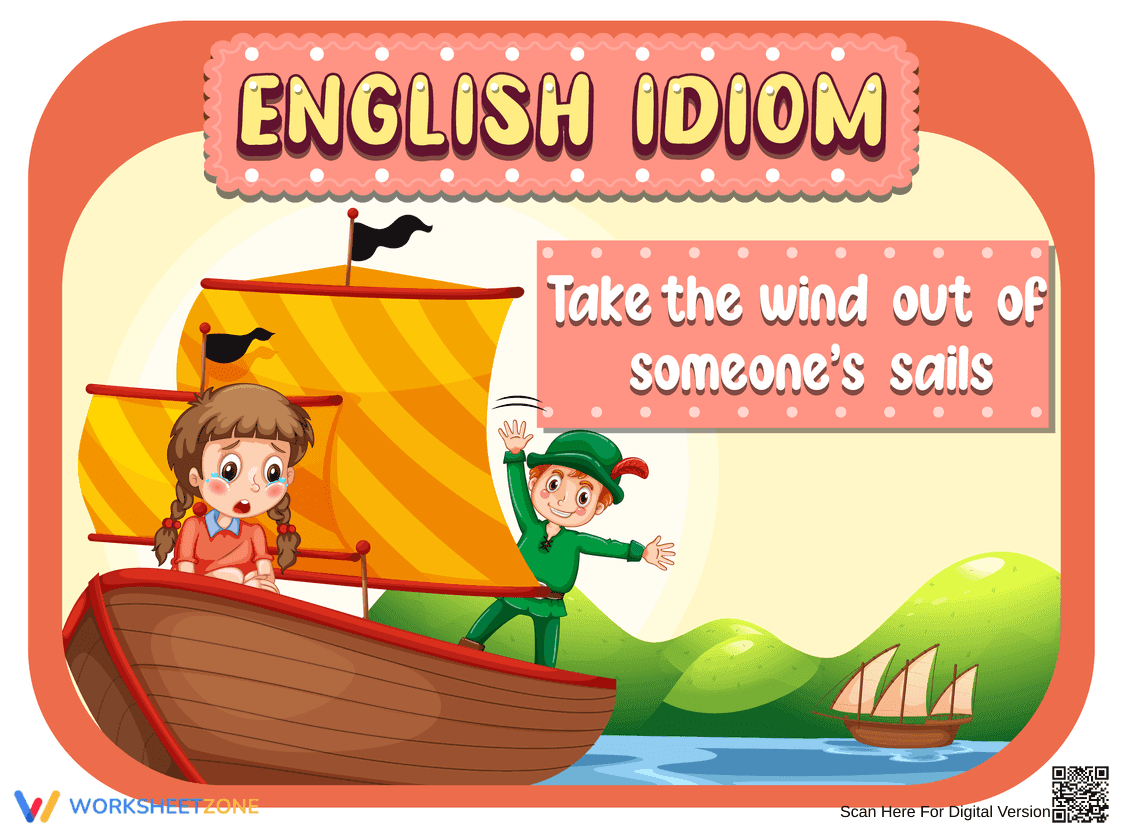
This English Language Arts resource helps students grasp figurative language by visualizing a common expression. By examining the idiom "take the wind out of someone's sails," learners develop stronger reading comprehension. This single-page visual worksheet provides a clear illustration to anchor student understanding of non-literal phrases.
At a Glance
- Grade: 4 · Subject: ELA
- Standard:
CCSS.ELA-LITERACY.L.4.5.B— Recognize and explain the meaning of common idioms.- Skill Focus: Figurative Language
- Format: 1 page · 1 visual task · No answer key · PDF
- Best For: Vocabulary building
- Time: 5–10 minutes
Inside this PDF, educators will find a single visual aid designed to introduce a specific English idiom. The page features a vibrant illustration of a boy blowing wind away from a girl's sailboat, connecting literal imagery to figurative meaning. This format serves as an excellent anchor chart or interactive notebook insert, requiring no complex instructions.
Zero-Prep Workflow
This resource is designed for immediate classroom implementation with minimal teacher preparation.
- Print (1 minute): Simply download the PDF and print the visual worksheet in color or grayscale.
- Distribute (1 minute): Hand out the page to individual students or display it on a smartboard for whole-class viewing.
- Review (3 minutes): Facilitate a brief discussion asking students to infer the idiom's meaning based on the character's expressions and actions.
Total teacher prep time is under two minutes, making this an ideal activity for morning work or a quick sub plan addition.
Standards Alignment
This resource aligns directly with CCSS.ELA-LITERACY.L.4.5.B: Recognize and explain the meaning of common idioms, adages, and proverbs. By analyzing the visual representation of the phrase, students practice decoding non-literal language, a crucial component of advanced reading comprehension. Both standard codes can be copied directly into lesson plans, IEP goals, or district curriculum mapping tools.
How to Use It
Introduce this visual worksheet before a direct instruction lesson on figurative language. Ask students to predict what the phrase means before providing the definition. Alternatively, use it during literacy centers where students write a short paragraph applying the idiom. As a formative assessment observation tip, listen to discussions to gauge if they connect the drawing to the emotional impact. Expected completion time is five to ten minutes.
Who It's For
This resource is primarily designed for third through sixth-grade students expanding their expressive vocabulary. It offers excellent differentiation for English Language Learners (ELLs) and visual learners who benefit from seeing a literal depiction of a figurative concept. Pair this visual worksheet with a reading passage rich in idioms or a broader anchor chart detailing common English expressions to maximize instructional impact.
Mastering figurative language is a critical milestone in elementary literacy development. According to Fisher & Frey (2014), explicit vocabulary instruction that includes visual representations significantly improves students' ability to comprehend complex literary texts. This resource targets CCSS.ELA-LITERACY.L.4.5.B, requiring students to accurately recognize and explain the meaning of common idioms. By providing a clear, engaging illustration of "take the wind out of someone's sails," educators can bridge the gap between literal interpretation and abstract meaning. Visual aids reduce cognitive load, allowing learners to focus on the linguistic nuance of the phrase rather than struggling to visualize the scenario independently. Integrating targeted idiom practice into daily routines supports broader reading comprehension goals and equips students with the expressive language skills necessary for effective communication and advanced literary analysis.


