


























Views
Downloads

Essential Letter T Cursive Tracing Worksheet | Grade 1
Paste this activity's link or code into your existing LMS (Google Classroom, Canvas, Teams, Schoology, Moodle, etc.).
Students can open and work on the activity right away, with no student login required.
You'll still be able to track student progress and results from your teacher account.
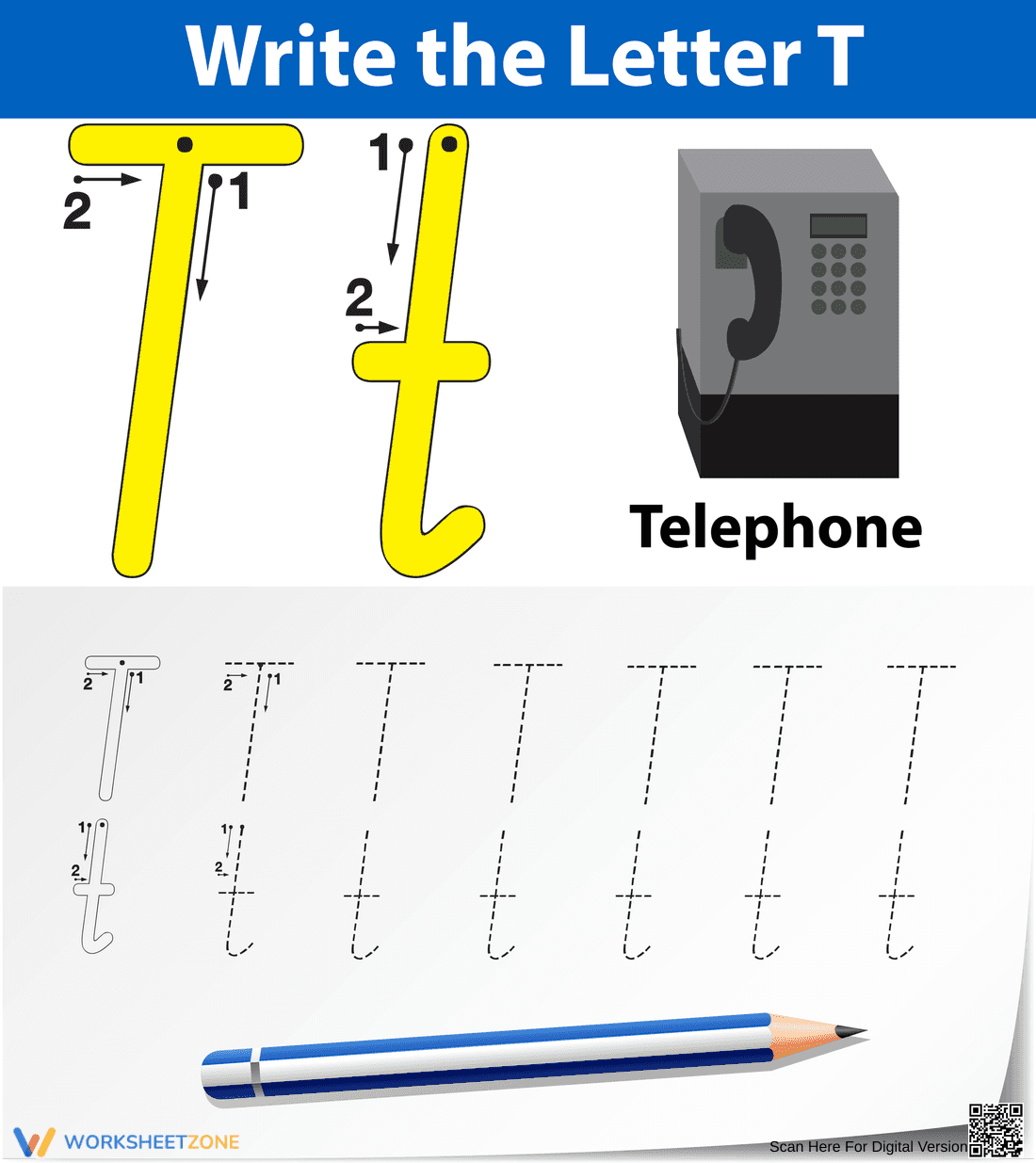
This Grade 1 cursive handwriting worksheet provides focused practice for mastering the letter T. Students develop fine motor control and letter recognition by following numbered directional arrows for both uppercase and lowercase forms. By the end of the session, learners will demonstrate improved stroke consistency and muscle memory for this specific character.
At a Glance
- Grade: 1 · Subject: English
- Standard:
CCSS.ELA-LITERACY.L.1.1.A— Print all upper- and lowercase letters with proper form and spacing- Skill Focus: Cursive Letter T formation
- Format: 1 page · 14 problems · Answer key included · PDF
- Best For: Independent handwriting practice and morning work
- Time: 10–15 minutes
The worksheet features a clear visual guide at the top, showcasing the cursive "T" and "t" with numbered steps and directional arrows. Below the instructional header, students find two rows of tracing opportunities. The first row contains seven uppercase letters, while the second row provides seven lowercase letters. A "Telephone" illustration serves as a mnemonic device to reinforce the letter-sound connection.
This resource is designed for a zero-prep classroom workflow. Teachers can print the single-page PDF in less than 30 seconds. Distribution takes approximately one minute during transition periods. Reviewing student work is instantaneous, as the tracing lines provide immediate visual feedback on stroke accuracy. This makes it an ideal candidate for emergency sub plans or quiet-time activities.
This resource aligns with `CCSS.ELA-LITERACY.L.1.1.A`, which requires students to print all upper- and lowercase letters. While the standard mentions printing, cursive instruction serves as a vital extension for developing advanced literacy and fine motor skills. Both standard codes can be copied directly into lesson plans, IEP goals, or district curriculum mapping tools.
Use this worksheet during the "You Do" phase of a handwriting lesson. After demonstrating the strokes on a whiteboard, assign this page for independent practice. It also functions well as a formative assessment tool; observe students as they trace to identify those struggling with the stroke order. Expect most students to complete the 14 tasks within 12 minutes.
This worksheet is primarily for first-grade students beginning their cursive journey. It is also effective for second-grade review or for students receiving occupational therapy services to improve grip and stroke precision. Pair this worksheet with a letter-sound anchor chart or a phonics passage focusing on the /t/ sound for a comprehensive literacy block.
Research from Fisher & Frey (2014) emphasizes the importance of the gradual release of responsibility, which is mirrored here through the transition from guided visual cues to independent tracing. Handwriting remains a foundational component of literacy, as physical letter formation is linked to better orthographic mapping in the brain. According to the NAEP, students who develop fluent handwriting early are better equipped to focus on higher-order composition tasks in later grades. This worksheet provides the 14 repetitions necessary to begin building that muscle memory. By focusing on a single letter, the cognitive load is minimized, allowing students to concentrate entirely on the mechanics of the cursive stroke. This targeted approach ensures that the letter T becomes a permanent part of the student's written repertoire, facilitating smoother transitions to whole-word cursive writing.


