


























Views
Downloads

Synonyms and Antonyms Worksheet | Essential Grade 1 ELA
Paste this activity's link or code into your existing LMS (Google Classroom, Canvas, Teams, Schoology, Moodle, etc.).
Students can open and work on the activity right away, with no student login required.
You'll still be able to track student progress and results from your teacher account.
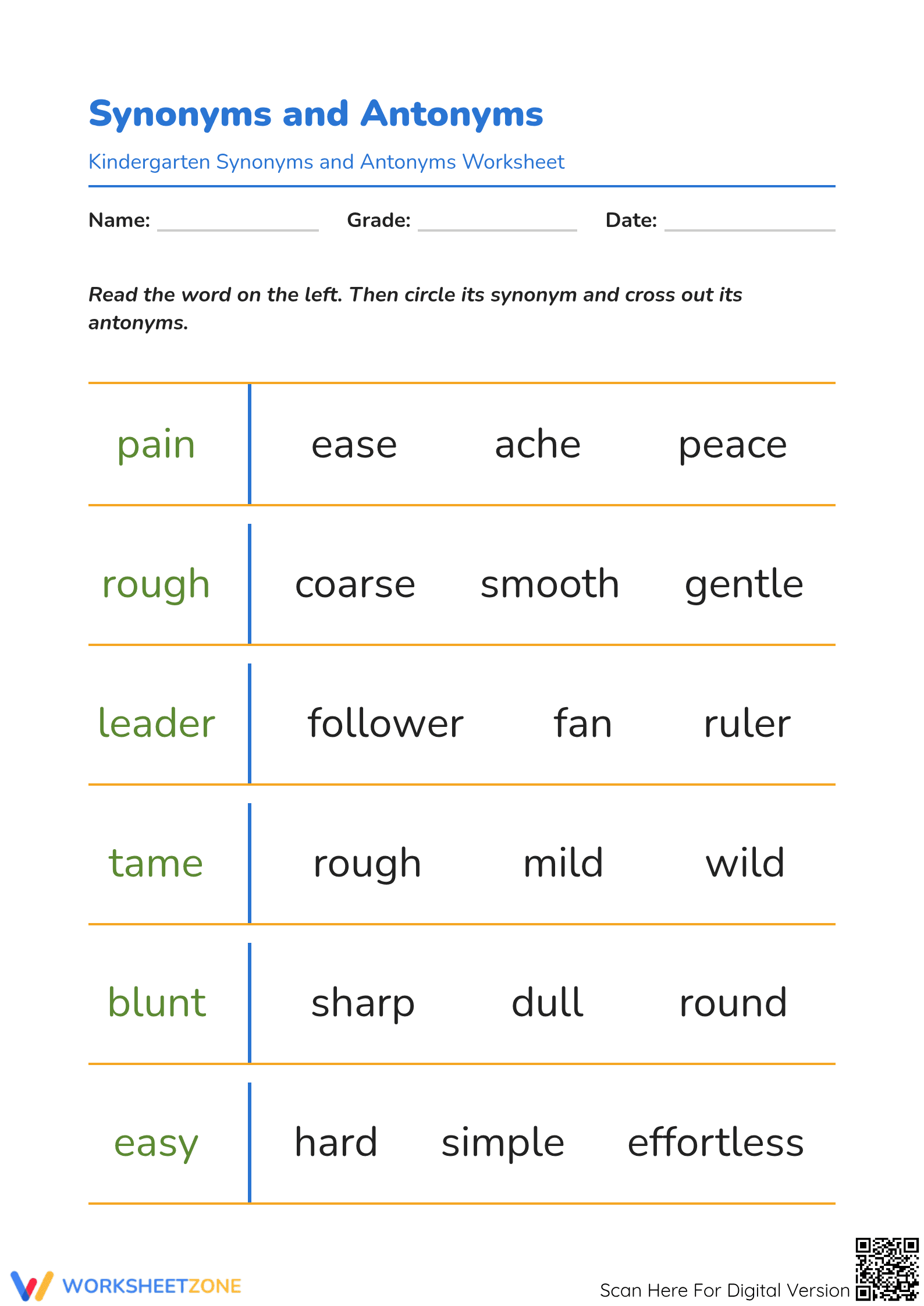
This Grade 1 synonyms and antonyms worksheet helps students distinguish between similar and opposite word meanings through active identification. By circling synonyms and crossing out antonyms, learners build a robust lexical foundation. This resource ensures students can recognize word relationships, a critical component of reading comprehension and vocabulary development in early elementary education.
At a Glance
- Grade: 1 · Subject: ELA
- Standard:
CCSS.ELA-LITERACY.L.1.5— Demonstrate understanding of word relationships and nuances in word meanings- Skill Focus: Synonyms and Antonyms
- Format: 1 page · 6 problems · Answer key included · PDF
- Best For: Independent practice or morning work
- Time: 10–15 minutes
The worksheet features a clean, six-row layout designed for young learners. Each row presents a target word on the left, followed by three options. Students must apply two different cognitive actions: circling the synonym and crossing out the antonyms. The resource includes a full answer key for quick grading and a QR code for digital access.
Teachers can implement this resource in under two minutes. First, print the single-page PDF for your class (1 minute). Next, distribute the sheets and provide a brief verbal instruction on the dual-action task (30 seconds). Finally, use the included answer key to review student work or facilitate a peer-grading session (30 seconds). It is an ideal choice for emergency sub plans or transition periods.
This resource aligns with `CCSS.ELA-LITERACY.L.1.5`, which requires students to demonstrate understanding of word relationships and nuances. Specifically, it targets the ability to define words by category and by attributes. Both standard codes can be copied directly into lesson plans, IEP goals, or district curriculum mapping tools.
Use this worksheet as a formative assessment after a direct instruction lesson on word pairs. Observe if students can distinguish between the two types of relationships without confusing the symbols (circle vs. cross). It typically takes 10 to 15 minutes to complete, making it perfect for a literacy center rotation.
This is designed for Grade 1 students, though it serves as an excellent challenge for Kindergarteners or a review for Grade 2. It pairs naturally with a classroom anchor chart displaying common word pairs or a read-aloud focused on descriptive language.
According to the RAND AIRS 2024 report, explicit instruction in word relationships like synonyms and antonyms significantly improves early reading fluency and lexical depth. This worksheet targets CCSS.ELA-LITERACY.L.1.5 by requiring students to actively categorize words based on their semantic proximity or opposition. By engaging in the dual task of circling and crossing out, students reinforce the cognitive distinction between similar and contrasting meanings. Research from Fisher & Frey (2014) emphasizes that such structured practice helps bridge the gap between basic decoding and deep comprehension. This resource provides the necessary repetition for students to internalize these lexical patterns, ensuring they can apply these skills to more complex texts. Educators can rely on this evidence-based approach to support foundational literacy goals and track student progress toward mastery of primary language standards.


