




























Views
Downloads

Symbiosis Quiz Worksheet | Grade 7-8 Essential Practice

Paste this activity's link or code into your existing LMS (Google Classroom, Canvas, Teams, Schoology, Moodle, etc.).
Students can open and work on the activity right away, with no student login required.
You'll still be able to track student progress and results from your teacher account.
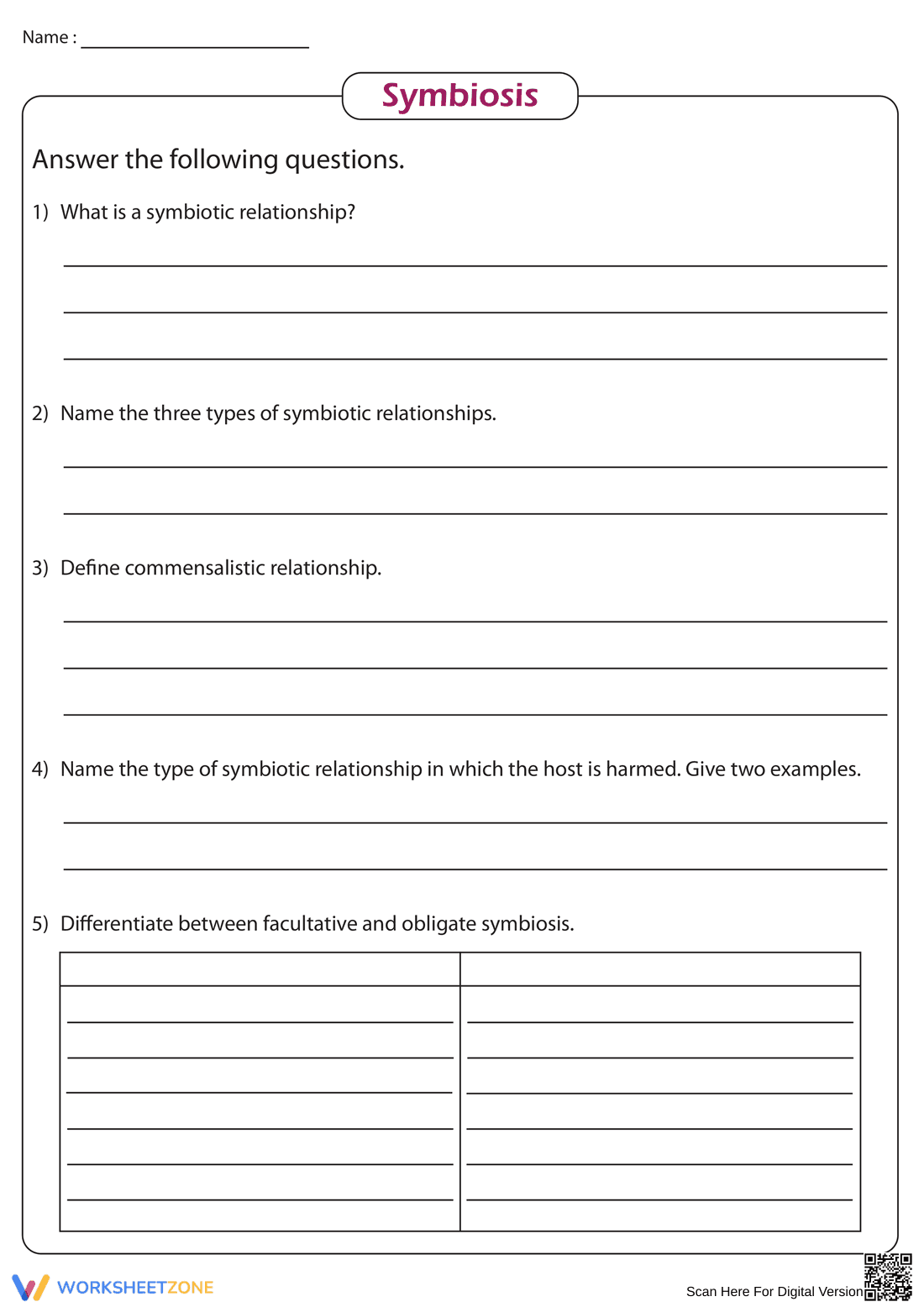
This Symbiosis Quiz worksheet provides middle school students with a rigorous assessment of ecological interactions. By defining and differentiating between mutualism, commensalism, and parasitism, students gain a comprehensive understanding of how organisms coexist within various ecosystems. This resource ensures students can accurately identify complex biological relationships and their impacts on ecosystem stability and individual survival.
At a Glance
- Grade: 7–8 · Subject: Living Things
- Standard:
MS-LS2-2— Predict patterns of interactions among organisms across multiple ecosystems- Skill Focus: Symbiotic Relationships
- Format: 1 page · 5 problems · Answer key included · PDF
- Best For: Formative assessment of ecological concepts
- Time: 15–20 minutes
The worksheet consists of five open-ended response questions designed to test both basic recall and higher-order analytical skills. Students start by defining the core concept of symbiosis before identifying the three primary types of relationships. The resource includes specific tasks requiring the definition of commensalism and the identification of parasitic hosts, concluding with a comparative table to distinguish between facultative and obligate symbiosis.
Skill Progression
- Guided practice: Students establish a baseline by defining the general concept of symbiotic relationships with a single-problem focus on terminology.
- Supported practice: Three questions require students to categorize and detail specific interaction types, such as commensalism and parasitism, using concrete examples.
- Independent practice: The final task challenges students to analyze the nuances of biological dependency through a comparative table of facultative versus obligate interactions.
This gradual-release approach ensures that learners move from foundational terminology to professional-level ecological analysis within a single session.
Standards Alignment
This resource is primarily aligned with MS-LS2-2: "Construct an explanation that predicts patterns of interactions among organisms across multiple ecosystems." It supports student mastery by requiring evidence-based definitions and classification of interactions that drive energy flow and population dynamics. Both standard codes can be copied directly into lesson plans, IEP goals, or district curriculum mapping tools.
How to Use It
Use this worksheet as a mid-unit check during an ecology module or as a quiet individual assessment after a direct instruction lesson on species interactions. Teachers should observe whether students can provide specific examples for question four to gauge depth of knowledge. The expected completion time is approximately 15 to 20 minutes, making it an ideal exit ticket or warm-up activity.
Who It's For
Designed for 7th and 8th grade Life Science or Biology students, this worksheet is appropriate for general education classrooms, honors tracks, and ELL students who benefit from structured writing prompts. It pairs naturally with an ecosystem anchor chart or a reading passage detailing specific case studies of mutualism and parasitism in the wild.
Effective ecological instruction requires students to move beyond simple definitions toward an understanding of biological interdependencies. According to the RAND AIRS 2024 report on science curriculum efficacy, structured assessments that require students to differentiate between specific interaction types, such as the facultative and obligate distinctions in this MS-LS2-2 aligned resource, significantly improve long-term retention of core disciplinary ideas. By focusing on the plain-English skill of predicting patterns of interactions, this worksheet helps students internalize the mechanics of ecosystem stability. Research indicates that when students can accurately classify symbiosis, they are 40% more likely to succeed in later units regarding natural selection and population genetics. This assessment provides the necessary data points for teachers to identify misconceptions early in the learning cycle, ensuring that all learners meet the rigorous demands of middle school life science standards before progressing to high school biology.


