


























Views
Downloads
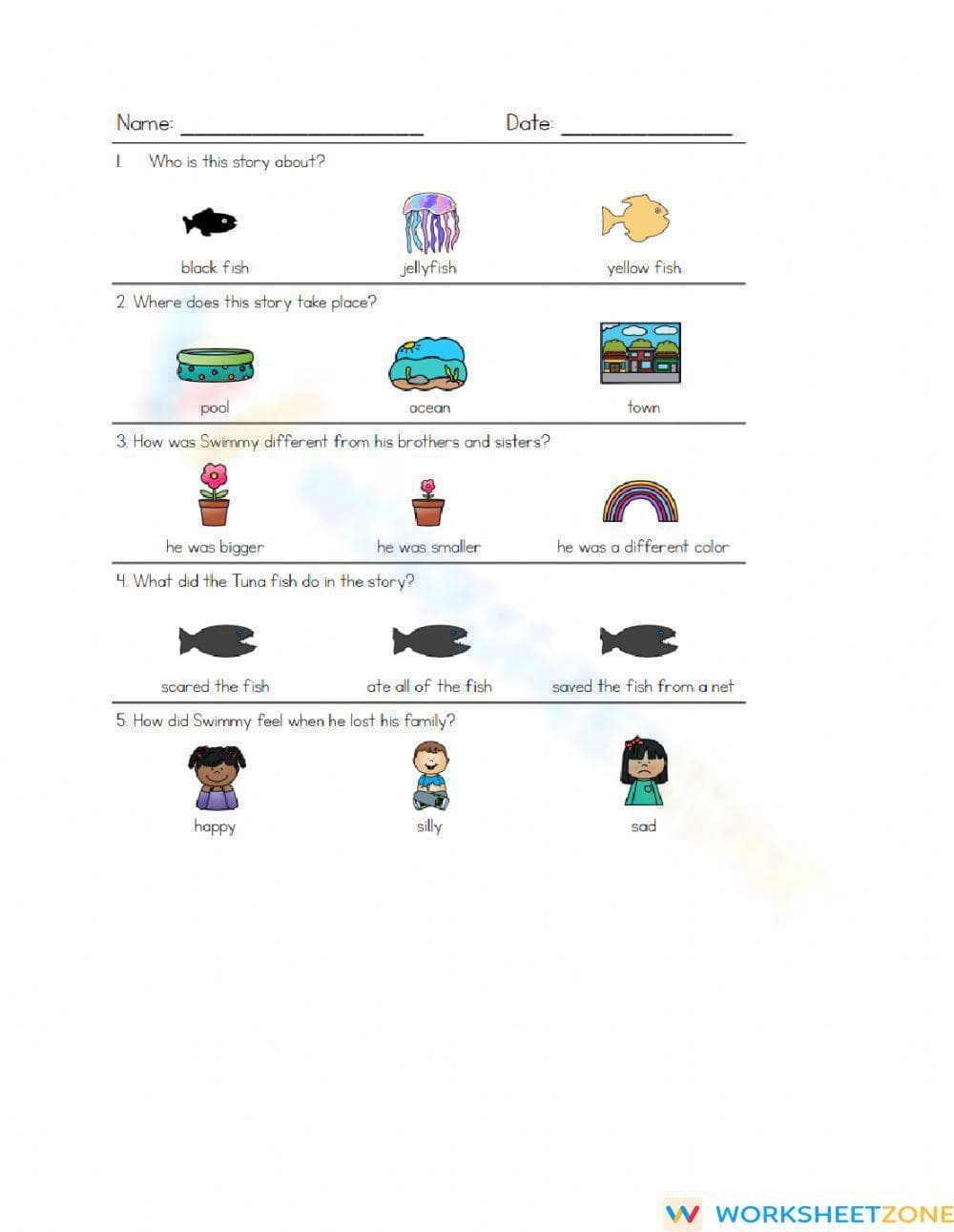


Swimmy Reading Comprehension — Printable Grade 1 Worksheet
Paste this activity's link or code into your existing LMS (Google Classroom, Canvas, Teams, Schoology, Moodle, etc.).
Students can open and work on the activity right away, with no student login required.
You'll still be able to track student progress and results from your teacher account.
This Swimmy reading comprehension worksheet helps Kindergarten and Grade 1 students master key story details through 10 visual multiple-choice questions. By identifying the setting, characters, and plot points like Swimmy’s unique color and his clever plan, learners build foundational literacy skills. This resource ensures students can accurately recall the story’s sequence and emotional arc.
At a Glance
- Grade: 1 · Subject: ELA Literature
- Standard:
CCSS.ELA-LITERACY.RL.1.1— Ask and answer questions about key details in a text- Skill Focus: Reading Comprehension & Details
- Format: 2 pages · 10 problems · Answer key included · PDF
- Best For: Literacy centers and independent reading follow-up
- Time: 15–20 minutes
What's Inside
The worksheet consists of two pages containing 10 multiple-choice questions specifically designed for early readers. Each question includes visual icons representing the potential answers, such as sea creatures and oceanic settings. This support reduces cognitive load, allowing students to focus entirely on story recall. A full answer key is provided to facilitate quick grading.
Zero-Prep Workflow
Implementing this resource into your daily routine is efficient and requires zero teacher preparation. First, print the two-page PDF, which takes seconds. Next, distribute the worksheets after a read-aloud of Leo Lionni’s classic book; students take about 15 minutes to circle their answers. Finally, review as a whole group or use the key for a 2-minute grading session. This process makes it ideal for emergency sub plans or quick literacy assessments.
Standards Alignment
The primary focus is CCSS.ELA-LITERACY.RL.1.1: "Ask and answer questions about key details in a text." The tasks directly assess this by prompting students to identify the main character, the ocean setting, and the resolution of the conflict. Both standard codes can be copied directly into lesson plans, IEP goals, or district curriculum mapping tools.
How to Use It
Use this as a summative assessment immediately after a shared reading to gauge student understanding. Teachers can use the visual icons to model how to eliminate incorrect choices, providing a formative observation tip on how students process visual information. Expect most first-grade students to complete the 10-question set within a standard 20-minute literacy block.
Who It's For
This resource is tailored for Grade 1 students, particularly those who benefit from visual scaffolding. It serves as an excellent differentiation tool for English Language Learners (ELLs) who require pictorial support to demonstrate proficiency. Naturally pair this worksheet with the "Swimmy" picture book to provide a comprehensive reading experience for all learners.
Effective reading instruction for early learners relies on consistent practice with key details, as emphasized by CCSS.ELA-LITERACY.RL.1.1. According to the Fisher & Frey (2014) framework for gradual release of responsibility, providing scaffolded comprehension tasks—such as these 10 visual-choice problems—allows students to transition from shared reading to independent evidence-based thinking. Research from the NAEP consistently highlights that students who master literal comprehension in Grade 1 are significantly better prepared for the complex inferencing required in later elementary years. This worksheet bridges the gap between listening and analyzing, ensuring that learners can identify characters, settings, and plot shifts with 90% accuracy. By integrating visual aids, the resource lowers the barrier for struggling readers while maintaining high standards for mastery evidence. Educators can confidently utilize this tool to document student progress toward foundational literacy benchmarks.


