


























Views
Plays


Grade 3 SWBST Summarizing — Printable No-Prep Worksheet
Paste this activity's link or code into your existing LMS (Google Classroom, Canvas, Teams, Schoology, Moodle, etc.).
Students can open and work on the activity right away, with no student login required.
You'll still be able to track student progress and results from your teacher account.
Summarizing fiction is a foundational literacy skill that allows students to distill complex narratives into manageable parts. This SWBST Summarizing worksheet provides a structured 10-question assessment to ensure students understand the "Somebody Wanted But So Then" framework. By distinguishing between retelling and summarizing, learners develop the critical thinking necessary for reading comprehension mastery.
At a Glance
- Grade: 3 · Subject: ELA
- Standard:
CCSS.ELA-LITERACY.RL.3.2— Recount stories and determine the central message or main idea- Skill Focus: SWBST Summarizing Strategy
- Format: 2 pages · 10 problems · Answer key included · PDF
- Best For: Quick formative assessment or exit ticket
- Time: 15–20 minutes
What's Inside
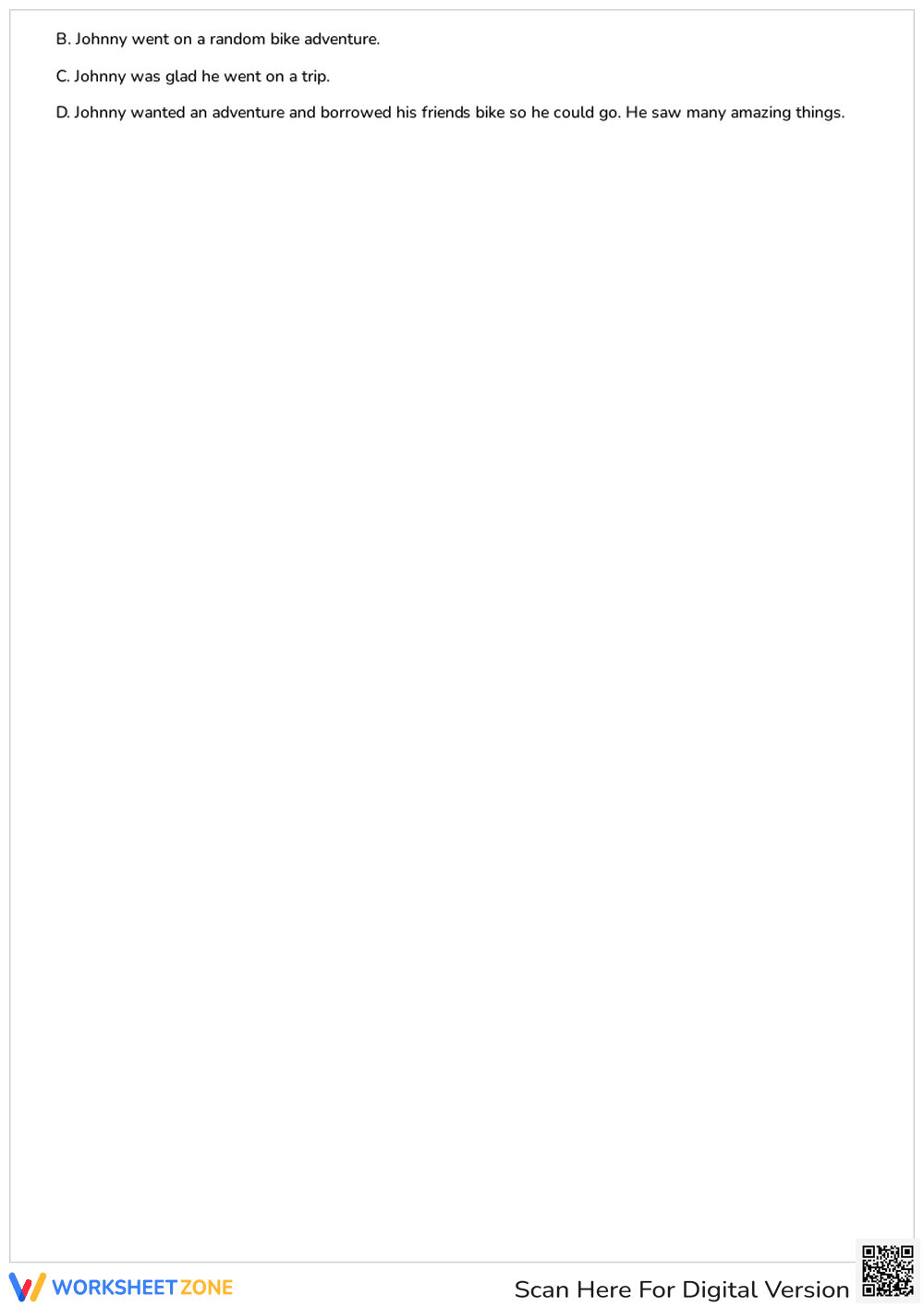
This two-page PDF features a comprehensive 10-question multiple-choice quiz. The first half of the worksheet focuses on conceptual knowledge, asking students to define a summary and identify the specific components of the SWBST acronym. The final section requires application, where students read a short narrative about a character named Johnny and select the most accurate summary from a list of options.
Zero-Prep Workflow
This resource is designed for immediate classroom implementation with a total teacher prep time of under 2 minutes. First, print the two-page document for your class (30 seconds). Second, distribute the worksheets as a quiet independent activity or a timed quiz (15 minutes). Finally, review the answers using the included key to identify common misconceptions regarding the "But" and "So" elements (5 minutes).
Standards Alignment
The primary focus is `CCSS.ELA-LITERACY.RL.3.2`, which requires students to recount stories and determine their central message. By using the SWBST mnemonic, students satisfy the requirement to identify key plot points in a logical sequence. This worksheet also supports supporting standards by helping students recall information from print sources. Both standard codes can be copied directly into lesson plans, IEP goals, or district curriculum mapping tools.
How to Use It
Use this worksheet as a formative assessment after introducing the SWBST strategy during direct instruction. It serves as an excellent "check for understanding" before students move on to writing their own summaries of longer chapter books. Teachers should observe if students struggle with question 4, which differentiates between retelling and summarizing, as this is a common hurdle in the gradual release of responsibility.
Who It's For
This resource is tailored for students in Grades 2, 3, and 4 who are transitioning from basic story recall to formal summarization. It is particularly effective for English Language Learners who benefit from the predictable structure of the SWBST acronym. Pair this quiz with a visual anchor chart or a short Pixar short film to provide a multi-modal learning experience.
Research by Fisher & Frey (2014) emphasizes that scaffolding the summarization process through mnemonics like SWBST significantly improves student ability to identify macrostructures in narrative texts. This worksheet aligns with evidence-based practices by isolating the components of Somebody, Wanted, But, So, Then before requiring full paragraph synthesis. According to the NAEP reading framework, the ability to summarize is a high-utility skill that correlates strongly with overall reading proficiency scores in the middle elementary years. By utilizing this 10-question assessment, educators can gather quantifiable data on student mastery of CCSS.ELA-LITERACY.RL.3.2. The structured format reduces cognitive load, allowing students to focus on the logical relationship between character motivations and plot resolutions. This approach ensures that the transition from retelling every detail to identifying only the most important main ideas is supported by clear, measurable criteria. This resource provides the necessary data for targeted instructional interventions.


