


























Views
Downloads
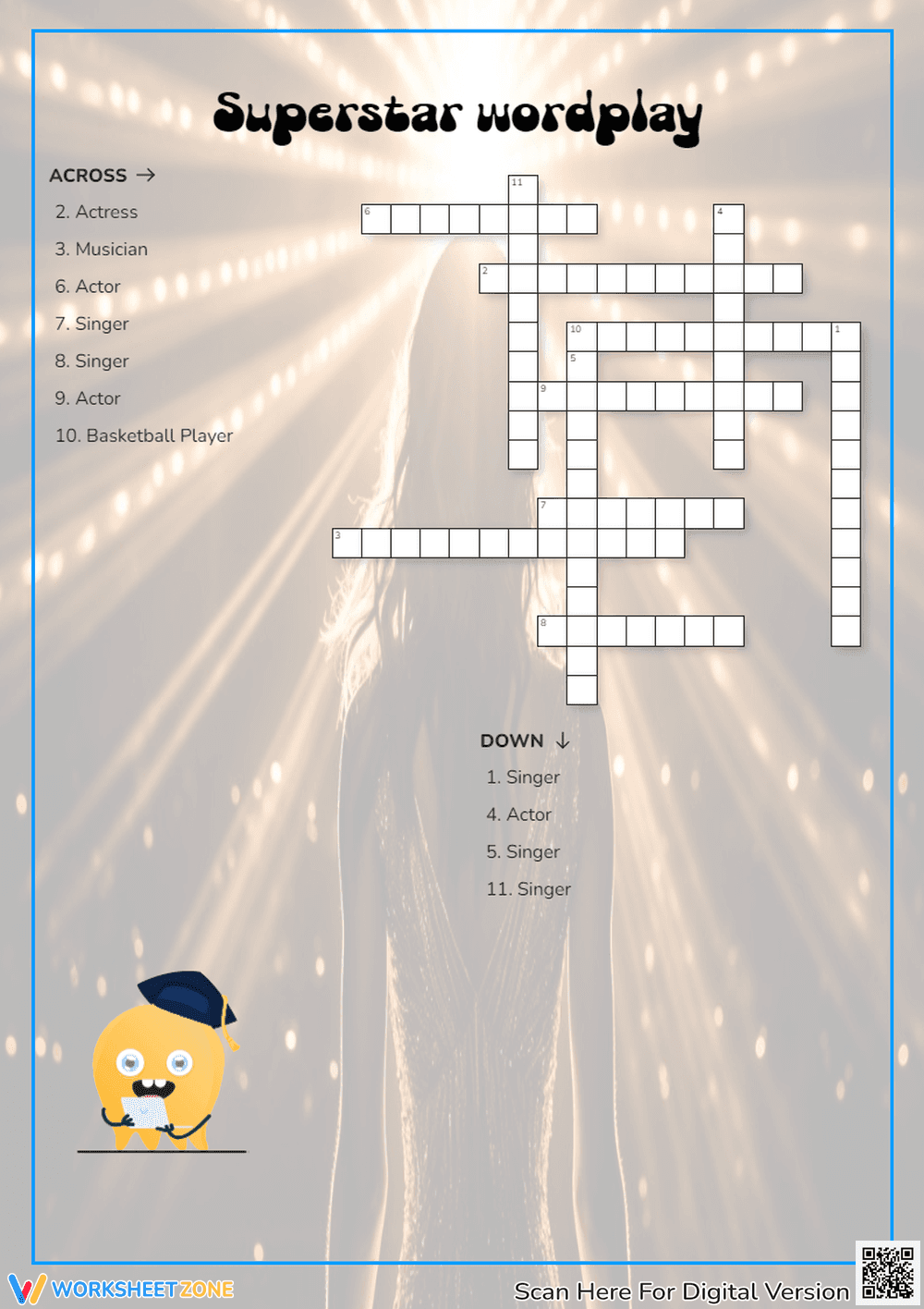

Grade 3 Celebrity Crossword — Printable No-Prep Worksheet
Paste this activity's link or code into your existing LMS (Google Classroom, Canvas, Teams, Schoology, Moodle, etc.).
Students can open and work on the activity right away, with no student login required.
You'll still be able to track student progress and results from your teacher account.
This engaging Grade 3 crossword puzzle helps students practice spelling and vocabulary recognition through a fun, pop-culture lens. By identifying famous actors, singers, and athletes from simple category clues, learners reinforce their spelling accuracy and word recall in an enjoyable, low-stakes format.
At a Glance
- Grade: 3 · Subject: ELA
- Standard:
CCSS.ELA-LITERACY.L.3.4— Determine the meaning of words and phrases- Skill Focus: Vocabulary and Spelling
- Format: 1 page · 11 problems · Answer key included · PDF
- Best For: Early finishers and sub plans
- Time: 10–15 minutes
This single-page printable features a visually appealing superstar-themed crossword grid. Students will find eleven distinct clues divided into standard "Across" and "Down" sections. The clues prompt learners to recall specific celebrities based on broad occupational categories like "Actress," "Musician," and "Basketball Player." A complete answer key is provided to ensure quick verification of student responses, making grading effortless.
Zero-Prep Workflow
- Print (1 minute): Download the PDF and print copies. The high-contrast design ensures clear reproduction.
- Distribute (1 minute): Hand out the puzzle. The instructions are intuitive and require no complex explanation.
- Review (3 minutes): Use the included answer key to quickly check student work.
With a total teacher prep time of under two minutes, this worksheet is an ideal, reliable option for emergency substitute teacher plans or unexpected schedule changes.
Standards Alignment
This activity aligns with CCSS.ELA-LITERACY.L.3.4, which requires students to determine or clarify the meaning of unknown and multiple-meaning words and phrases based on grade-level reading and content. While functioning as a fun pop-culture activity, it supports foundational spelling and word retrieval skills. Both standard codes can be copied directly into lesson plans, IEP goals, or district curriculum mapping tools.
How to Use It
This crossword serves as an excellent activity for early finishers. It can be distributed during independent work time to keep students engaged in a quiet, productive task. As a formative assessment observation tip, monitor how students use intersecting letters to problem-solve unknown words, demonstrating their understanding of spelling patterns. Expected completion time ranges from ten to fifteen minutes.
Who It's For
Designed for third-grade students, this worksheet is highly accessible for second and fourth graders depending on their pop culture knowledge. For students needing support, provide a word bank on the board to reduce cognitive load. This puzzle pairs naturally with a broader unit on biographies or a direct instruction lesson on using intersecting letters to solve word problems.
Integrating engaging, thematic puzzles into the classroom routine provides meaningful cognitive benefits beyond simple entertainment. Aligned with CCSS.ELA-LITERACY.L.3.4, this activity requires students to determine the meaning of words and phrases while practicing accurate spelling retrieval. According to a recent ScienceDirect TpT Analysis, incorporating gamified elements like crosswords into independent practice significantly increases student time-on-task and reduces off-task behaviors during transitional periods. By challenging learners to recall specific proper nouns based on categorical clues, this worksheet reinforces memory retrieval pathways and encourages the practical application of spelling conventions. The structured format of the crossword grid also naturally scaffolds the problem-solving process, as intersecting letters provide immediate feedback and guide students toward the correct answers. This low-stakes, high-interest approach ensures that foundational literacy skills are practiced consistently without causing student fatigue.


