


























Views
Downloads
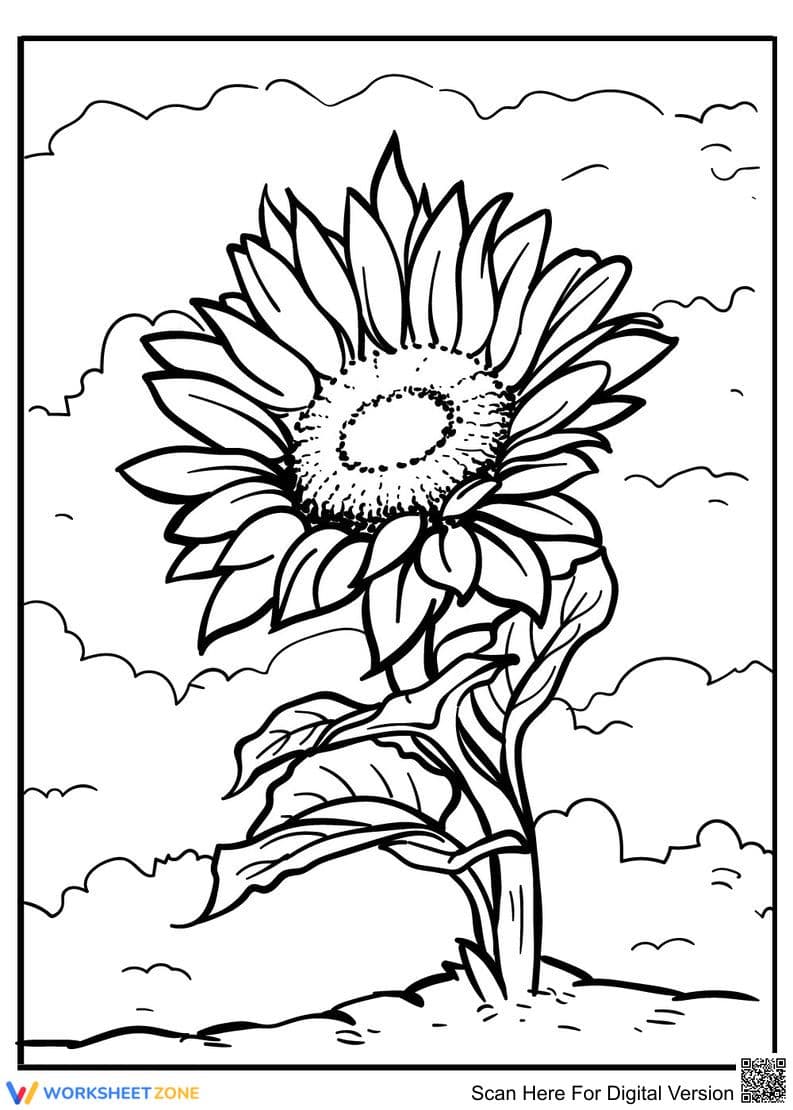

Sunflower in the Wind Coloring Page | Essential Printable
Paste this activity's link or code into your existing LMS (Google Classroom, Canvas, Teams, Schoology, Moodle, etc.).
Students can open and work on the activity right away, with no student login required.
You'll still be able to track student progress and results from your teacher account.
This Sunflower in the Wind coloring worksheet provides students with a high-quality artistic canvas to practice fine motor control and color theory. By engaging with the intricate petals and background elements, learners develop the hand-eye coordination necessary for writing and detailed tasks. It offers a peaceful, creative outlet that integrates naturally into any elementary classroom setting.
At a Glance
- Grade: K-5 · Subject: Arts & English
- Standard:
CCSS.ELA-LITERACY.SL.K.5— Add visual displays to descriptions to provide additional detail and clarity- Skill Focus: Fine motor development
- Format: 1 page · 1 task · No answer key needed · PDF
- Best For: Morning work or creative brain breaks
- Time: 15–20 minutes
This single-page PDF features a large, detailed sunflower positioned against a sky filled with wispy clouds. The line art is crisp and clear, providing distinct boundaries that help younger students practice staying within the lines while offering enough detail for older students to experiment with shading and texture. No additional teacher setup is required beyond basic coloring supplies like crayons, markers, or colored pencils.
The zero-prep workflow for this resource is designed for maximum efficiency in busy classrooms. First, print the desired number of copies in under 30 seconds. Second, distribute the pages to students during transition periods or as a focused morning activity, taking less than 1 minute. Finally, review the completed work by displaying it on a classroom bulletin board to celebrate student creativity. Total teacher preparation time is less than 2 minutes.
The primary standard addressed is CCSS.ELA-LITERACY.SL.K.5, which encourages students to add drawings or other visual displays to descriptions to provide additional detail. While primarily an artistic task, this worksheet supports foundational literacy by strengthening the small muscle groups in the hand required for letter formation. This standard code can be copied directly into lesson plans, IEP goals, or district curriculum mapping tools.
Use this worksheet as a calming activity to help students settle in after recess or lunch. It serves as an excellent formative assessment tool for observing pencil grip and pressure control in early learners. Expect students to spend between 15 and 20 minutes completing the page, depending on the complexity of the artistic mediums they choose to employ.
This resource is ideal for Kindergarten through 5th-grade students, particularly those who benefit from tactile, visual learning. It is a perfect pairing for a science lesson on plant life cycles or a weather unit focusing on wind. Occupational therapists may also find this useful for students working on specific fine motor goals in a low-stress environment.
According to the RAND AIRS 2024 report on early childhood development, the integration of artistic tasks like coloring is vital for developing the pre-writing skills necessary for academic success. This Sunflower in the Wind worksheet aligns with CCSS.ELA-LITERACY.SL.K.5 by providing a structured visual task that enhances a student's ability to express detail through non-verbal means. Research from Fisher & Frey (2014) suggests that creative expression can significantly improve student focus during subsequent high-stakes instructional blocks. By providing 1 page of focused artistic practice, this resource helps bridge the gap between creative play and formal academic requirements. The use of specific imagery like a sunflower allows for cross-curricular connections to biology and environmental science, making it a versatile tool for any elementary educator. This summary confirms the worksheet's utility in fostering both fine motor precision and creative engagement in a classroom setting.


