




























Views
Downloads
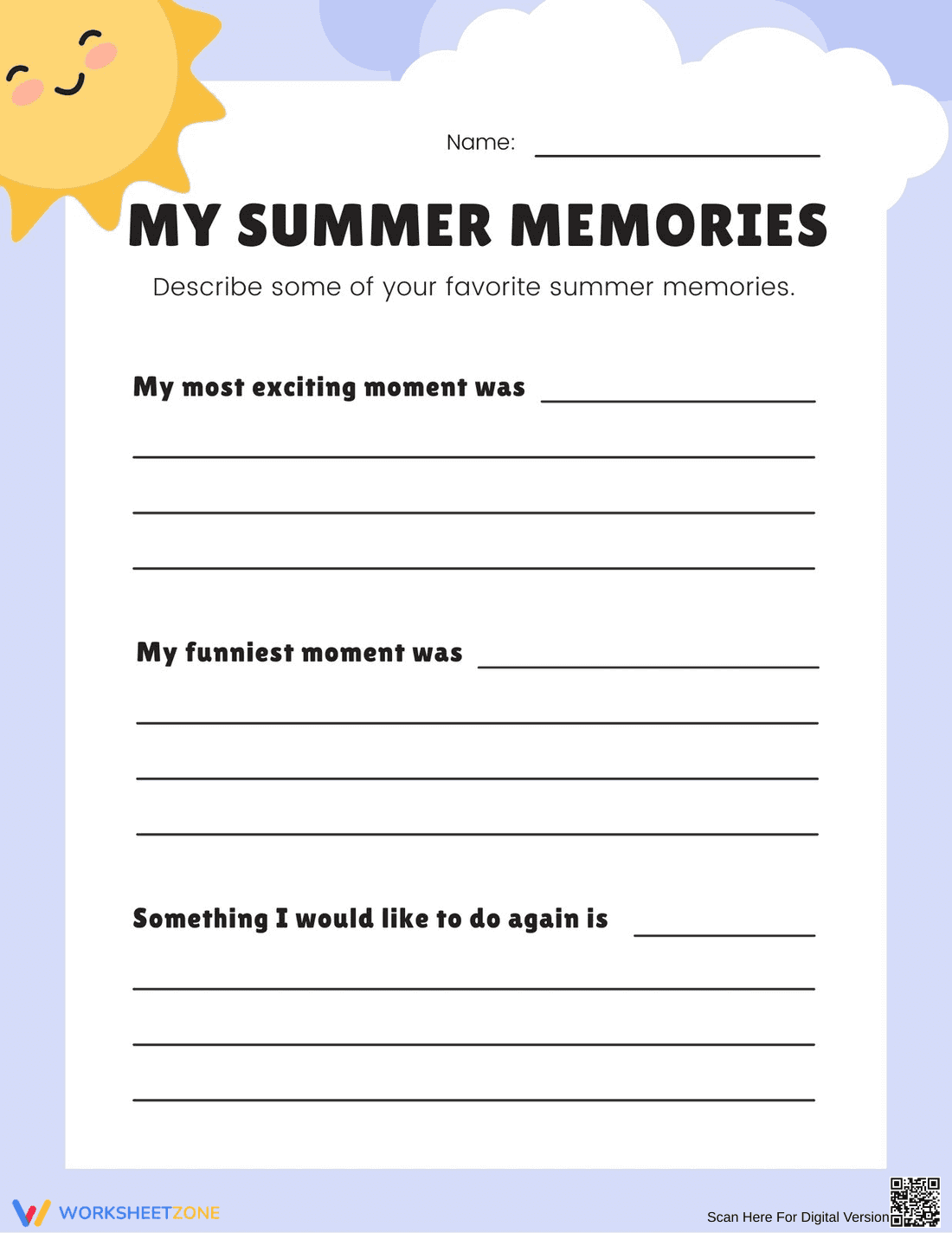

Summer Memories Writing Prompt | Grade 1 Essential

Paste this activity's link or code into your existing LMS (Google Classroom, Canvas, Teams, Schoology, Moodle, etc.).
Students can open and work on the activity right away, with no student login required.
You'll still be able to track student progress and results from your teacher account.
This Grade 1 summer memories writing prompt helps students transition back to school by reflecting on their seasonal experiences. By providing structured sentence starters, the worksheet encourages young writers to recount specific events with clarity and detail. It serves as an ideal icebreaker activity that builds narrative stamina while assessing baseline writing skills.
At a Glance
At a Glance
- Grade: 1 · Subject: ELA
- Standard:
CCSS.ELA-LITERACY.W.1.3— Recount two or more appropriately sequenced events with some details- Skill Focus: Personal Narrative Writing
- Format: 1 page · 3 tasks · No answer key needed · PDF
- Best For: Back-to-school icebreaker and narrative assessment
- Time: 15–20 minutes
What's Inside
Inside this single-page PDF, you will find three distinct writing prompts designed to elicit descriptive responses. The layout features wide primary lines suitable for first-grade handwriting. Each section begins with a bold sentence starter—covering exciting moments, funny occurrences, and future desires—to reduce the cognitive load of starting a blank page and help students focus on their narrative content.
Zero-Prep Workflow
The zero-prep workflow for this resource is designed for maximum efficiency in a busy classroom. First, print the single-page PDF (30 seconds). Next, distribute the sheets to students as a morning work or bell-ringer activity (1 minute). Finally, review the responses during a share chair session to build classroom community (10-15 minutes). Total teacher preparation time is under 2 minutes.
Standards Alignment
This resource is aligned with `CCSS.ELA-LITERACY.W.1.3`, which requires students to write narratives that recount sequenced events with details regarding what happened and a sense of closure. It also supports CCSS.ELA-LITERACY.L.1.1 by providing a framework for practicing grammar and sentence structure. Both standard codes can be copied directly into lesson plans, IEP goals, or district curriculum mapping tools.
How to Use It
Use this worksheet during the first week of school to gauge student writing levels. It works well as a formative assessment to see who can maintain a topic and use punctuation correctly. Alternatively, assign it as a low-stakes homework task to involve parents in the back-to-school transition. Expect students to complete the three prompts in approximately 15 to 20 minutes depending on their writing speed.
Who It's For
This worksheet is for first-grade students, though it can be used for kindergarteners ready for sentence writing or second graders needing a quick review. It pairs naturally with a Summer Share anchor chart or a mentor text about seasonal changes. It is particularly useful for English Language Learners who benefit from the provided sentence frames.
Narrative writing in early elementary grades is a critical predictor of later literacy success. According to Fisher & Frey (2014), providing scaffolds like sentence frames allows novice writers to focus on content generation rather than structural anxiety. This worksheet utilizes three specific prompts to guide students through the recount process, aligning with the CCSS.ELA-LITERACY.W.1.3 requirement for sequenced narrative events. Research from the NAEP indicates that students who engage in regular, low-stakes personal writing demonstrate higher engagement and improved fluency over time. By using this 1-page resource, educators provide a structured environment for students to practice descriptive language and chronological organization. The clear visual cues and sun-themed graphics serve as non-linguistic representations that support memory retrieval. This tool is an efficient way to collect baseline data on student capitalization, punctuation, and spelling during the critical first weeks of the academic year.


