


























Views
Downloads
Essential Suffixes Worksheet | Grade 3 English Aligned
Paste this activity's link or code into your existing LMS (Google Classroom, Canvas, Teams, Schoology, Moodle, etc.).
Students can open and work on the activity right away, with no student login required.
You'll still be able to track student progress and results from your teacher account.
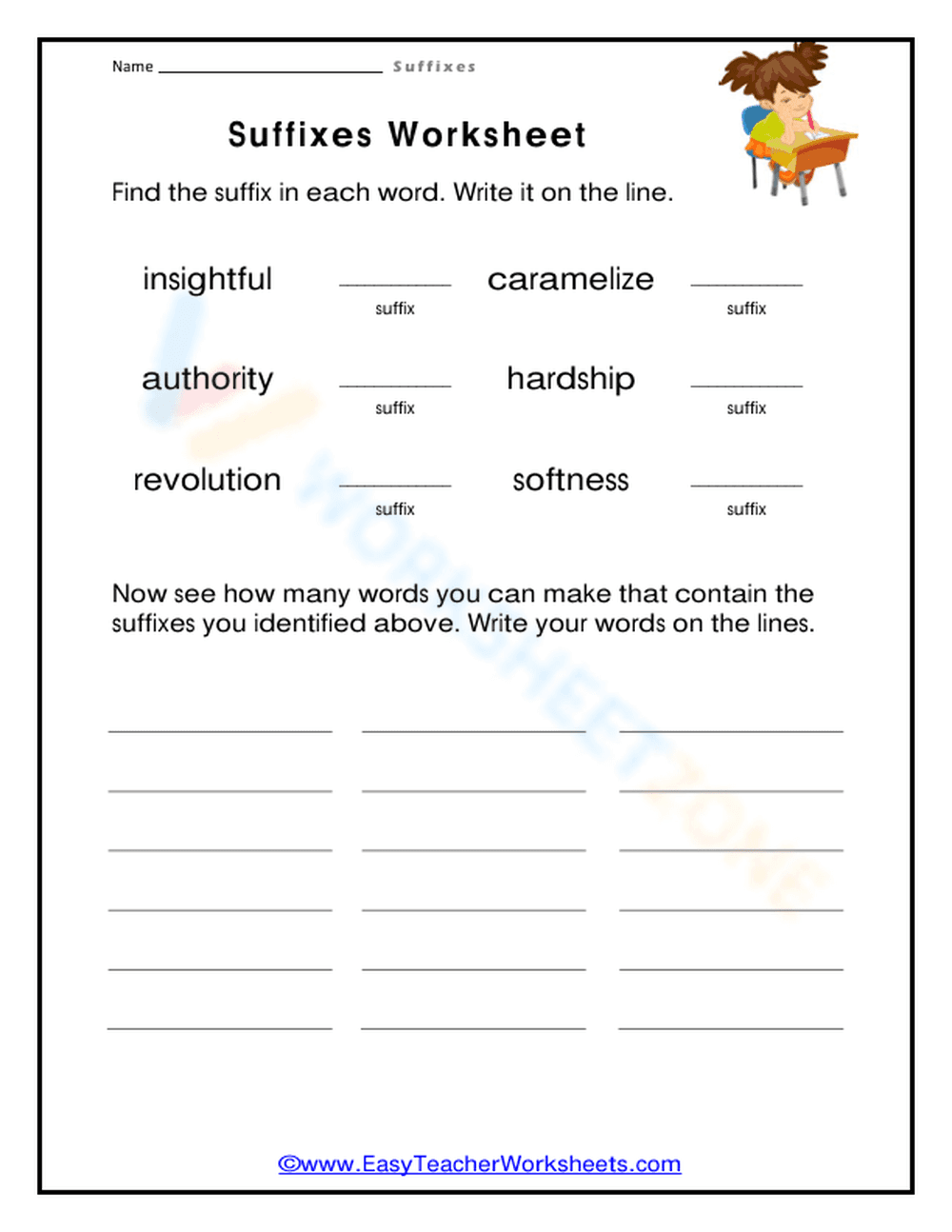
This essential Grade 3 suffixes worksheet provides a direct method for students to master the identification and application of word endings. By isolating suffixes and then generating original examples, learners deepen their understanding of how affixes alter word meaning. This resource ensures students gain confidence in decoding complex vocabulary effectively.
At a Glance
- Grade: 3 · Subject: English Language Arts
- Standard:
CCSS.ELA-LITERACY.L.3.4.B— Identify and use suffixes to determine new word meanings- Skill Focus: Suffix Identification and Word Construction
- Format: 1 page · 24 tasks · Answer key included · PDF
- Best For: Independent practice or quick sub plans
- Time: 15–20 minutes
This one-page PDF contains two distinct sections designed for maximum engagement. The first section presents six challenging words—insightful, caramelize, authority, hardship, revolution, and softness—where students must identify the specific suffix. The second section provides 18 dedicated lines for students to generate their own words using those identified suffixes, reinforcing the skill through active creation.
Zero-Prep Workflow
The zero-prep workflow for this worksheet is optimized for busy educators. First, print the single-page document (30 seconds). Second, distribute the copies to students for an independent warm-up or bell-ringer activity (1 minute). Third, review the answers as a class or use the provided key for self-grading (5 minutes). Total teacher preparation time is well under two minutes.
Standards Alignment
The primary focus is CCSS.ELA-LITERACY.L.3.4.B, which requires students to determine the meaning of new words formed when an affix is added to a known word. A supporting standard is CCSS.ELA-LITERACY.L.3.4.A, as students use the root word as context for understanding the suffixed form. Both standard codes can be copied directly into lesson plans, IEP goals, or district curriculum mapping tools.
How to Use It
Assign this worksheet during the independent practice phase of a vocabulary lesson to measure student retention of suffix rules. It also serves as an excellent formative assessment tool; observe if students struggle with the abstract suffixes like "-ity" or "-ship" to identify areas needing re-teaching. The expected completion time is 15 to 20 minutes, making it ideal for transitions.
Who It's For
This resource is tailored for Grade 3 students but is also highly effective for Grade 2 enrichment or Grade 4 review. It is particularly helpful for ESL and ELL students who are building their morphological awareness. Pair this worksheet with a suffix anchor chart or a short reading passage to provide students with additional context for their word creation.
This Grade 3 instructional resource targets the essential skill of suffix recognition and application, directly aligning with CCSS.ELA-LITERACY.L.3.4.B. Research conducted by Fisher & Frey (2014) emphasizes that morphological awareness—the understanding of how prefixes and suffixes change word meanings—is a critical predictor of reading comprehension success in the upper elementary years. By requiring students to not only identify suffixes such as -ful, -ize, and -ness but also to generate 18 original word examples, this worksheet moves beyond passive recognition toward active linguistic mastery. Educators can utilize these 24 specific tasks as a high-signal formative assessment to determine if learners are ready for more complex Greek and Latin roots. This printable tool is an efficient solution for classroom instruction or remedial support, ensuring that students develop the decoding skills necessary for academic success across all subjects.


