


























Views
Downloads
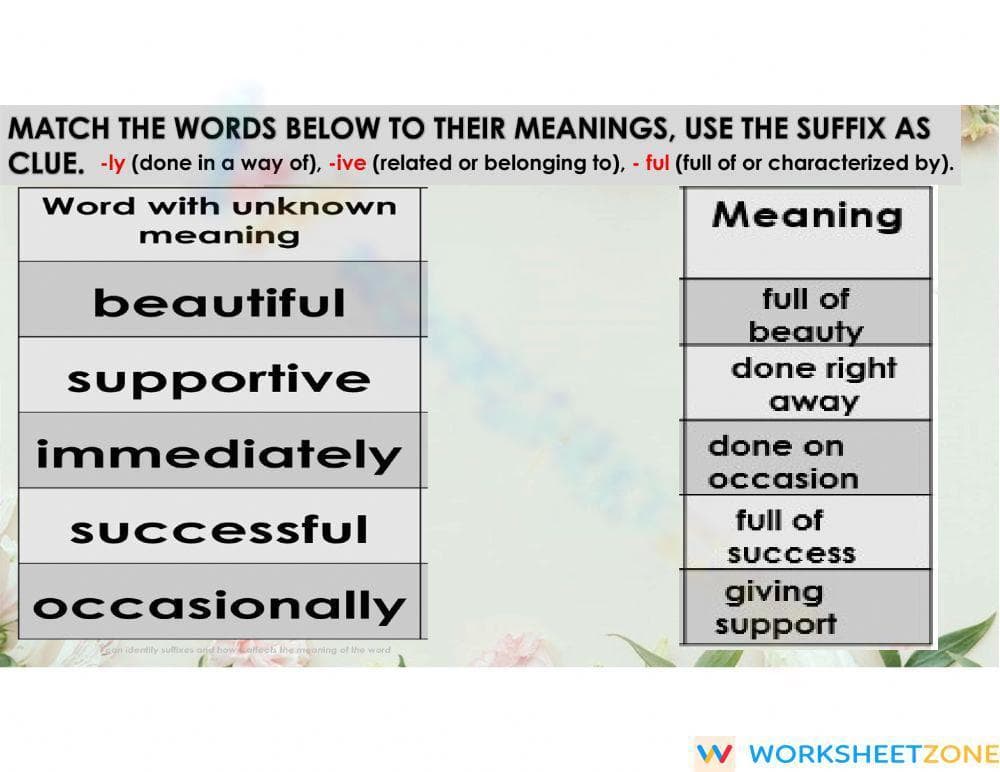

Printable Suffix Matching Worksheet | Grade 3-4 ELA
Paste this activity's link or code into your existing LMS (Google Classroom, Canvas, Teams, Schoology, Moodle, etc.).
Students can open and work on the activity right away, with no student login required.
You'll still be able to track student progress and results from your teacher account.
This Grade 3 and Grade 4 suffixes worksheet helps students master the meaning of common word endings like -ly, -ive, and -ful. By matching vocabulary terms to their definitions using suffix clues, learners build essential morphological awareness and decoding skills. This resource provides immediate reinforcement for lexical word classes through structured, independent practice.
At a Glance
- Grade: 3–4 · Subject: English Language Arts
- Standard:
CCSS.ELA-LITERACY.L.3.4.B— Determine word meanings by identifying and analyzing common suffixes in context- Skill Focus: Morphological analysis of suffixes (-ly, -ive, -ful)
- Format: 1 page · 5 problems · Answer key included · PDF
- Best For: Independent practice or quick literacy centers
- Time: 10–15 minutes
What's Inside
Inside this focused PDF resource, you will find a clean, one-page layout featuring a matching table designed for high readability. The worksheet presents five high-frequency words—beautiful, supportive, immediately, successful, and occasionally—alongside a list of corresponding meanings. It includes a clear instructional header that defines each suffix clue to scaffold the learning process, ensuring students can work independently without constant teacher intervention. A complete answer key is provided to facilitate rapid grading or student self-correction.
Zero-Prep Workflow
The zero-prep workflow for this resource is designed to save busy educators time. Simply print the single-sheet PDF in less than 30 seconds, distribute it to your Grade 3 or Grade 4 class in under a minute, and review the completed matching tasks together in a five-minute wrap-up session. This streamlined process requires exactly zero minutes of teacher preparation, making it a perfect candidate for sudden sub plans, morning work, or independent practice stations.
Standards Alignment
This activity is directly aligned to CCSS.ELA-LITERACY.L.3.4.B, which requires students to determine the meaning of the new word formed when a known affix is added to a known word. It also supports higher-grade vocabulary acquisition goals by focusing on lexical word classes and morphological patterns. Both standard codes can be copied directly into lesson plans, IEP goals, or district curriculum mapping tools.
How to Use It
Educators can use this worksheet as a formative assessment after direct instruction on the suffixes -ly, -ive, and -ful to gauge student mastery. While students work, observe if they are using the suffix definitions provided at the top as a strategic tool rather than guessing. Alternatively, assign this as a quick-start activity during a literacy rotation; most students will reach completion within 10 to 15 minutes.
Who It's For
This resource is tailored for Grade 3 and Grade 4 students, including English Language Learners who benefit from the explicit definitions of affixes provided. It pairs naturally with a root word anchor chart or a short reading passage focusing on descriptive adjectives. The scaffolded definitions make it accessible for students working slightly below grade level while maintaining rigor for on-grade peers.
Research from Fisher & Frey (2014) emphasizes that morphological awareness—the ability to recognize and manipulate the smallest units of meaning in language—is a critical predictor of reading comprehension success in the intermediate grades. This worksheet targets that exact skill by requiring students to apply knowledge of CCSS.ELA-LITERACY.L.3.4.B to decode five distinct vocabulary terms. By explicitly teaching the relationship between suffixes and word meanings, educators provide students with a generative strategy for tackling unknown words in complex texts. The structured matching format reduces cognitive load, allowing Grade 3 and Grade 4 learners to focus specifically on the semantic contribution of the suffix. This evidence-based approach to lexical word classes ensures that students move beyond rote memorization toward a deeper understanding of English word structures, which is essential for meeting rigorous state standards and improving overall literacy outcomes across the curriculum.


