


























Views
Downloads
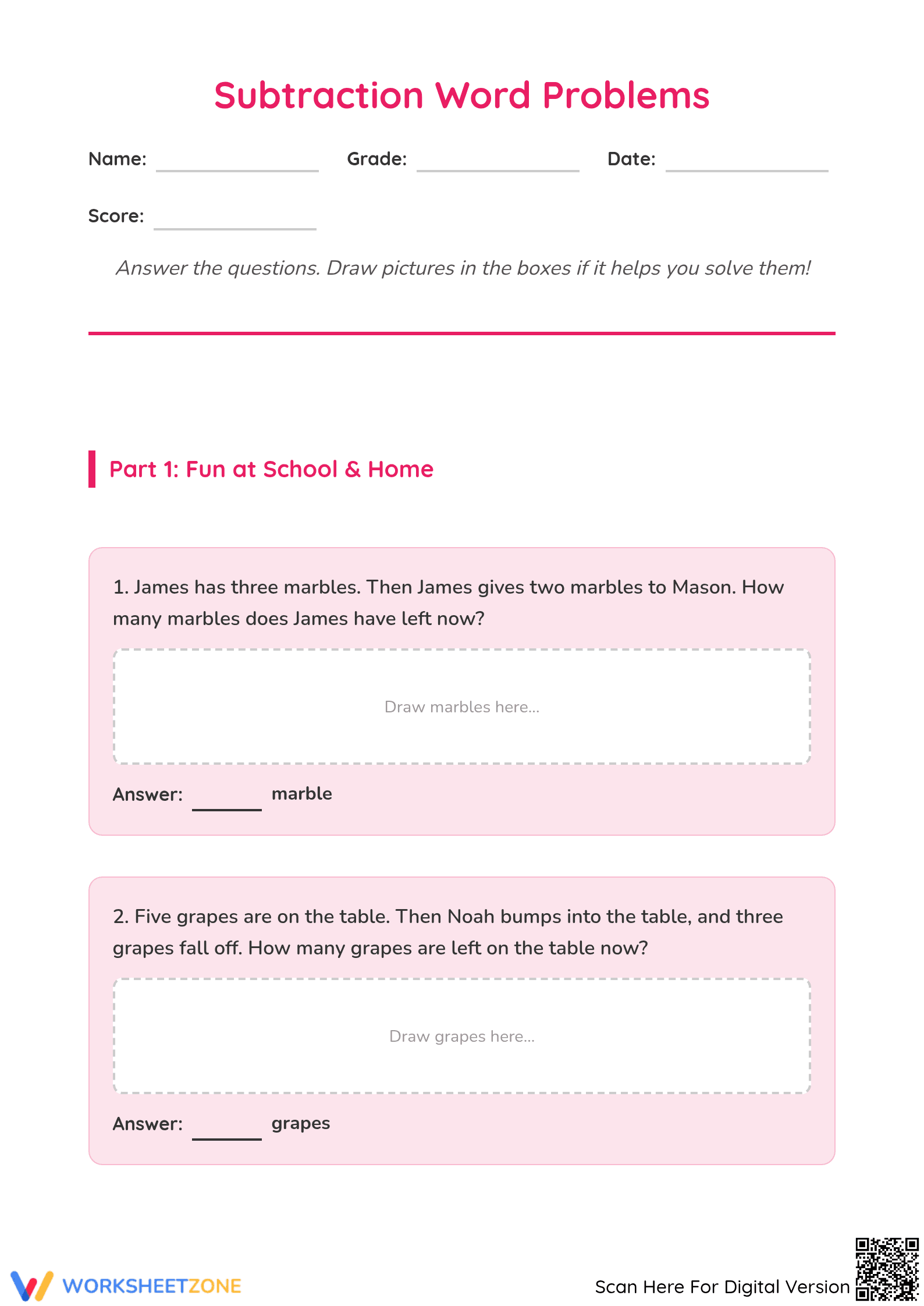


Subtraction Word Problems Printable | Grade 2 Math
Paste this activity's link or code into your existing LMS (Google Classroom, Canvas, Teams, Schoology, Moodle, etc.).
Students can open and work on the activity right away, with no student login required.
You'll still be able to track student progress and results from your teacher account.
This Grade 2 math worksheet helps students master subtraction word problems by providing structured space to draw, count, and solve. By visualizing each scenario, young learners build a strong conceptual understanding of taking away, ensuring they can confidently tackle single-digit and early double-digit subtraction tasks.
At a Glance
- Grade: 2 · Subject: Math
- Standard:
CCSS.MATH.CONTENT.2.OA.A.1— Solve one- and two-step subtraction word problems- Skill Focus: Subtraction Word Problems
- Format: 4 pages · 9 problems · Answer key included · PDF
- Best For: Independent practice and math centers
- Time: 20–30 minutes
Inside this comprehensive resource, educators will find four pages of carefully sequenced math tasks. The worksheet features nine distinct word problems, each providing a dedicated drawing box where students can visually represent the scenario before writing their final numerical answer. A complete answer key is included to make grading fast and objective.
- Guided practice: The first section, "Fun at School & Home," introduces highly relatable, simple scenarios with numbers under ten to build early confidence.
- Supported practice: The "Let's Practice More!" section increases the rigor slightly, incorporating teen numbers and encouraging students to rely on their drawing strategies.
- Independent practice: The final "Challenges" section introduces multi-step thinking and larger quantities up to twenty, testing true skill mastery.
This gradual-release approach ensures students receive the exact scaffolding they need as they move from simple concepts to more complex mathematical reasoning.
Aligned to primary standard CCSS.MATH.CONTENT.2.OA.A.1, this resource requires students to use addition and subtraction within 100 to solve one- and two-step word problems involving situations of taking from and comparing. Both standard codes can be copied directly into lesson plans, IEP goals, or district curriculum mapping tools.
This worksheet is highly versatile for daily classroom instruction. Use it during core math blocks as an independent follow-up activity after a whole-group lesson on subtraction strategies. Alternatively, place it in a math center where students can use physical manipulatives alongside the drawing boxes. As a formative assessment tip, observe whether students are drawing individual circles or using more advanced grouping strategies to represent the quantities. Expect students to complete the full packet in 20 to 30 minutes.
This resource is designed for second-grade students developing their foundational arithmetic skills. The built-in drawing boxes provide excellent differentiation for visual learners and students who benefit from concrete representations of abstract math concepts. It pairs perfectly with physical base-ten blocks or a direct instruction lesson on identifying key subtraction vocabulary words.
Integrating visual models into early arithmetic instruction is a proven method for increasing mathematical comprehension. According to EdReports 2024, instructional materials that explicitly connect word problems to visual representations significantly improve student outcomes in elementary mathematics. This resource directly supports that pedagogical approach by requiring students to draw their thought process. Aligned with CCSS.MATH.CONTENT.2.OA.A.1, it ensures learners can effectively solve one- and two-step subtraction word problems. By moving from concrete drawings to abstract equations, students develop a more robust number sense that serves as a foundation for future algebraic thinking. This structured practice helps solidify the cognitive link between reading comprehension and mathematical execution, ensuring young learners can confidently decode and solve real-world math scenarios.


