


























Views
Downloads


Printable Subtraction Number Line Worksheet | Grade 1 Math
Paste this activity's link or code into your existing LMS (Google Classroom, Canvas, Teams, Schoology, Moodle, etc.).
Students can open and work on the activity right away, with no student login required.
You'll still be able to track student progress and results from your teacher account.
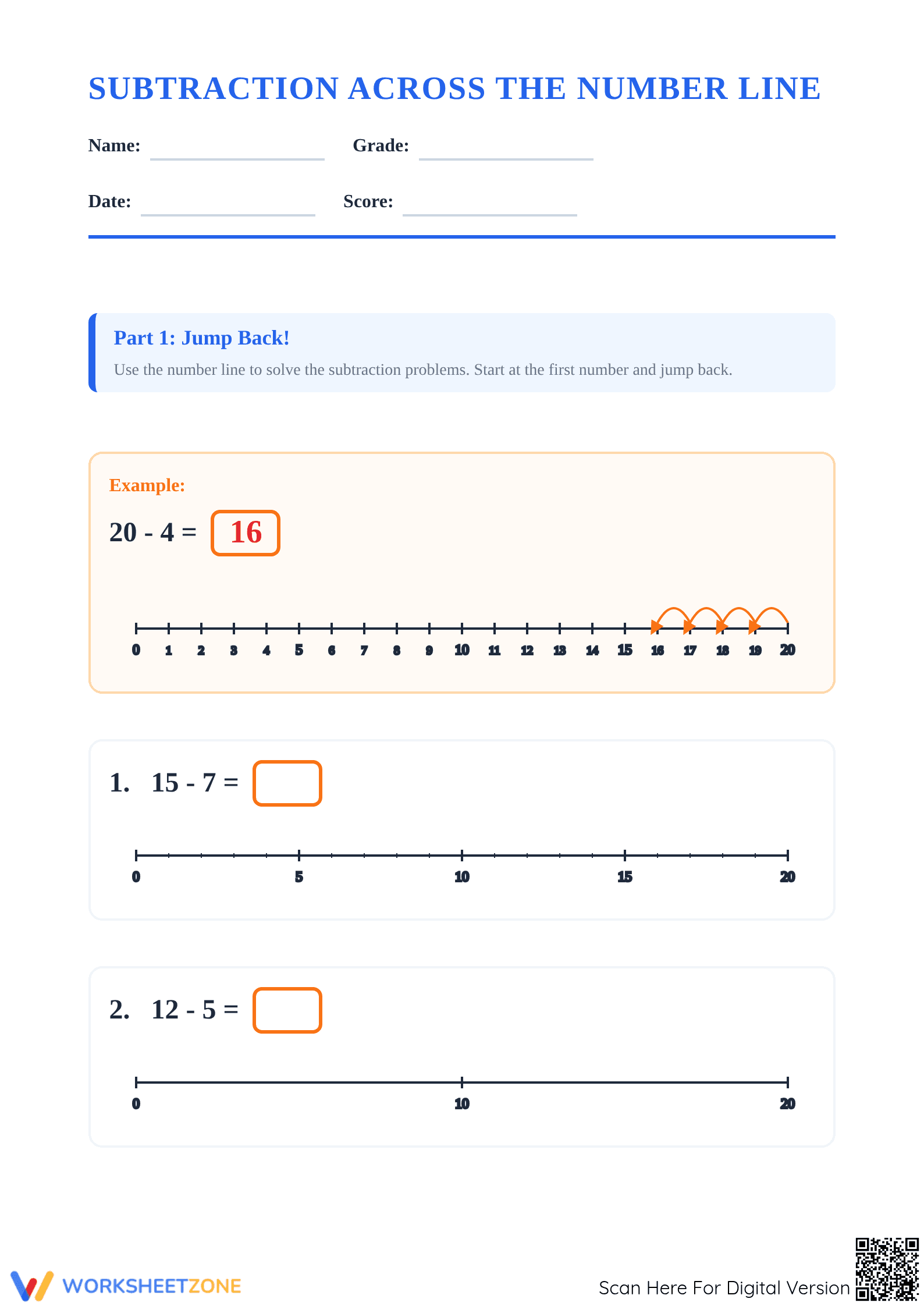
Mastering subtraction becomes a visual and intuitive process with this comprehensive practice packet. Students use the "jump back" strategy on provided number lines to solve 12 distinct subtraction problems within 20. By physically representing the subtraction as movement across a scale, learners build a deeper conceptual understanding of numerical relationships and subtraction facts.
At a Glance
- Grade: 1–2 · Subject: Math
- Standard:
CCSS.MATH.CONTENT.2.MD.B.6— Represent differences within 100 on a number line diagram- Skill Focus: Subtraction via Counting Back
- Format: 4 pages · 12 problems · Answer key included · PDF
- Best For: Small group math centers or independent practice
- Time: 20–30 minutes
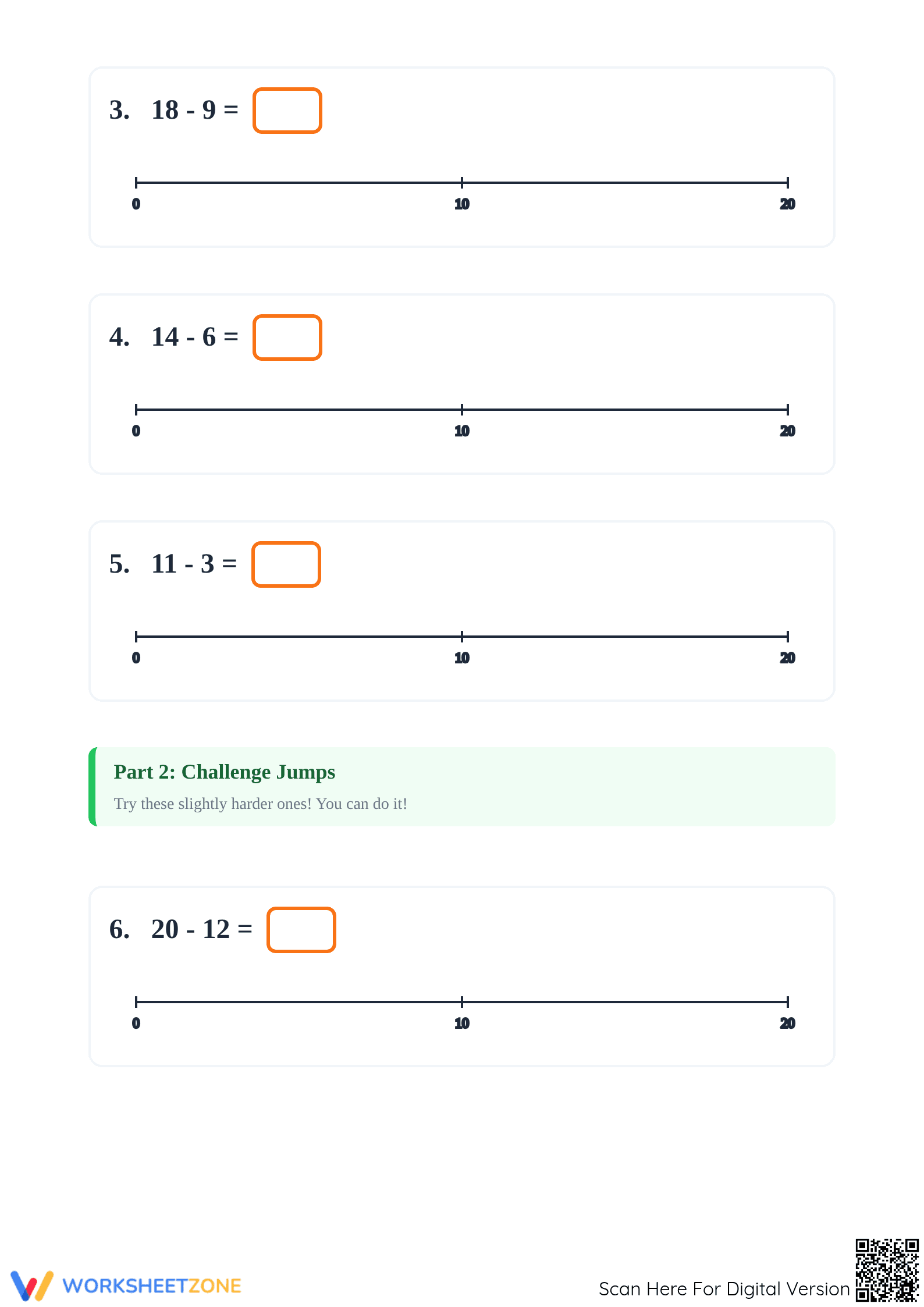
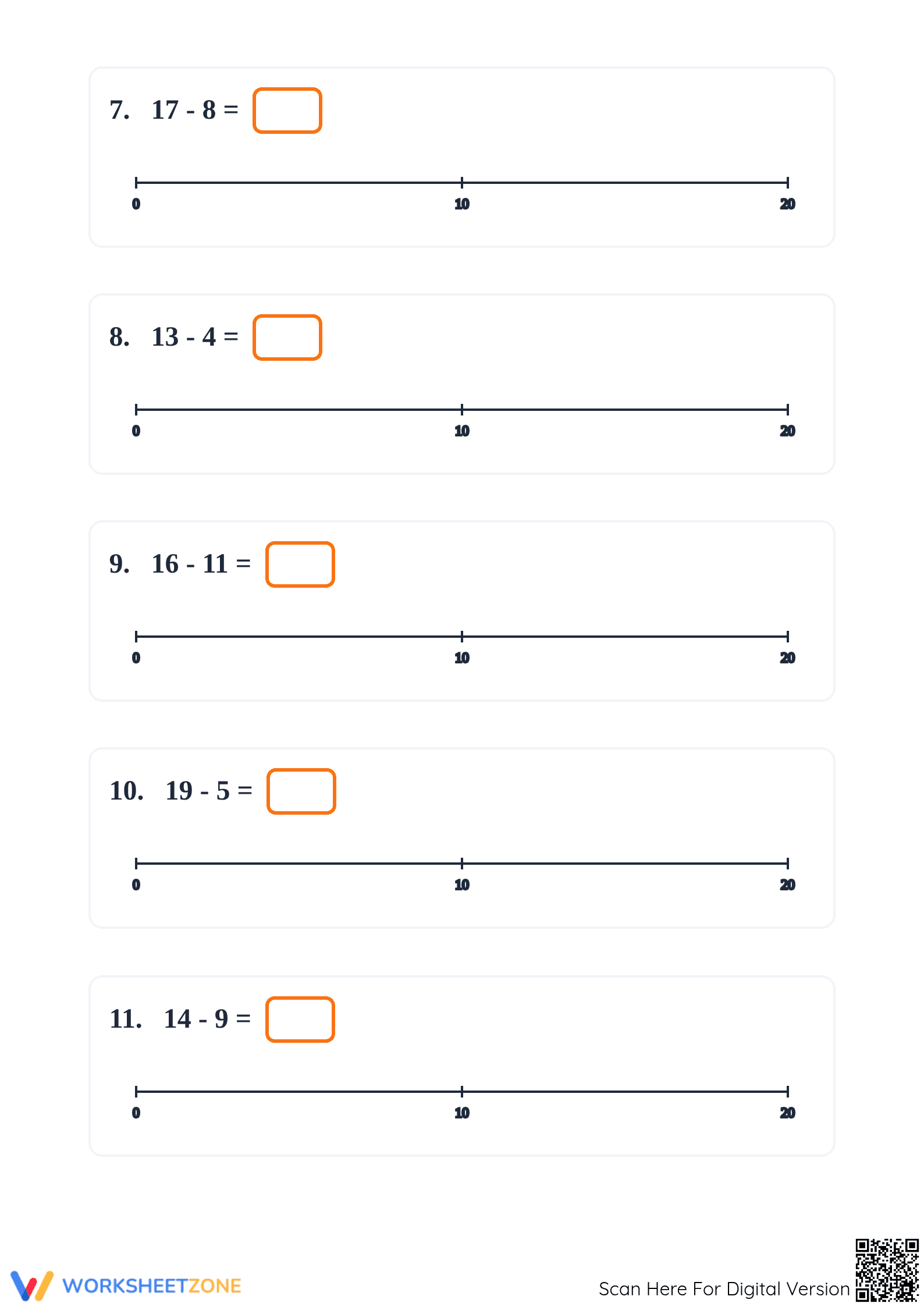
This 4-page PDF resource includes 12 subtraction tasks, each paired with a dedicated number line ranging from 0 to 20. The first page features a clear, worked example illustrating the "jump back" method to model the subtraction process. The packet is organized into two sections: "Jump Back!" for initial practice and "Challenge Jumps" for more complex problems, ensuring a complete answer key for rapid grading.
Skill Progression
- Guided Practice: The packet begins with an explicit worked example and initial problems with labeled intervals to orient the learner to the number line scale.
- Supported Practice: Middle problems remove labels for intermediary points, requiring students to count intervals accurately as they move left across the line.
- Independent Practice: The final section presents "Challenge Jumps" where students must independently execute the subtraction strategy on larger jumps across the number line.
This gradual-release model ensures students transition from conceptual modeling to procedural fluency with confidence.
Standards Alignment
The primary alignment for this resource is CCSS.MATH.CONTENT.2.MD.B.6, which requires students to represent whole-number differences on a number line diagram. While the numbers remain within the Grade 1 fluency range (subtraction within 20), the use of the number line as a tool is a critical Grade 2 measurement and data standard. Both standard codes can be copied directly into lesson plans, IEP goals, or district curriculum mapping tools.
How to Use It
Use this resource during the direct instruction phase of a lesson on subtraction strategies to model counting back. Alternatively, assign it as a math center activity after students have practiced with physical number line floor mats. For a formative assessment observation tip, watch students as they draw their "jumps"—if they consistently land one number off, they may be counting the starting number rather than the intervals.
Who It's For
This packet is designed for first-grade students working on subtraction fluency and second-grade students needing conceptual reinforcement of the number line. It is an excellent resource for Tier 2 intervention groups or for inclusion in a student's IEP folder for visual math goals. Pair this with a physical desk-top number line or a subtraction anchor chart to reinforce the directional movement of counting back.
Research by Fisher & Frey (2014) emphasizes the importance of the gradual release of responsibility, a framework reflected in this worksheet's progression from a worked example to "Challenge Jumps." The number line serves as a powerful mental model that bridges the gap between concrete manipulatives and abstract numerical symbols, which is a core component of effective mathematical instruction identified in the NAEP and EdReports 2024 reviews. By requiring students to physically mark their jumps, the worksheet forces active engagement with the CCSS.MATH.CONTENT.2.MD.B.6 standard, ensuring that the subtraction process is not merely rote memorization but a spatial representation of value. This approach aligns with evidence-based practices for improving math outcomes among diverse learners, providing the visual scaffolding necessary for students to internalize the logic of counting back and develop lasting computational fluency.


