




























0
Views
0
Downloads

0.0
0
Save
0 Likes
Share
Sub-Genre Specific Traits Across Texts
0 Views
0 Downloads

Paste this activity's link or code into your existing LMS (Google Classroom, Canvas, Teams, Schoology, Moodle, etc.).
Students can open and work on the activity right away, with no student login required.
You'll still be able to track student progress and results from your teacher account.
Information
Description
What It Is:
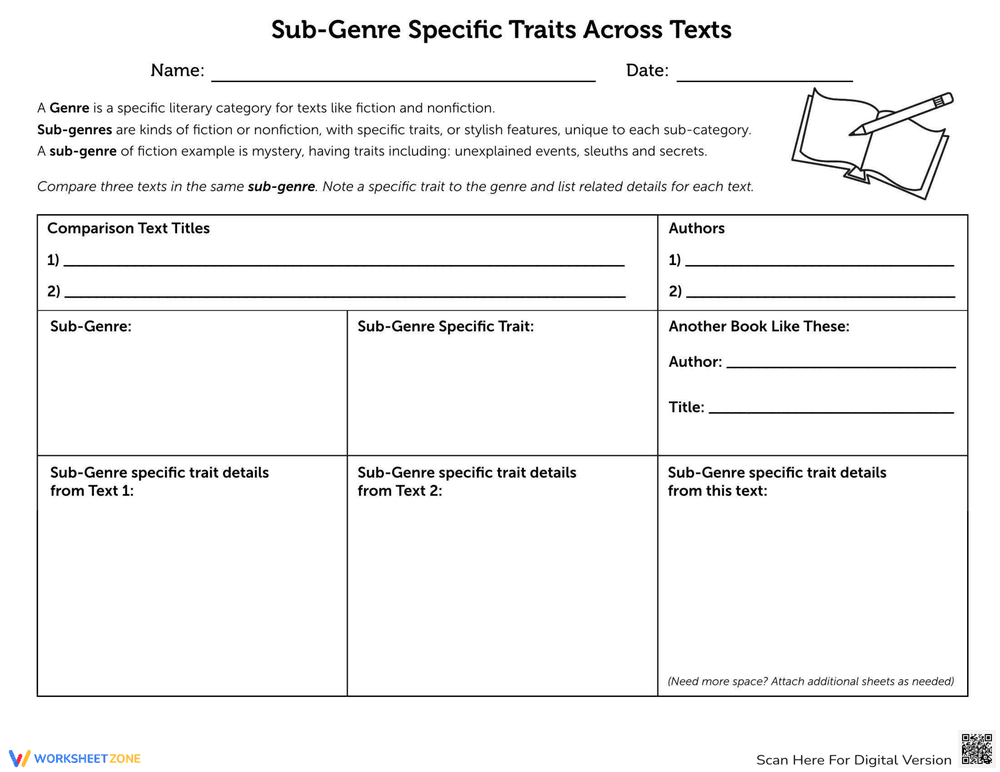
This is an educational worksheet designed to help students analyze and compare sub-genres across different texts. It includes sections for writing the names of three comparison texts and their authors. There are also areas to identify the sub-genre, specific traits of that sub-genre, details supporting those traits from each text, and a space to list another book that is similar. The worksheet also includes a definition of 'genre' and 'sub-genre' at the top.
Grade Level Suitability:
This worksheet is suitable for grades 6-9. The activity requires students to analyze texts, identify sub-genres, and compare details, which aligns with middle school and early high school reading comprehension and analytical skills.
Why Use It:
This worksheet helps students develop critical thinking skills by comparing and contrasting different texts within the same sub-genre. It reinforces understanding of literary genres and sub-genres, and encourages close reading to identify specific traits and supporting details.
How to Use It:
Begin by having students read three different texts within the same sub-genre. Students then fill in the worksheet by listing the title and author of each text. Next, they identify the sub-genre and its specific traits. Finally, they provide details from each text that support the identified traits and list another book that is similar.
Target Users:
This worksheet is ideal for middle school and early high school students learning about literary genres and sub-genres. It is also beneficial for students who need practice with text analysis and comparison skills. Teachers can use it as an in-class activity, homework assignment, or assessment tool.
This is an educational worksheet designed to help students analyze and compare sub-genres across different texts. It includes sections for writing the names of three comparison texts and their authors. There are also areas to identify the sub-genre, specific traits of that sub-genre, details supporting those traits from each text, and a space to list another book that is similar. The worksheet also includes a definition of 'genre' and 'sub-genre' at the top.
Grade Level Suitability:
This worksheet is suitable for grades 6-9. The activity requires students to analyze texts, identify sub-genres, and compare details, which aligns with middle school and early high school reading comprehension and analytical skills.
Why Use It:
This worksheet helps students develop critical thinking skills by comparing and contrasting different texts within the same sub-genre. It reinforces understanding of literary genres and sub-genres, and encourages close reading to identify specific traits and supporting details.
How to Use It:
Begin by having students read three different texts within the same sub-genre. Students then fill in the worksheet by listing the title and author of each text. Next, they identify the sub-genre and its specific traits. Finally, they provide details from each text that support the identified traits and list another book that is similar.
Target Users:
This worksheet is ideal for middle school and early high school students learning about literary genres and sub-genres. It is also beneficial for students who need practice with text analysis and comparison skills. Teachers can use it as an in-class activity, homework assignment, or assessment tool.


