


























Views
Downloads

Student Trading Card Worksheet | Grade 5 Essential
Paste this activity's link or code into your existing LMS (Google Classroom, Canvas, Teams, Schoology, Moodle, etc.).
Students can open and work on the activity right away, with no student login required.
You'll still be able to track student progress and results from your teacher account.
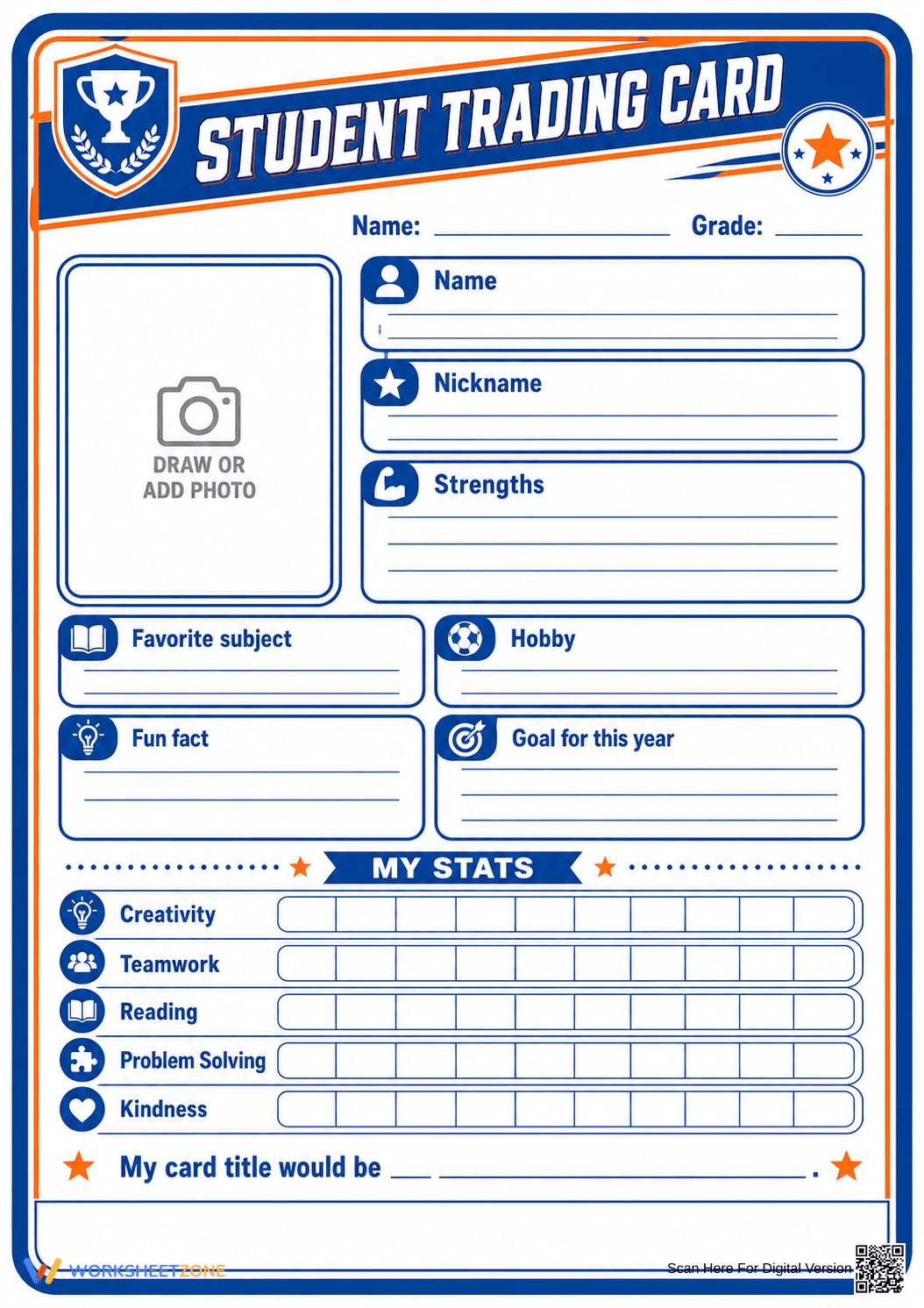
This Grade 5 Student Trading Card worksheet facilitates immediate student engagement during the first week of school. By transforming personal reflection into a collectible card format, students practice descriptive writing and self-assessment. This activity helps build a positive classroom culture while allowing teachers to gather valuable diagnostic data on student interests and writing stamina.
At a Glance
- Grade: 5 · Subject: ELA / SEL
- Standard:
CCSS.ELA-LITERACY.SL.5.4— Present descriptive details to support personal themes and self-reflection- Skill Focus: Descriptive writing and self-awareness
- Format: 1 page · 14 tasks · Answer key N/A · PDF
- Best For: Back-to-school icebreakers and community building
- Time: 20–30 minutes
This single-page PDF features a high-interest trading card layout with 14 distinct interaction points. It includes a dedicated space for a student portrait or drawing, seven ruled writing panels for personal details like strengths and goals, and five interactive stat bars for self-rating creativity and teamwork. The clean vector design ensures high-quality printing in both color and grayscale for immediate classroom use.
The zero-prep workflow is designed for busy educators. First, print the single-page PDF (30 seconds). Second, distribute the sheets to students as a morning work or get to know you activity (1 minute). Third, review the completed cards to identify student strengths and interests for future grouping (5 minutes). This resource is an ideal emergency sub plan or first-day activity that requires no teacher setup.
The primary standard addressed is `CCSS.ELA-LITERACY.SL.5.4`, which requires students to report on a topic or present an opinion using appropriate facts and relevant, descriptive details. By completing the Strengths and Goal for this year sections, students practice concise, evidence-based self-reporting. Both standard codes can be copied directly into lesson plans, IEP goals, or district curriculum mapping tools.
Use this worksheet during the first 48 hours of the school year as a low-stakes formative assessment of writing skills. Observe how students prioritize their Strengths versus their Goals to gauge self-confidence and growth mindset. For a follow-up, have students trade cards in small groups to find peers with similar hobbies or complementary skills, fostering immediate social connections and peer-to-peer communication.
This resource is designed for general education Grade 5 classrooms but is highly effective for English Language Learners (ELLs) due to the heavy visual scaffolding and short-form writing requirements. It pairs naturally with a Classroom Community anchor chart or a direct instruction lesson on setting SMART goals for the upcoming academic semester to ensure student success.
According to the RAND AIRS 2024 report on classroom climate, structured self-reflection tools significantly improve student-teacher rapport in the initial weeks of instruction. This worksheet aligns with CCSS.ELA-LITERACY.SL.5.4 by requiring students to present descriptive details about their own lives and academic identities. Research from Fisher & Frey (2014) emphasizes that getting to know you activities are most effective when they incorporate visual elements and clear prompts that reduce cognitive load while maximizing personal expression. By utilizing the Student Trading Card format, educators provide a high-interest entry point for writing that mirrors real-world media consumption. This approach supports social-emotional learning (SEL) benchmarks by encouraging students to identify personal strengths and set measurable goals. The 14 specific tasks provide a comprehensive profile that can be used for instructional grouping and personalized feedback throughout the school year.


